


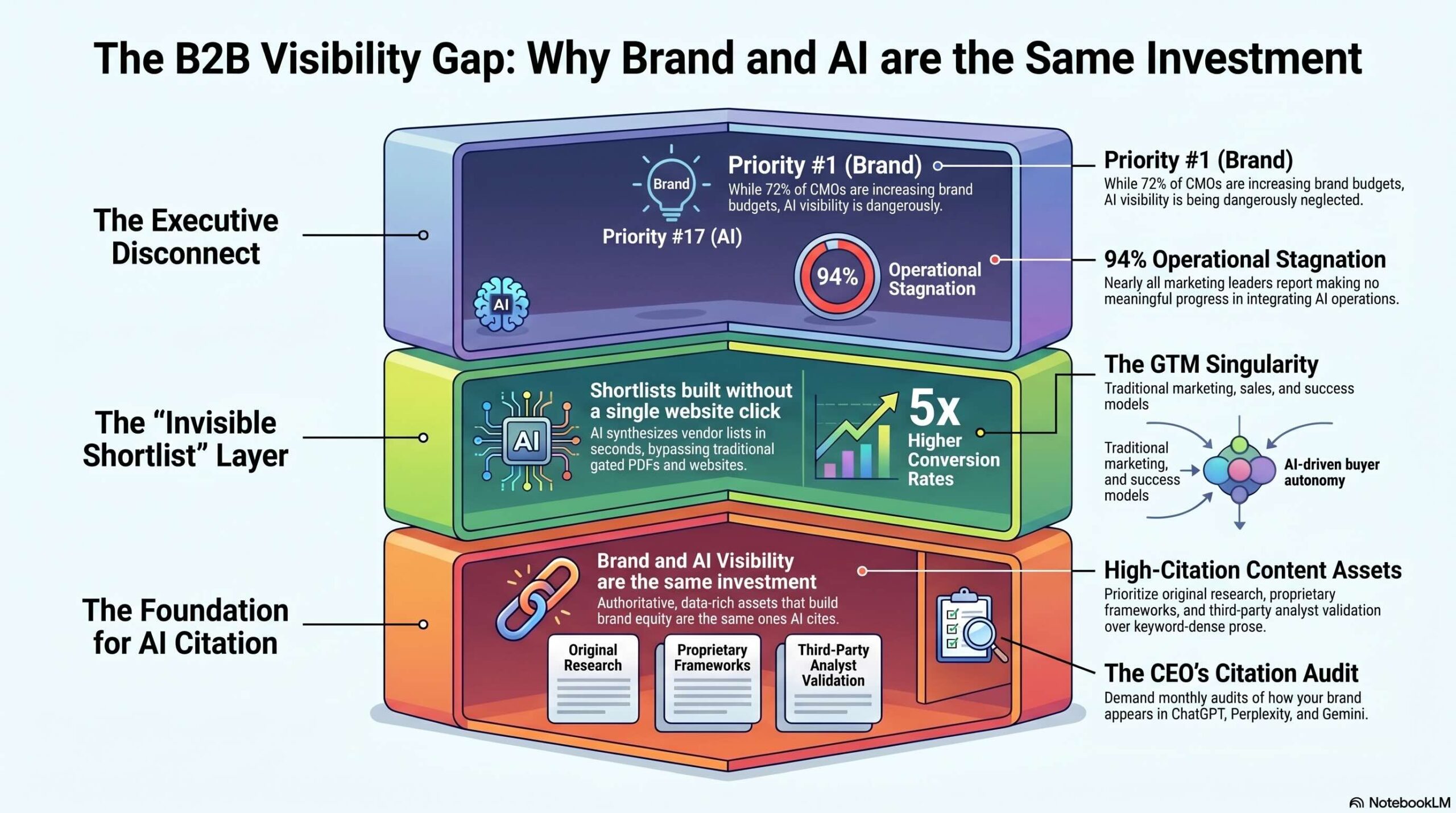
Branding is the number one priority for Chief Marketing Officers (CMOs) in 2026. At the same time, the majority of B2B buyers are preparing to use AI tools to evaluate and shortlist their suppliers before even speaking to a salesperson. For food ingredient brands, the gap is tricky: they are investing in brand awareness that buyers no longer encounter in the same way. If your expertise doesn't appear in the AI's summary, the shortlist is built without you, and the lost opportunity remains invisible.
The paradox that figures render visible
The brand dominates the 2026 marketing agendas. According to the report relayed by Entrepreneur, it is at the top of the directors' priorities. marketing (CMO), whilst visibility in AI search remains far behind in terms of implementation: 94 % of respondents report having made no tangible progress in integrating AI into their operations [1]. Gartner confirms the underlying trend: brand awareness is a priority for 2026, and marketing directors are re-evaluating their approach to search in light of ChatGPT and AI-generated summaries [2].
A nuance is necessary, as it avoids a misunderstanding. Other surveys place AI at the top of priorities, in the top 2 of almost all countries studied [4]. The problem is therefore not that marketing directors are unaware of AI. It is that they are investing in the brand without making this brand visible where the search is moving: the answer synthesised by the algorithm.
Why is the ingredients sector more exposed?
The B2B food sector is accumulating aggravating factors. The purchase of an ingredient mobilises an entire committee: R&D, application, regulatory affairs, purchasing, marketing. Forrester, cited by Entrepreneur, places the order of magnitude at around 13 internal stakeholders and 9 external influencers per purchasing decision [1][3]. Each carries out their own research.
And the first step is no longer the showroom or the call to the sales representative. It's the query addressed to an AI engine: what ingredient to reduce sugar without loss of texture, which supplier of plant-based proteins documented on the microbiome. If the synthesised answer doesn't mention your solution, you're discarded before the first exchange. The corresponding pipeline never existed, so the loss cannot be measured anywhere.
CMO: your brand asset is already your AI asset
Here's the point that most general analyses miss, and which is particularly important for the agri-food sector. The content that builds the authority of an ingredient brand is precisely what AI engines cite: clinical data, mechanisms of action, application trials, regulatory dossiers, claims supported by verifiable sources. Where a consumer brand struggles to be «citable», a scientific B2B brand has rare material: proof.
Editorial rigour then ceases to be an added extra, becoming an advantage for AI search engine optimisation. Sourced content (PubMed, EFSA, dated reports), structured in an inverted pyramid, that clearly answers specific questions, ticks the criteria that generative engines favour when citing a source. The «verified source or silence» discipline becomes a lever for visibility, not just credibility.
What this means in concrete terms
Write for the question, not the keyword. Buyers ask AI questions in natural language. Structuring content around real questions, benefits, application context, dosage, and regulatory status increases the chances of being included in a summary.
Make the evidence extractable. A sourced figure, a trial datum, a dated reference: these are the elements that AI picks up on. Drowning them in vague prose renders them invisible.
Target third-party quotes. Search engines weigh what independent sources confirm. Studies, expert statements, press coverage: authority is also built outside of your own website.
Measuring presence in AI responses. The question of leadership is no longer just «where do I rank on Google,» but «what does AI answer when my buyer queries my category.».
The real question for 2026
For all CMOs, the reflex of the year will be to strengthen the brand. The challenge, however, will be elsewhere. When your ideal buyer asks an AI which supplier to consult in your category, is your expertise part of the answer, or are you building a reputation that the algorithm doesn't know how to relay?
FAQ
Does GEO replace SEO?
No. SEO remains useful, but an increasing amount of search is moving towards AI-synthesised answers. GEO, or optimisation for generative engines, complements SEO by optimising content for citability [2].
Is a separate budget required for AI visibility?
Not necessarily. The same assets, sourced and structured scientific content, serve both the brand and citation by AI engines. The issue is more about methodology than additional budget.
How to know if AI is mentioning my brand?
By directly querying search engines (ChatGPT, Perplexity, AI search engine summaries) on your category and use cases, then observing if your solution appears in the response and with which sources.
Sources
[1] Deshraj M. Brand is the No. 1 CMO Priority for 2026. AI Search is No. 17. Here’s Why That Gap Should Worry You. Entrepreneur. 18 May 2026.
[2] Gartner. CMOs’ Top Challenges and Priorities for 2026. gartner.com. 4 December 2025.
[3] Forrester. The State of Business Buying 2026 (data cited by Entrepreneur).
Serviceplan Group, University of St. Gallen, Heidrick & Struggles. CMO Barometer 2026. 26 November 2025.