



This migration from X to Bluesky is not just symbolic: it reflects a real redefinition of the spaces where knowledge meets. For decision-makers in scientific communication and B2B publications, understanding the mechanisms and opportunities of this shift is essential. Let's take a look at the figures, the dynamics of engagement, and the strategic implications.
In a nutshell
Between 2023 and early 2025, 18 % academics - out of a sample of 300,000 profiles tracked by the University of Zurich - have migrated from X to Bluesky. The rate varies greatly depending on the discipline: 31.3 % in arts and humanities, against 13.3 % in medicine. These figures usher in a new era of scientific communication, one that is more targeted, collaborative and potentially more impactful.
1. Measured and differentiated academic migration
The University of Zurich followed 300,000 academic profiles, with a migration rate of 18 % to Bluesky between 2023 and early 2025. The rate is much higher in the arts and humanities (31.3 %), which is significantly lower in medicine (13.3 %)
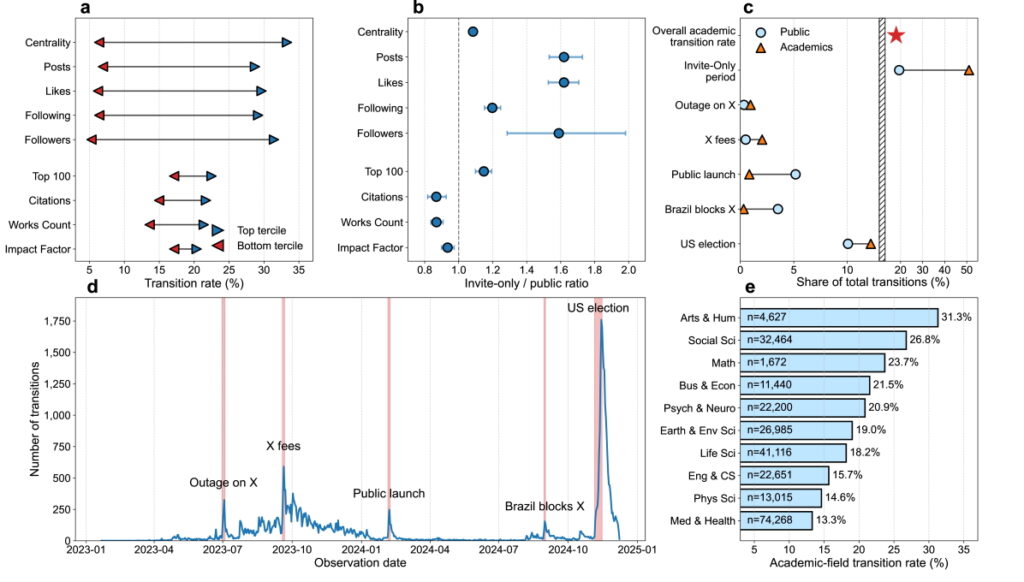
Source: arXiv:2505.24801
2. Why the move to Bluesky? A more favourable platform
Combined with this migration, other indicators reinforce the idea that Bluesky is becoming a more suitable space for scientific exchanges:
- Analyses highlight a spectacular growth in traffic and subscribers on Bluesky, including Ars Technica, a well-known website specialising in news and in-depth analysis on technology, science, technology policy, video games and society (+63 % subscribers in 2025), on some days surpassing X in engagement volume for scientists.
- Specific work on the academic presence shows that Bluesky often generates more original content, with more interaction (likes, reposts, replies, quotes) and less misleading information that X.
3. Social dynamics: influence and contagion
The Zurich study does not stop at the switch rate: it analyses the social mechanisms behind the switch to Bluesky. Key findings:
- Two-thirds of transitions are induced by a simple contagion: an academic follows in the footsteps of a peer already present on Bluesky.
- Migration is stimulated by network looks (simple contagion) rather than personal efforts.
- A majority of researchers who reconstruct their Twitter relationships on Bluesky remain more active over time.
4. Towards new indicators (altmetrics) useful to institutions
Bluesky isn't just a social platform: it's becoming a a genuine academic showcase. Publications are mentioned in a significant way, and exchanges appear richer and more committed than on X. This opens up new perspectives:
- For publishers, capitalise on these references can enrich altmetrics (indicators that quantify the visibility and online attention given to scientific publications and other research work).
- For institutions, analysing engagement (quality and interaction) is becoming more relevant than simple counters.
Implications for B2B decision-makers (publishers, institutions, communicators)
| Issues | Strategic line |
| Organised migration | Measured but significant academic migration: plan a structured presence on Bluesky. |
| Commitment and value creation | A more interactive platform, relevant for promoting research. |
| Alternative indicators | More original Altmetrics, to be integrated into reporting. |
| Solid network | Recreating Twitter networks on Bluesky encourages dynamic engagement. |
| Disciplinary adaptation | Universes reached at different speeds: adapt content (e.g. music, arts vs. health). |
Conclusion & call-to-action
The migration of researchers to Bluesky goes far beyond buzz: it is a gradual transformation of the spaces in which knowledge is circulated. For B2B players in scientific communication, this means rethinking editorial strategies, altmetrics monitoring methods and community management.
What first step would you consider? A dedicated corporate account? Active monitoring of altmetrics on Bluesky? Or an internal mapping of the researchers already involved?
References
- University migration (University of Zurich) - Dorian Quelle et al, Why Academics Are Leaving Twitter for Bluesky, arXiv, May 2025 (arXiv)
- X commitments vs Bluesky - How is science discussed on Bluesky?, arXiv, July 2025 (arXiv)
- Evolution of altmetrics - Are there stars in Bluesky?, arXiv, December 2024 (arXiv)
- Scientific traffic and subscribers - “X's dominance ‘over’ as Bluesky becomes new hub for research”, Times Higher Education, April 2025 (Times Higher Education (THE))