



A British study by the University of Manchester (1983-2017, 2,945 senior citizens) shows that the gradual delay in mealtimes with age is not harmless: each hour's delay in eating breakfast increases mortality by 8 to 11 %.
When age upsets the mealtime clock, particularly breakfast
Participants (mean age 64, 71.5 % female) reported at inclusion:
- Breakfast 8.22 am (±43 min)
- Lunch 12h38 (±30 min)
- Dinner 17:51 (±53 min)
Over time, breakfast was delayed by +7.94 minutes per decade (adjusted: +2.89 min), while dinner slipped from +3.67 minutes. On average, breakfast was eaten 31 minutes after waking up and dinner 5.38 hours before bedtime.
Over 22 years of follow-up (63,388 participant-years), 2,361 deaths were recorded.
- Quantified risk Each hour's delay in eating breakfast increases mortality by 11 % (HR: 1.11; IC 95 %: 1.03-1.18).
- Survival to 10 years 89.5 % for “early eaters” versus 86.7 % for “late eaters”, i.e. 2,800 avoidable deaths per 100,000 senior citizens.
Delaying breakfast: aggravating factors and risk profiles
Analysis of 19 diseases using the Cornell Medical Index reveals associations:
- Fatigue and depression breakfast delayed
- Anxiety shortened food window
- Oral health Earlier dinner
A sub-sample of 1,226 genotyped subjects confirmed the effect of chronotypes: each standard deviation in the polygenic “vesperality” score delayed breakfast by 7.2 minutes, lunch by 3.1 min and dinner by 3.9 min.
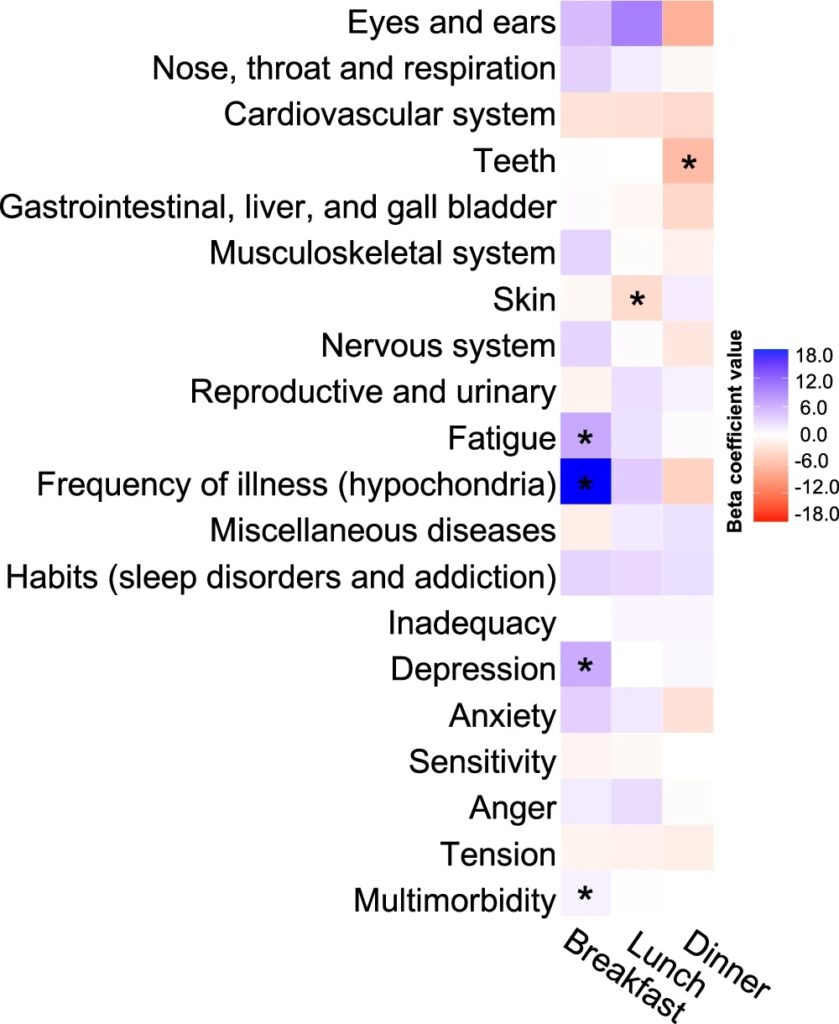
Communications Medicine (Commun Med) ISSN 2730-664X (online)
The authors acknowledge:
- the lack of standardisation of chrononutrition measurements,
- the impossibility of assessing day-to-day variability,
- a selection bias linked to the health of elderly participants,
- the absence of data on meal frequency or nutritional composition.
Food timing: a new biomarker for predicting longevity
The timing of meal is emerging as a simple, predictive biomarker. It paves the way for :
- Personalised nutrition according to chronotype (stimulating formulations in the morning for vesper profiles, prolonged energy for morning people).
- Chronoactive solutions for seniors: food monitoring in residences, early detection tools for carers, targeted ingredients.
The study concludes that randomised clinical trials are needed to validate the potential of food timing as a longevity strategy.
Is late breakfast really the death knell? This 34-year-old British study provides a quantified answer: yes, and with an 8% additional risk per hour of time difference. For the nutraceutical industry, this represents the emergence of a new, accessible and predictive biomarker.