


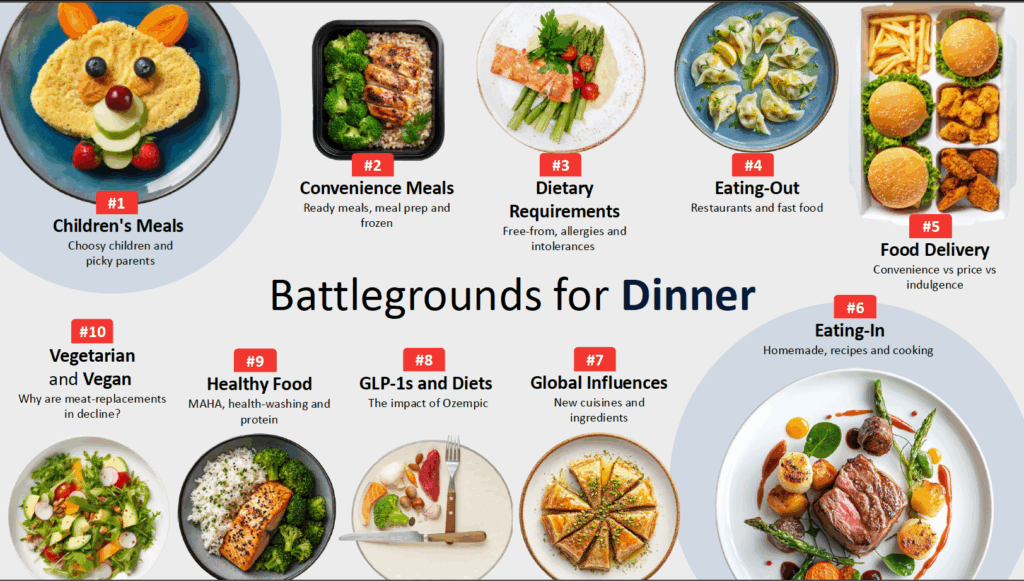
In 2026, dinner (or supper in Belgium) will no longer be just a family meal: it will become a real strategic battleground between health, practicality, sustainability and pleasure. According to the report The Future of Dinner published by Mintel and Black Swan Data, ten major «battlegrounds» will define the future of this key consumer moment (in the USA), with useful lessons for B2B food players in Europe. Two of them are particularly revealing: children's meals and the rise of “home-made” food.
Dinner: mirroring consumer tensions
Dinner brings together all the current contradictions of consumers:
- Well-being vs. indulgence The rise of health diets and functional foods has come up against the search for pleasure and comfort.
- Durability vs. price Consumers want clean, local and traceable ingredients, but are constrained by inflation.
- Speed vs. quality The success of “30 minute meals” (+24 %) shows that practicality is still the decisive factor, but expectations in terms of taste and flavour are still very high. naturalness has never been stronger.
These tensions do not only concern the American market. They reflect global trends which are already influencing R&D, marketing and innovation in ingredients.
Children's meals: appealing to parents and children alike
Nearly 80 % of parents with children under the age of 12 are Millennials today. They grew up with Happy Meals, but now reject ultra-processed foods in favour of organic, plant-based and “clean label” food. Their challenge: to prepare healthy, affordable and quick meals that their children will actually eat.
Key trends identified
- Clean ingredients : +35 % - a major driving force, which is becoming the standard for attracting this target group.
- High protein: +27 % - including in fun formats (protein sauces, enriched pasta).
- Probiotics and microbiota : +13 % - increasing introduction of fermented foods, despite the fact that the sensory acceptability of these products is still a concern for the youngest consumers.
- Plant-based : -17 % - A weak signal that illustrates disillusionment with certain alternatives that are considered too processed.
Inspiring example: Goodles
The brand has reinvented mac & cheese, an iconic children's dish, in a new version. clean label, high in protein and prebiotic fibre. The result is a product that's comforting for children, reassuring for parents, and suitable for vegan or gluten-free diets.
Strategic lesson : innovate in the familiar rather than the exotic. Ingredients companies can contribute to this by :
- low-processing vegetable protein bases,
- fibre and prebiotic fortification solutions,
- flavours and textures adapted to children's palates.
The return of “home-made”: premiumisation and the quest for authenticity
American consumers are cooking more at home, not out of passion, but out of economic necessity. But they don't want to sacrifice the experience: “eating-in” must rhyme with “dining-out”.
The report shows that :
- 30 minute meals: +24 % - the segment is exploding with the drive for efficiency.
- Gourmet : -6 % and culinary experience: -21 % - paradoxically on the decline, but reflecting a need for authenticity rather than artificial sophistication.
- Ready meals : -3 % - mistrust of industrial frozen foods is driving consumers towards products perceived as being of higher quality.
Example: Rao's Lasagna
The success of this frozen dish is based on its a sense of authenticity and freshness, This is enhanced by the possibility of enriching it with premium herbs, oils and cheeses.
Opportunities for ingredients
- Premium condiments and signature sauces giving ready meals a “restaurant at home” feel.
- Global herbs and spices The answer to the quest for authentic flavours and variety.
- Fresh-like solutions for frozen foods a major lever for rehabilitating the segment.
What are the implications for Europe's ingredients industry?
- Combining nutrition and sensory pleasure
Brands need to provide manufacturers with solutions that reconcile macros (protein, fibre, probiotics) with appropriate sensory experiences: crunchiness, colours, familiar textures. - Rethinking plants
The decline in ultra-processed substitutes in the United States is a signal for Europe The future of plant-based products lies in greater naturalness and transparency. - Accessible premiumisation
Consumers want to elevate their everyday meals without paying restaurant prices. This opens up opportunities for ingredients that provide taste, perceived quality and a “homemade” dimension at a lower cost. - Predictive data as a driver of innovation
Mintel and Black Swan Data demonstrate the importance of tools capable of capturing weak signals and anticipating behaviour. For ingredient suppliers, relying on this kind of intelligence is key to guiding R&D and marketing strategy.
The diner of 2026 will be more than a meal: it will be a strategic playground where nutrition, pleasure, accessibility and sustainability collide. The American trends identified by Mintel and Black Swan Data are already resonating in European markets. They invite ingredient suppliers to develop solutions that are clean, high in protein, sensorial and premium, while remaining accessible.
And you, how are you preparing your ingredients to respond to these new “dinner moments” and win the battle of 2026?
Reference
The Future of Dinner : Key battlegrounds for innovation in 2026