



We've known for a very long time that fibre deficiency is no longer just a matter of transit. A study from 2026 reveals how fibre deficiency triggers an intestinal inflammatory cascade - with measurable repercussions all the way to the brain. Here we decipher a mechanism that could redefine our approach to cognitive ageing.
A massive, documented, ignored deficit
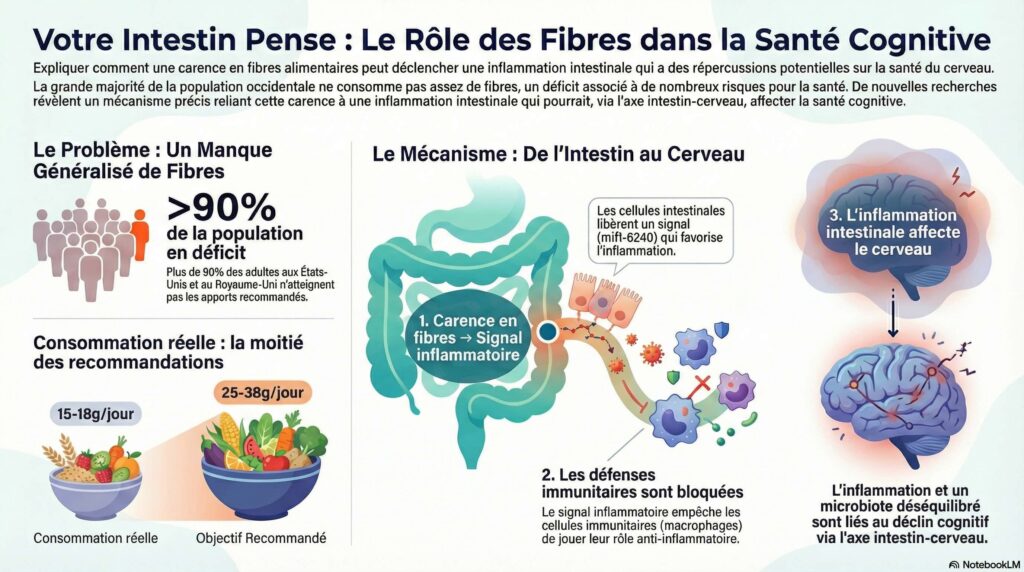
The figures are relentless. In the United States, More than 90 % of women and 97 % of men do not meet the recommended fibre intake. The average intake is around 15-16 g/day - half the recommended 25 g for women and 38 g for men under 51. As a result, the Dietary Guidelines for Americans have classified fibre as a «nutrient of concern» since 2005.
In the United Kingdom, same table. With a recommendation set at 30 g/day, 96 % of adults remain below the threshold. Seniors have average intakes of around 18 g/day. The 2019-2023 data from the National Diet and Nutrition Survey confirm that inadequacy is almost universal.
This «fibre gap» is not just a quirk of nutritionists. It is associated with an increased risk of cardiovascular disease type 2 diabetes and intestinal pathologies. But what we are now discovering is that the consequences could go well beyond the digestive tract.
2026: science identifies the inflammatory mechanism
A study published this year in npj Biofilms and Microbiomes provides an unprecedented level of precision. It deciphers, step by step, how fibre deficiency destabilises the intestinal balance.
In mice, a fibre-deprived diet induces marked inflammatory bowel lesions. The culprit identified: the cells of the intestinal wall (enterocytes) release extracellular vesicles enriched in miR-6240, a small regulatory RNA. This miR-6240 inhibits the expression of a key protein, STAT6.
Without STAT6, macrophages - the immune cells responsible for regulating inflammation - are no longer able to adopt their anti-inflammatory profile (known as «M2»). The result: intestinal inflammation spirals out of control.
The most striking thing is that the researchers have demonstrated that these vesicles, when transferred alone to healthy mice, are sufficient to reproduce the inflammatory damage. The proof of concept is solid.
From the intestine to the brain: an underestimated dialogue
The intestine-brain axis is no longer a hypothesis. It is a two-way communication system, combining nerve pathways (particularly the vagus nerve), immune signals and hormonal messengers.
At the heart of this dialogue: fermentable fibres. They feed bacteria that produce short-chain fatty acids (SCFAs). Faecalibacterium, Ruminococcaceae, Lachnospiraceae. However, a reduction in these populations is frequently observed in people with Mild cognitive decline (MCI) or Alzheimer's disease.
SCFAs, particularly butyrate, do more than simply nourish the intestinal mucosa. They modulate systemic inflammation and exert epigenetic effects - they influence gene expression without modifying DNA. Impact demonstrated in the laboratory: improved synaptic plasticity and memory.
A meta-analysis published in 2025 reinforces this point. It confirms that a dysbiosis - fewer SCFA-producing bacteria, more pro-inflammatory bacteria such as Escherichia/Shigella - is regularly associated with cognitive decline and Alzheimer's disease.
Correlation or causation? What we know (and what we don't yet know)
A word of caution. The human evidence directly linking fibre consumption and cognitive protection remains heterogeneous. Intervention studies are still few and far between, with variable protocols and often short durations.
What we can say:
- Fibre deficiency alters the microbiota intestinal tract
- This dysbiosis is associated with markers of systemic inflammation
- The same dysbiosis profiles are found in patients with cognitive decline
- In the laboratory, fibre supplementation can restore certain neurochemical markers such as BDNF, which is involved in brain plasticity.
What we can't yet say is that increasing fibre intake directly protects against cognitive decline. The link is plausible and mechanistically coherent, but not yet proven by robust clinical trials.
What this means for prevention
If the fibre-cognition link is confirmed, the implications are considerable. Fibre deficiency massively affects Western populations - and particularly senior citizens, who combine low fibre intake with vulnerability to cognitive decline.
Here are a few emerging ideas:
- Not all fibres are created equal. Fermentable fibres - those that produce SCFAs - seem the most promising. Inulin, fructo-oligosaccharides, beta-glucans, arabinoxylans: these types of fibre could become familiar in strategies to prevent cerebral ageing.
- Timing may be everything. Acting early, before chronic dysbiosis sets in, could be more effective than trying to correct an already altered microbiota.
- The «gut first» approach is gaining in credibility. Rather than targeting the brain directly with molecules that have difficulty crossing the blood-brain barrier, modulating inflammation via the intestine could prove more accessible.
Pending definitive proof
The science is advancing, but the recommendations remain simple: reaching the recommended fibre intake (25-30 g/day) is still a target that almost the entire population falls short of. Even before talking about cognition, this is a cardiovascular, metabolic and digestive health issue.
The 2026 study on miR-6240 and STAT6 adds another piece to the jigsaw. It shows that fibre deficiency is not trivial - it triggers a precise molecular cascade, with identified targets and reproducible mechanisms.
It remains to be seen whether correcting this deficit can reverse the trend. The next few years will tell. In the meantime, one thing is certain: what happens in the gut does not stay in the gut.
FAQ
What level of fibre consumption should you aim for? Recommendations vary slightly from country to country: 25-38 g/day in the United States depending on gender and age, 30 g/day in the United Kingdom. Most Western adults consume around 15-18 g/day - barely half that.
Do all fibres have the same effect on the microbiota? No. Soluble and fermentable fibres (inulin, FOS, beta-glucans) promote the production of short-chain fatty acids. Insoluble fibres (cellulose) have other effects, particularly on transit, but have less impact on the microbiota.
Is the 2026 study applicable to humans? It was carried out in mice. The mechanisms identified (extracellular vesicles, miR-6240, STAT6) exist in humans, but their exact role in human intestinal inflammation remains to be confirmed by clinical studies.
Can increasing fibre intake be expected to have an effect on cognitive decline? This is plausible but not proven. Current data shows consistent associations and mechanisms, but no causal link has yet been established by clinical trials. On the other hand, increasing fibre intake has many other proven benefits.
Sources
- Quagliani D, Felt-Gunderson P. Closing America's Fiber Intake Gap. Am J Lifestyle Med. 2017. PMC6124841
- Food Foundation UK. UK still failing to meet basic dietary guidelines. 2023. foodfoundation.org
- National Diet and Nutrition Survey 2019-2023. gov.uk
- miR-6240/STAT6 study. npj Biofilms and Microbiomes. 2026. Nature
- Gut microbiota and cognitive decline: meta-analysis 2025. PMC12566805
- Short-chain fatty acids and brain function. PMC8719029
- Gut-brain axis mechanisms. PMC11406392
Are you interested in this subject?
→ Do you have a specific question? Our AI assistant can give you quick guidance: Talking to the assistant
→ Need structured support? Find out more about our formats - from one-shots to editorial partnerships: See the offers
→ Would you like to discuss it in person? 30 minutes to define your needs, with no obligation: Reserve a slot