


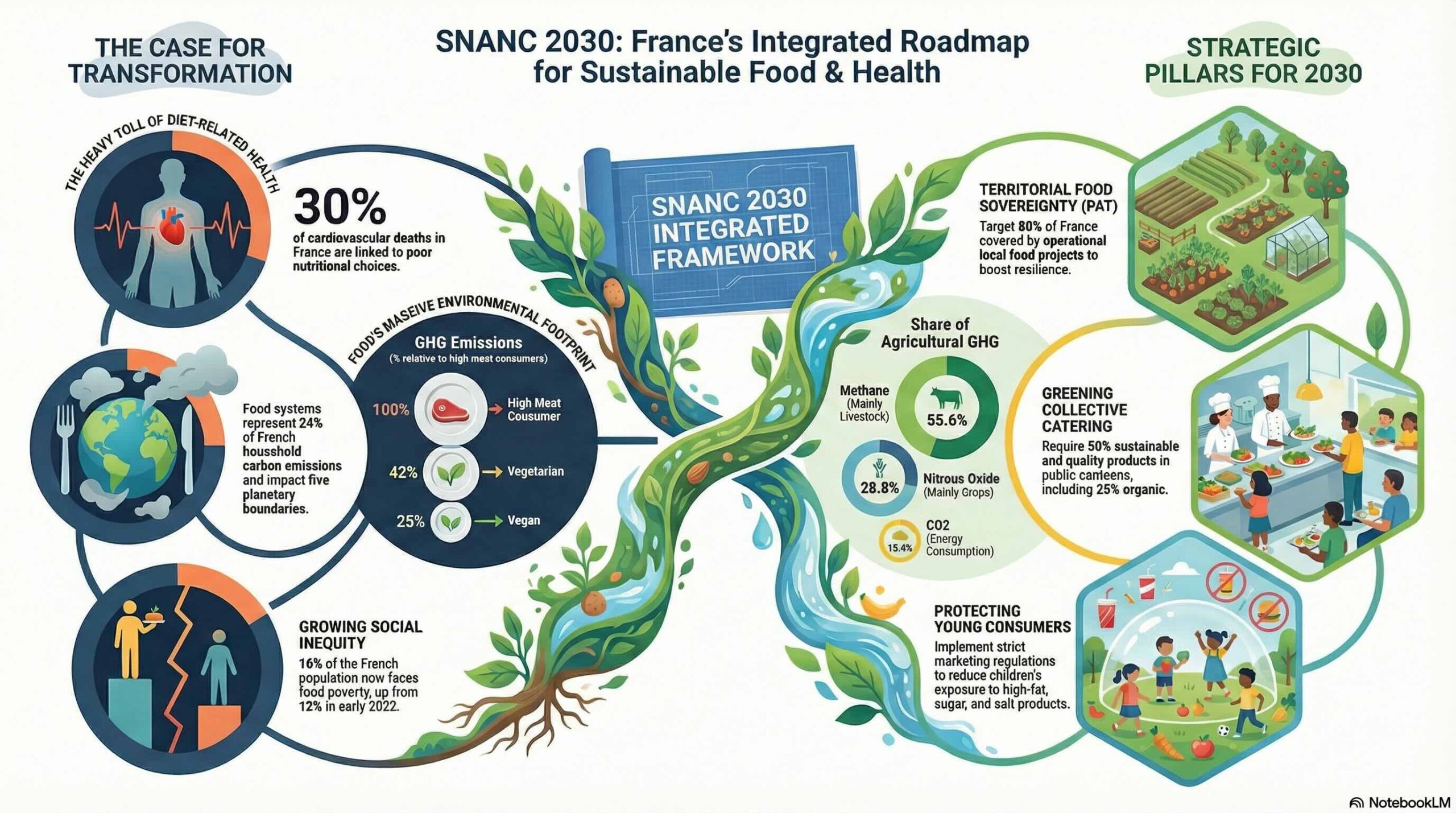
Food accounts for 24 % of the carbon footprint of French households, 30 % of cardiovascular deaths and 177.5 billion dollars in hidden costs according to the FAO. With the SNANC 2025-2030 (National Food, Nutrition and Climate Strategy 2025-2030), published on 11 February 2026, the French government is officially linking nutrition, climate and food sovereignty within the same strategic framework - with direct consequences for the reformulation and specifications of food ingredients.
A known diagnosis, a new political ambition with SNANC
The SNANC's findings on nutrition and climate come as no surprise to anyone in the sector:
- excess salt, sugar and fat
- deficit in fibres
- high contribution of animal proteins to the carbon footprint
- food insecurity increased from 12 % to 16 % between 2020 and 2022
What changes with SNANC is systemic integration. Indeed, for the first time, a national strategy is articulating :
- public health
- climate transition
- social justice
- food sovereignty
in the same structured document : 4 strategic priorities, 20 objectives, 14 priority actions.
The French food system represents 99.5 billion euros in added value (3.8 % of GDP) and 1.4 million jobs. When a public authority announces its transformation, the impact goes beyond institutional communication.
Reformulation: thresholds that structure the market
SNANC provides for :
- maximum thresholds for salt, sugars and fats
- minimum fibre thresholds
- revision of collective agreements for the most consumed categories
This move from the “recommendation” register to the “threshold” register changes the dynamic. For suppliers of :
- functional fibres
- salt substitutes
- sugar reduction solutions
- texturizers
- fat substitutes
- plant protein
reformulation becomes an institutionalised strategic lever. Commercial discourse gains a political foothold.
Environmental labelling: the end of declarations
The strategy announces :
- voluntary environmental labelling
- the experimental extension of the Nutri-Score non-pre-packaged foods and out-of-home catering
- objectivising the environmental criteria of private labels
As a clear B2B consequence, manufacturers will demand :
- robust LCA data
- detailed traceability
- carbon documentation
- proof of origin
An ingredient without measurable data will quickly become a vulnerable ingredient in calls for tender.
Mass catering and sovereignty: possible volume effect
State catering services must :
- give priority to short distribution channels
- keep out non-European foodstuffs
- pursue the target of 50 % of sustainable products, including 20 % of organic products
This may redistribute certain market shares, in particular :
- European plant proteins
- pulses
- structured local industries
But industrial competitiveness remains a prerequisite. Sovereignty does not dispense with volume or price.
The real critical point: execution
SNANC adopts a progressive approach: consultation → voluntary commitments → experimentation → regulation if insufficient.
Implementation will involve :
- the National Food Programme (PNA)
- the National nutrition and health programme (PNNS)
It all depends on :
- indicators that are actually monitored
- imposed timetables
- financial resources mobilised
The 450 Territorial Food Projects (TFPs), 241 of which are operational, are an interesting lever - but their deployment remains uneven.
Another major tension is how to reconcile a move upmarket in environmental terms with affordability in a context of food insecurity. The strategy is ambitious. Balancing the budget will be decisive.
What this means in practical terms for ingredient suppliers
SNANC does not create new trends. It makes them official. This formalisation changes the hierarchy of priorities.
- The reformulation goes from “nice to have” to political alignment.
- Environmental proof goes from being a marketing differentiator to a contractual prerequisite.
- The origin and structure of supply chains are becoming arguments of sovereignty.
The main strategic risk is not regulation. It's a wait-and-see attitude. The 2027 specifications will be negotiated in 2026. The trajectory is set. The question is no longer “if”, but “how fast”.
FAQ - SNANC 2025-2030 and food ingredients
Does SNANC impose any immediate obligations?
No. It sets a trajectory. The obligations will derive from the NAP/NSP and any regulatory texts.
Which ingredients are most affected?
Those linked to salt/sugar/fat reduction, fibre enrichment, vegetable proteins and low carbon impact solutions.
Is environmental labelling becoming compulsory?
It is advertised as a voluntary scheme, but European regulations are moving in the direction of tighter supervision.
Will short distribution channels have an impact on the B2B market?
Yes, in particular through public catering and the pressure exerted on manufacturers to improve their environmental indicators.
What is the main risk for suppliers?
Not anticipating the gradual tightening of specifications.
References
- National strategy for food, nutrition and climate 2025-2030
- Government press release - 11 February 2026
- Climate and Resilience Act (2021)
- FAO - The State of Food and Agriculture 2023 (Hidden Costs of Agrifood Systems)