


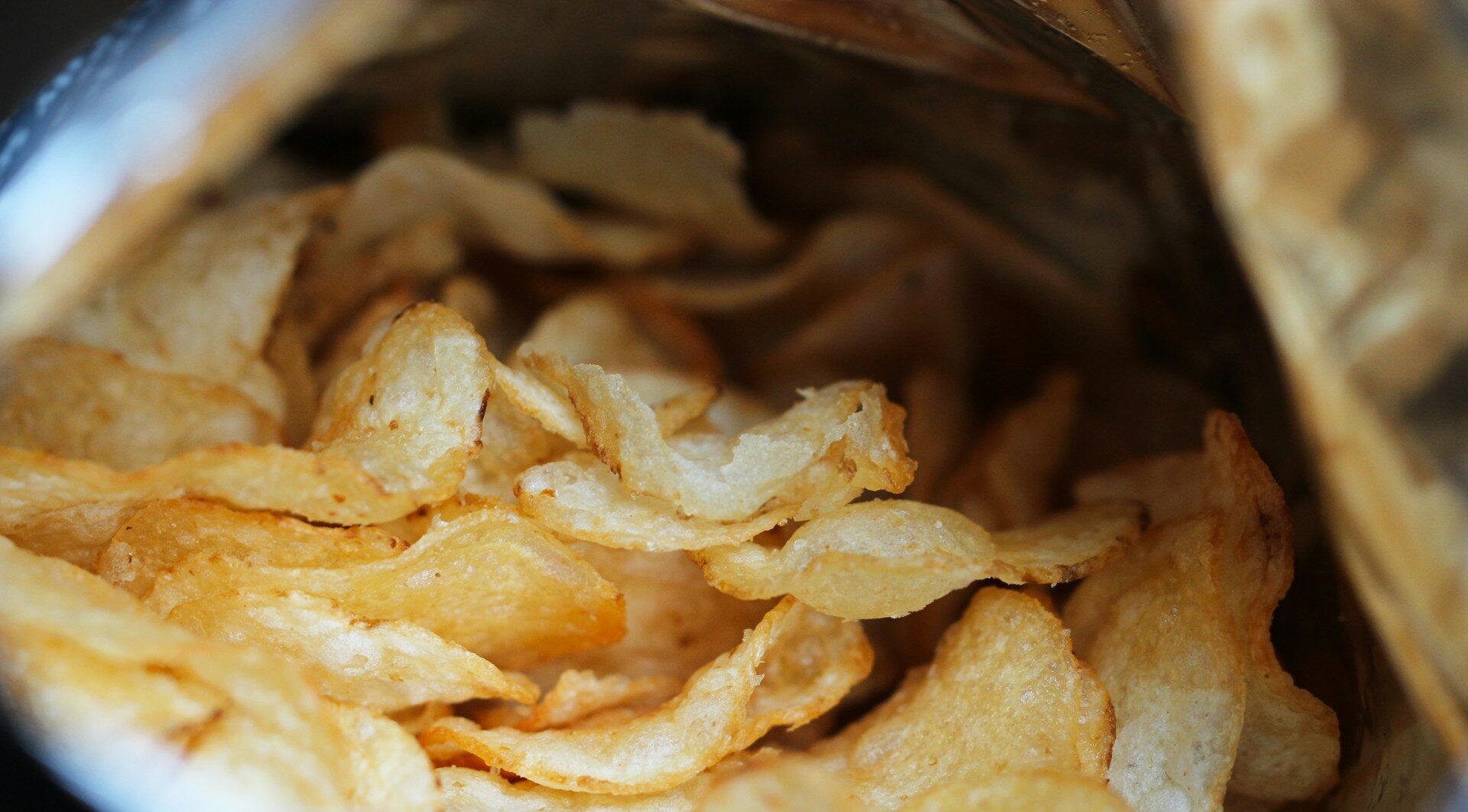
You've eaten. You're not hungry any more. And yet the sight of a packet of crisps triggers something. A study published in Appetite by the University of East Anglia (UEA) has just documented this snacking paradox using electrodes and a reward learning protocol. The verdict: even when full, the brain continues to code snacks as highly desirable. It's not a question of willpower. It's the wiring.
The EEG doesn't lie about snacking (and it's not kind to our good resolutions)
76 volunteers, an electroencephalogram, a task of the type reward-based learning and images of chocolate, crisps, sweets and popcorn. This is the protocol used by the UEA team, in collaboration with the University of Plymouth.
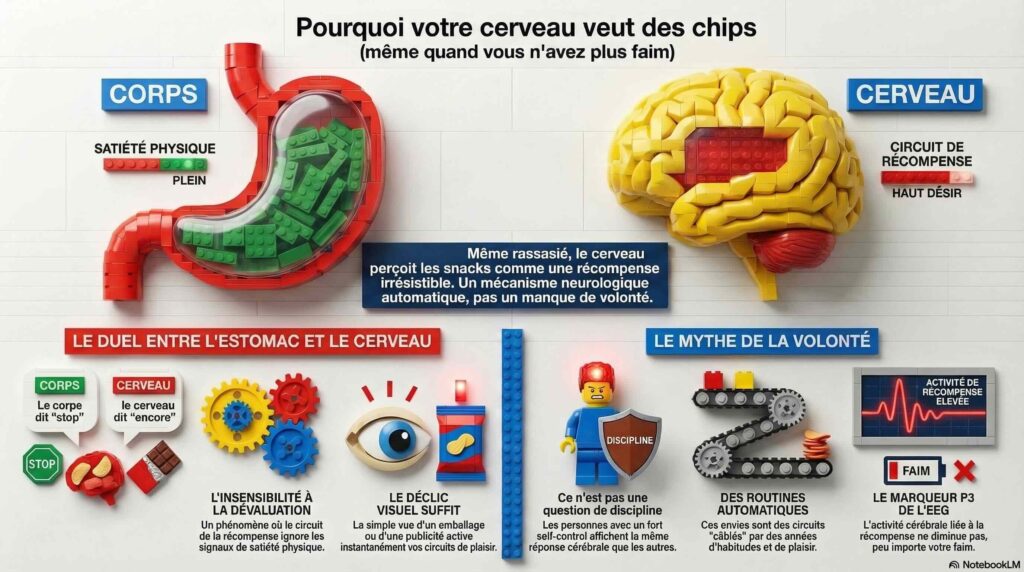
The principle: Correct responses to the task were associated with images of attractive foods - a way of measuring how the brain attributes reward value to them. Halfway through the task, each participant ate one of these snacks to satiety complete. Expected behavioural outcome: the volunteers no longer wanted it, and their behaviour during the task clearly indicated this.
What the EEG showed, however, was different. The researchers measured the P3 component of the evoked potentials - a marker of reward processing and anticipation. This amplitude did not decrease when confronted with images of the food, even though it was «devalued». The brain continued to code these snacks as highly rewarding, independently of satiety signals.
This is what the authors call «insensitivity to devaluation» at the neural level. The body says stop. The brain stays in reward mode.
«Lack of willpower»: the explanation that no longer holds for snacking
This is the most interesting point for nutrition and ingredients professionals. The participants' self-control abilities did not predict the extent of this cerebral resistance to devaluation. In other words, individuals who reported good eating discipline and little desire to nibble more had the same neuronal response as others.
These reward circuits resemble automatic routines - built up over years of association between certain foods, pleasure, and social or emotional contexts. All it takes is a visual signal to activate them: packaging, advertising, a display at the checkout. The context is the trigger.
This is in line with other work on the double reward signal during food intake: a first response to ingestion, a second to the arrival of nutrients in the stomach - a mechanism that contributes to the risk of over-consumption of highly palatable foods.
The authors« conclusion is straightforward: in an environment saturated with food signals, this neuronal wiring becomes a structural factor in overeating. Thomas Sambrook, co-author of the study, calls it a »recipe for overeating".
What this means for formulation (and marketing)
This study does not propose a solution. It poses a constraint. And constraints, properly understood, become angles for differentiation.
Rethinking the promise of satiety. If the reward circuits do not shut down with physiological satiety, increasing fibre or protein density will not be enough to stop snacking in an environment rich in signals. Product positioning must work both levers: hunger management and reducing exposure to stimuli - portion sizes, consumption contexts, distribution times.
Work on palatability without over-stimulation. Research into hyper-palatability suggest that certain fat-sugar-salt combinations enhance the reward response beyond reason. Ingredient suppliers can explore satisfactory but less «supranormal» sensory profiles: complex matrices, intrinsic sugars, structured lipids. The aim is not to make products without pleasure, but to avoid over-activating circuits which, as we now know, do not switch off easily.
Design snacks that offer real protection. The challenge is not to do away with snacking. It's a question of directing it. Nutritional density, controlled glycaemic index, satiating fibres and proteins, pleasant sensory profile without hyperstimulation: functional ingredients - prebiotic fibres, plant protein textured, polyphenols, complex cereal matrices - offer a field of innovation consistent with these neuroscientific data.
Integrating neuroscience into responsible marketing. Knowing that the cerebral reward response persists in a satiated individual raises a concrete question: how can we communicate about products without exploiting this mechanism? Brands that work on messages of moderation, of portion control, of mindful snacking, This will be a differentiating factor as the regulatory and societal framework becomes stricter.
Combining neuroscience and clinical assessment. For biotechs and foodtechs developing new ingredients, these results justify going beyond perceived satiety in clinical studies. Measuring the propensity to snack when not hungry, actual food intake behaviour, and - where possible - behavioural or neuro-psychological biomarkers: this is what will make it possible to document a real impact rather than a declared impact.
Towards «automatic anti-snacking» strategies: who's taking a stand?
This work, published in Appetite (2025) shifts the conversation. We're moving away from the «all you have to do is control yourself» approach to a structural interpretation of over-consumption behaviour. Visit brain remains reactive to visual signals of snacks even when the body is full - and no self-control variable predicts the intensity of this response.
For the ingredients and nutrition industry, this is a clear signal: the winning strategies over the next few years to reduce snacking will combine formulation, behavioural neuroscience, responsible marketing and the construction of portfolios that are less geared towards maximum stimulation.
Players able to position themselves as public health partners on these issues - with documented evidence, formulation solutions and market concepts - will have a concrete advantage in a context where regulatory and societal pressure on ultra-stimulant foods is only increasing.
FAQ - What professionals really wonder about snacking
Does the study imply that satiety ingredients are useless? No. They are still useful for managing physiological hunger - which is already a lot. But the study shows that they do not cut off the brain's reward response to visual signals. Satiety and craving are two partially independent systems. An ingredient that is effective on one is not necessarily effective on the other.
What is P3 and why is it relevant to formulation? The P3 is an electrophysiological component measured by EEG, associated with the processing of reward value and anticipation. If its amplitude does not decrease after satiation with a specific food, this means that the brain continues to attribute a high motivational value to this food, independently of the physiological state. It is an objective, non-declarative marker - which gives it a probative value that intention surveys do not have.
Is there a regulatory framework for the notion of «hyper-palatability»? Not yet directly in the EU - but it is fuelling active regulatory debates, particularly around the reformulation of AUJA (highly attractive ultra-processed foods) and marketing restrictions. Positioning ourselves upstream on these issues, with a documented formulation approach, is one way of getting ahead of the game.
Can a «less hyper-palatable» snack still be good? That's the real R&D question. Satisfying ≠ supranormal. There are sensory profiles that deliver pleasure without triggering the extreme level of activation associated with optimised fat-sugar-salt combinations. This is where the complexity of the matrices - whole grains, polyphenols, ferments, structured lipids - creates value.
Can these results be applied to all snack categories? The study was conducted with classic sweet and savoury snacks (chocolate, crisps, popcorn, sweets). The results are consistent with the literature on high reward density foods, but specific work would be needed for more functional categories (protein bars, legume snacks, etc.). This is precisely the type of study that ingredient suppliers could initiate on snacking.
Video summary
Sources
- Parker et al (2025). Appetite, DOI : 10.1016/j.appet.2025.108390 - original study
- UEA News Release : https://www.uea.ac.uk/about/news/article/science-reveals-why-you-cant-resist-a-snack-even-when-youre-full
- Neuroscience News : https://neurosciencenews.com/food-reward-satiety-snacking-30216/
- EurekAlert : https://www.eurekalert.org/news-releases/1117968
- Medical Xpress : https://medicalxpress.com/news/2026-02-brain-scans-reveal-resist-snack.html
- Nautilus : https://nautil.us/the-urge-to-snack-is-built-into-our-brains-1271651/
- News-Medical : https://www.news-medical.net/news/20260301/Decoding-the-braine28099s-love-for-tempting-snacks.aspx
- Scienmag : https://scienmag.com/science-uncovers-why-you-crave-snacks-even-when-youre-fully-satiated/
Are you working on the formulation of snacks or on a satiety/well-being positioning?
→ Do you have a specific question? Our AI assistant can give you quick guidance: Talking to the assistant
→ Need structured support? Find out more about our formats - from one-shots to editorial partnerships: See the offers
→ Would you like to discuss it in person? 30 minutes to define your needs, with no obligation: Reserve a slot