


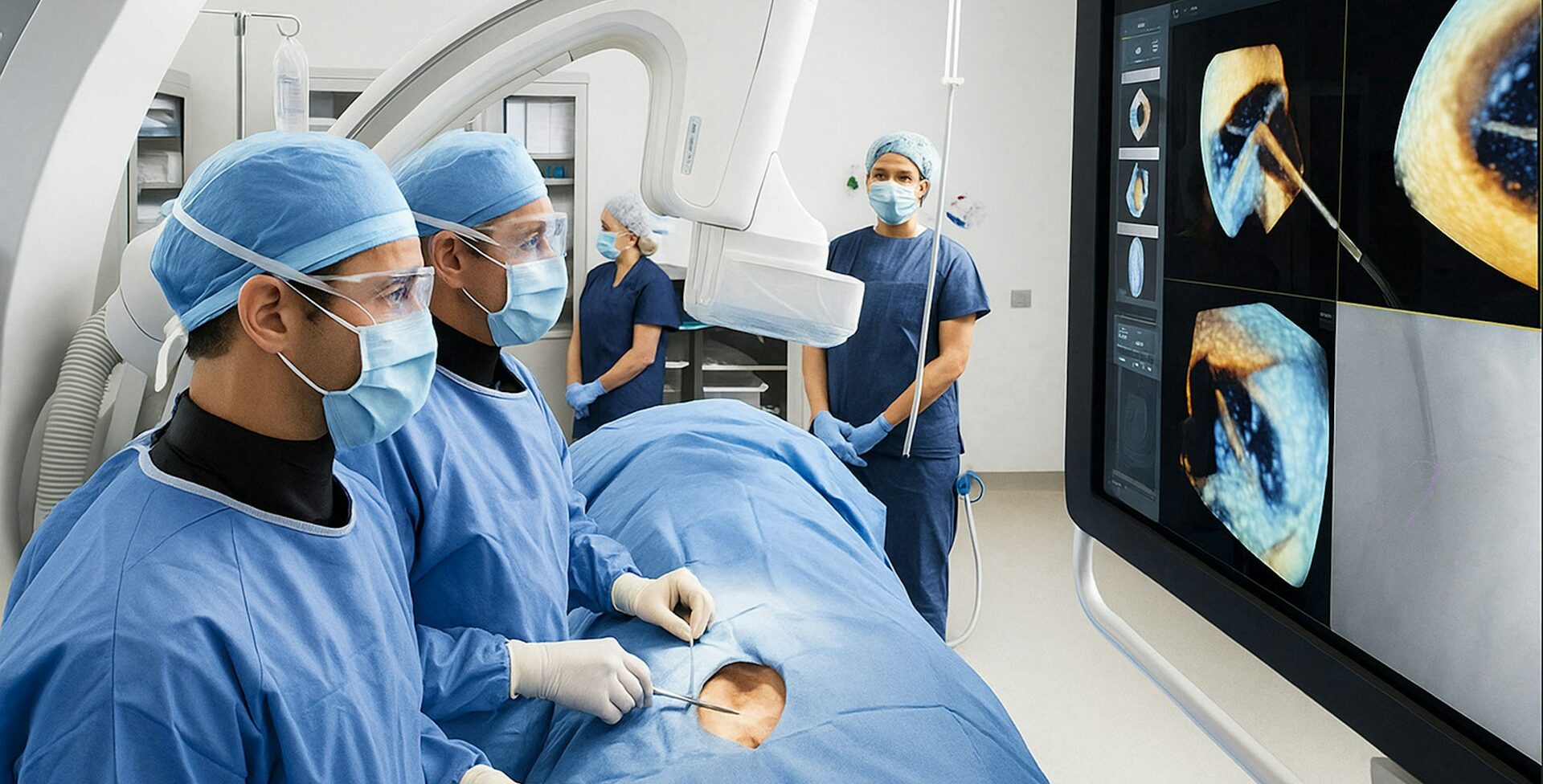
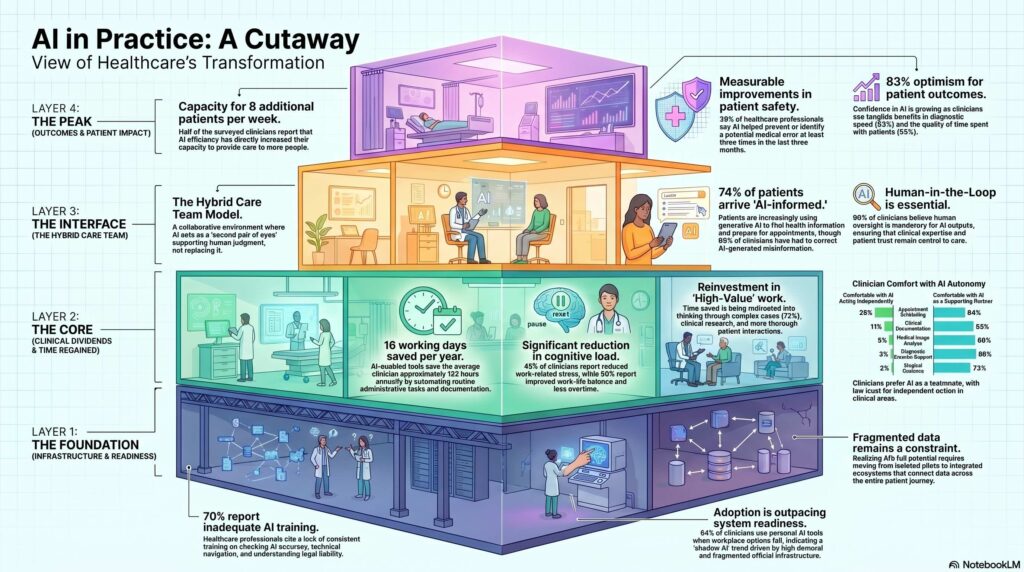
Artificial intelligence is gradually becoming established in hospitals and doctors’ surgeries, promising to ease the burden on healthcare teams and improve the quality of care. According to the Philips Future Health Index 2026, AI is already saving many clinicians the equivalent of more than 16 working days a year, whilst increasing their capacity to treat more patients. But behind these productivity gains, one major issue stands out clearly: nearly 70 % of healthcare professionals believe that training in AI tools is insufficient, uneven or simply non-existent.
For professionals in nutrition and health, these results are far from anecdotal. They outline the parameters of a new care model, where the’IA it does not replace the clinician but reinforces their judgment, reorganises their time and redefines their relationship with increasingly informed patients.
Measurable time and capacity gains already.
The Philips Future Health Index 2026Full reportis based on a survey of over 2,000 healthcare professionals and 20,000 patients in 10 countries, making it one of the most comprehensive barometers of the real-world adoption of AI in the clinic.
A few key figures stand out:
- 65 % Clinicians report an increase in their use of AI over the last 12 months.
- Almost half report a time saving of at least 132 hours per year, which is over three weeks of full-time work.
- On average, surveyed professionals indicate they can manage eight additional patients per week thanks to AI tools.
These benefits are not merely a matter of «time savings» in an accounting sense: more than 80 % of respondents state that AI enables them (or will enable them) to focus more on complex, high-value-added clinical tasks. Against a backdrop of a shortage of medical staff, this ability to free up time for clinical reasoning, patient education or the coordination of care pathways is a major asset.
Beyond effectiveness, the impact on the work experience is also notable: 49 % Some clinicians report feeling less work-related stress, whilst 65 % say they feel more confident in their decision-making and 39 % report that’an AI tool identified or helped to prevent at least three potential errors in the last three months.
For hospital managements and healthcare industry professionals, this data reinforces the idea that AI is no longer just a subject of R&D, but an operational tool capable of absorbing part of the administrative burden and securing medical decisions.
A skills shortage that threatens the ramp-up of AI
The flip side of the coin is that the adoption of AI appears to be driven more by technological supply than by a genuine skills transformation plan at present. In the Philips Future Health Index 2026, 70 % healthcare professionals estimate that AI tool training within their organisation is limited, uneven, or non-existent.
The most frequently cited needs relate to:
- The ability to verify the reliability of AI-generated recommendations (clinical validation, understanding model limitations).
- The basic skills to navigate complex interfaces, configure tools, or interpret automated risk scores.
- Understanding the legal and liability issues: who is responsible in case of an error, how to document decisions based on AI, etc.
This «skills gap» is all the more problematic as AI is often integrated into already fragmented IT environments. The report highlights the difficulty many institutions face in moving beyond the pilot stage: projects remain confined to a few pioneering departments, hampered by a lack of interoperability, budget constraints and the absence of a global vision from management.
For nutrition and health companies developing data-driven solutions (nutritional risk stratification algorithms, decision support tools for managing obesity or metabolic diseases, etc.), these results are a clear signal: the value will come not only from the sophistication of the algorithm, but also from the quality of the training and support system offered to users.
Towards a «hybrid care team»: clinician, AI, and patient
Another strong takeaway from the Philips report is the emergence of a model for a ’hybrid care team,« where AI complements human work and the patient becomes an active partner. Three-quarters of clinicians surveyed say their patients now arrive at consultations already informed by AI tools, whether these are health chatbots, self-monitoring apps, or summaries generated from their records.
Far from perceiving this as a threat, 63 % professionals consider these informed patients key partners in the future care model. Specifically, this translates into:
- Consultations refocused on dialogue and shared decision-making, rather than the simple transmission of raw information.
- Better preparation for exchanges: structured symptoms, better documented history, clearer expectations.
- A possibility to delegate part of the therapeutic education or follow-up to digital tools, while maintaining clinical supervision.
As Carla Goulart Peron, Chief Medical Officer at Philips, points out, time savings do not only translate into operational efficiency gains: they are also reflected in the quality of patient-clinician interactions, the available listening time, and the ability to tailor advice.
For clinical nutrition, dietetics or the prevention of metabolic diseases, this hybrid model paves the way for pathways where AI can continuously monitor diet, physical activity or supplement intake, while the healthcare professional focuses on interpretation, motivation and adjustment of the care plan.
What are the implications for B2B actors in nutrition and health?
Beyond the findings, the Future Health Index 2026 offers several courses of action for companies in ingredients, biotech, or food-tech that wish to be part of this transformation.
Position your solutions within the logic of clinical time-saving
The figures presented by the Philips Future Health Index 2026 (16 days gained per year, eight additional patients per week) provide a concrete benchmark for discussing the ROI of digital or AI-driven innovations with medical directors. Adapting marketing language to this metric – minutes saved per consultation, reduction in administrative tasks, securing of decisions – makes the value proposition more tangible.
Integrate training as a component of the product
The training gap identified by 70 % clinicians shows that an AI tool without a robust educational framework risks being underused, or even rejected. Incorporating micro-learning modules, contextualised clinical case studies, medico-legal guidelines or internal certifications could become a key differentiating factor.
Co-design with clinicians and patients
The concept of a ’hybrid care team« encourages the involvement of both professionals and patients in the design of solutions: nutritional monitoring interfaces, clinical dashboards, food recommendation algorithms, etc. Producers of ingredients or digital solutions can see this as an opportunity to create joint programmes with hospitals or care networks.
Working on interoperability and ease of integration
The identified technological brakes (fragmented IT environments, lack of interoperability) remind us that the value of an AI solution also depends on its ability to integrate frictionlessly into existing systems, whether these are patient records, LIMS, remote monitoring platforms or clinical databases.
For a B2B provider, this means: documented APIs, standard connectors, enhanced regulatory compliance, and clear communication on data security.
FAQ – AI in healthcare: what to take away from the Philips Future Health Index 2026 report
Is AI replacing clinicians?
No, the Philips Future Health Index 2026 study describes rather a model where AI supports the work of healthcare professionals by automating certain tasks (sorting records, image analysis, documentation) and providing decision support, while clinical judgment and human interaction remain central.
How to explain the gain of 16 working days per year?
The Philips Future Health Index 2026 report collates statements from clinicians who estimate gaining an average of over 132 hours per year thanks to AI, equivalent to more than three full-time working weeks, by reducing, for example, the time spent on data entry or information searching.
Why is AI training considered insufficient?
Because in many establishments, tools are deployed without a structured skills development plan, leaving clinicians alone to face complex systems and sometimes unclear legal issues. Professionals are asking for practical training to understand, evaluate, and oversee the use of these technologies.
Do patients trust AI in healthcare?
The Philips Future Health Index 2026 shows that an increasing number of patients are already using AI tools to inform themselves or monitor their health, and that clinicians are largely ready to consider them as full partners in a hybrid care model, provided that the information generated by these tools is discussed and validated during consultations.
What opportunities exist for players in the nutrition and food-tech sectors?
Companies developing solutions that combine data, AI, and nutrition (risk screening, dietary personalisation, continuous monitoring) can leverage these findings to demonstrate their potential impact in terms of time savings, decision quality, and patient engagement, provided they integrate training and change management from the outset.
Sources
Philips. Future Health Index 2026 – Global report. Koninklijke Philips N.V., 2026.