



Generative AI is enjoying unprecedented popularity. But not all platforms are being used in the same way. While the OpenAI-NBER study (September 2025) has highlighted the worldwide use of ChatGPT by the general public, Anthropic is publishing, with its Economic Index a detailed analysis of the adoption of Claude, focusing on geography and companies (Anthropic, Economic Index September 2025 Report). The results reveal a striking contrast: ChatGPT is first and foremost a universal assistant, while Claude has established itself as an automation engine in professional environments.
Concentrated but rapid adoption of Claude
The report stresses that the adoption of Claude follows the same laws as the major technologies of the 20th century (electricity, PCs, the Internet), but over much shorter timeframes. In the United States, 40 % of employees say they will be using AI at work in 2025, 20 % in 2023.
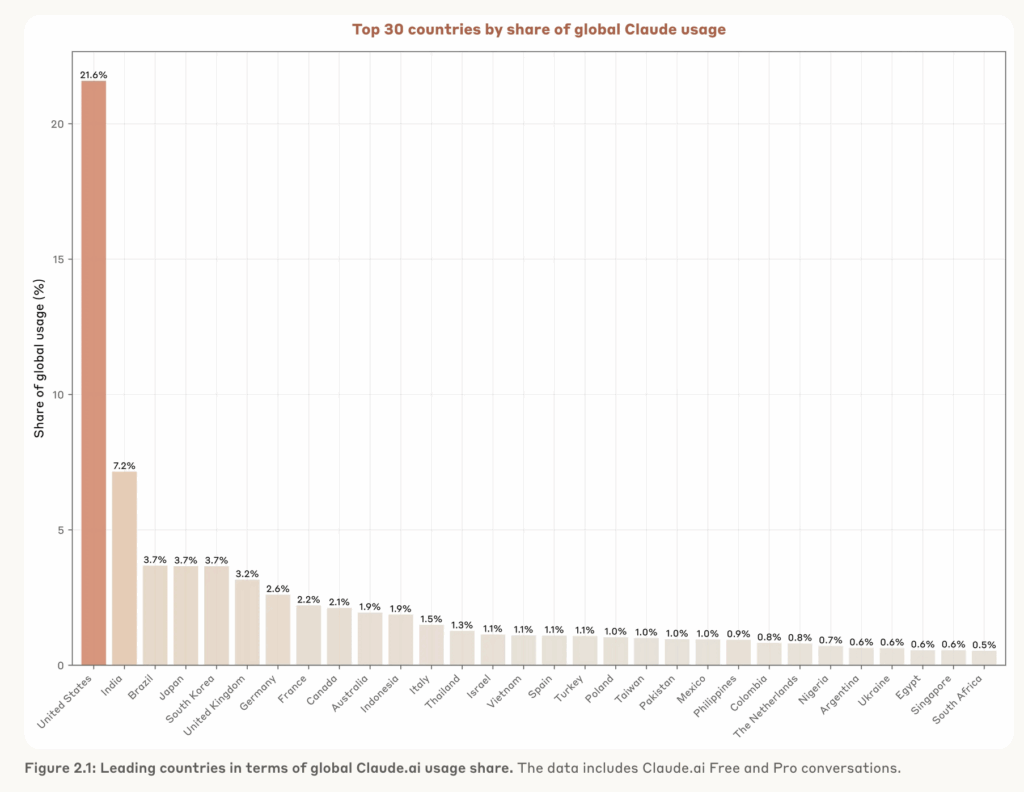
However, as in the case of past technologies, adoption remains geographically and sectorally concentrated A few countries, regions and companies are currently reaping most of the benefits.
Claude's uses: dominant coding, but diversification underway
Recent developments
Between early 2025 and September 2025 :
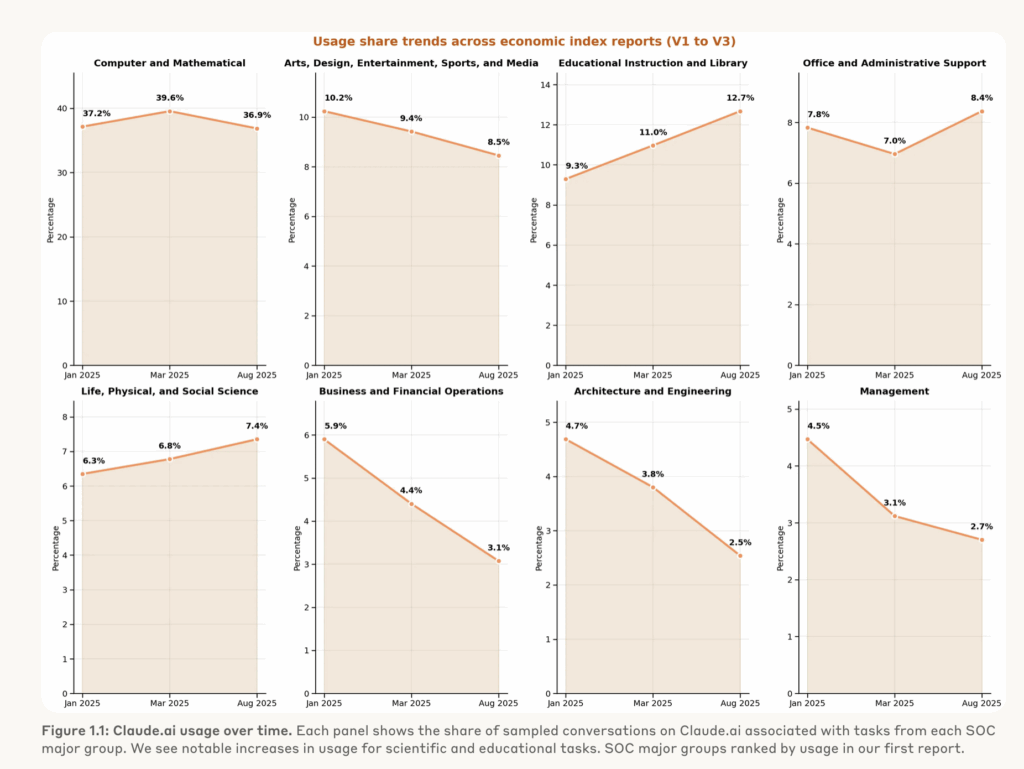
- Coding remains the primary use, representing 36 % tasks.
- Education up from 9.3 % to 12.4 %.
- Science increase of 6.3 % to 7.2 %.
Claude is therefore increasingly involved for cognitive uses (teaching, research), Even though IT development remains central.
More autonomy entrusted to AI
So-called conversations “directive”, where the user delegates a complete task to Claude, have gone from 27 % to 39 % in eight months. Coding is a good illustration of this trend: fewer debugging requests (-2.9 points) and more complete program creation (+4.5 points).
Geography: a North-South divide
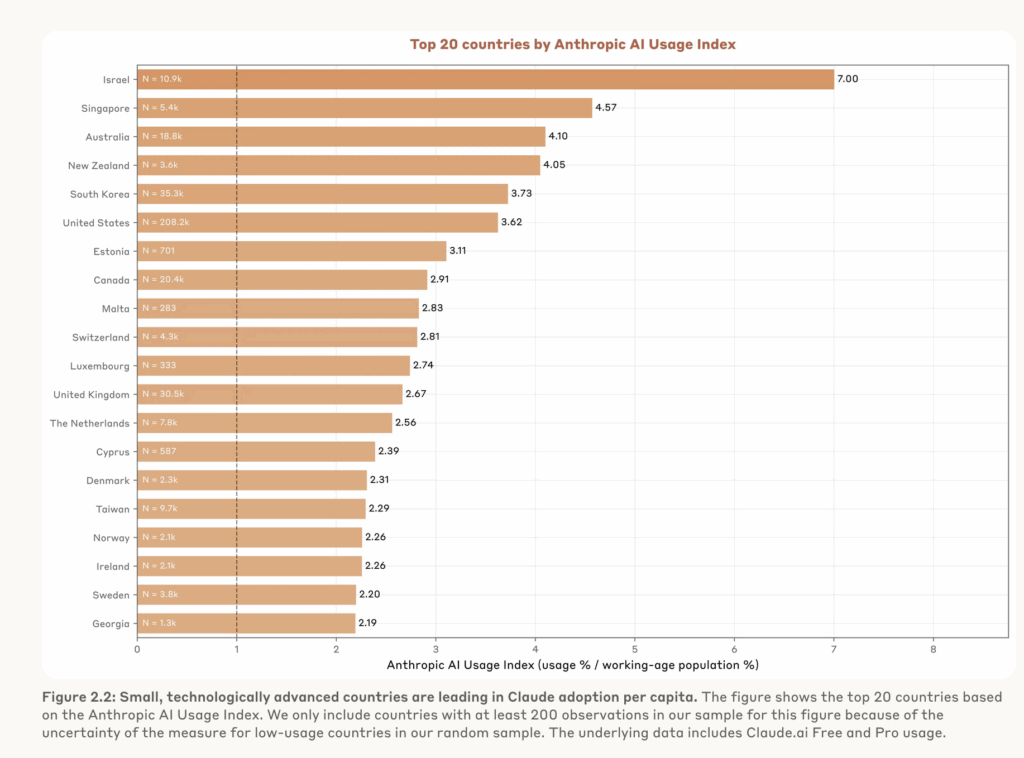
L’Anthropic AI Usage Index (AUI) measures the intensity of use by country and region, taking into account the active population.
- Leading countries Israel (7x more than forecast), Singapore (4.6x more than forecast), Canada (2.9x), Washington DC (3.82x), Utah (3.78x).
- Emerging countries Indonesia (0.36x), India (0.27x), Nigeria (0.2x).
Two trends are emerging:
- Concentration in wealthy economies, This increases the risk of growing global inequalities.
- Diversity of uses in advanced countries (education, science, business), while in emerging countries, coding accounts for more than half of all interactions.
Finally, another difference:
- Countries with high adoption rates → more’increase (human-IA collaboration).
- Low adoption countries → more’automation (total delegation of tasks).
Companies and Claude's API: large-scale automation
Anthropic analyses its traffic for the first time Proprietary API (1P), used by companies.
- Dominant automation : 77 % of API uses correspond to full execution, compared with ~50 % on the web interface side.
- Key areas coding, administrative tasks, office automation.
- Less price sensitivity Companies choose tasks on the basis of capacity and economic value, not cost per request.
- Main brake The context. The success of automation depends on the quality of internal data and the way companies are organised.
In short, the Claude API illustrates a logic of deep integration into workflows, with priority given to the gross productivity.
Claude vs ChatGPT: two usage models
The OpenAI study on ChatGPT and Anthropic's work on Claude reveal complementary dynamics.
Comparison table
| Dimension | ChatGPT (OpenAI, Sept. 2025) | Claude (Anthropic, Sept. 2025) |
|---|---|---|
| Adoption | 700M weekly users (general public, global) | Concentrated in wealthy countries (Singapore, Canada, US) |
| Dominant uses | Practical advice (29 %), searching for information (24 %), writing/publishing (24 %) | Coding (36 %), education (12.4 %), science (7.2 %), administrative |
| Orientation | 73 % non-pro / 27 % pro | Mainly professional |
| Interaction mode | Asking (49 %), Doing (40 %), Expressing (11 %) | “Directive (automation) up sharply: 39 % (API: 77 %) |
| Added value | Reflection co-pilot, decision support | Task automation, gross productivity |
| User profiles | Young people, parity, strong adoption in emerging countries | Companies, IT/admin/marketing sectors, advanced countries |
| Recent developments | Increase in information searches (+10 points in 1 year) | Increase in education (+3.1 points), science (+0.9), automation +12 points |
Conclusion
The Anthropic Economic Index confirms that AI is following two distinct trajectories:
- ChatGPT has established itself as a universal tool for the general public, It's the ideal tool for research, writing and decision-making.
- Claude is developing mainly as a enterprise automation engine, concentrated in advanced economies and integrated via API.
These results show a divide: cognitive assistant for individuals, productive automaton for organisations. Together, they show that the AI revolution is not monolithic, but multifaceted - and that its benefits are likely to be unevenly distributed between regions and economic players.
Reference:
Anthropic Economic Index report: Uneven geographic and enterprise AI adoption - 15 Sept. 2025