


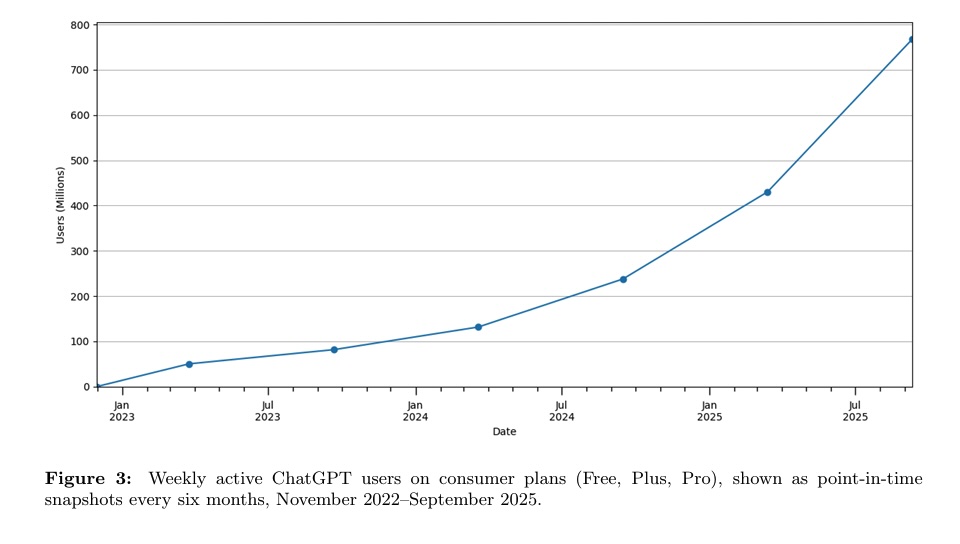
In less than three years, ChatGPT has become a daily tool for almost 10 % of the world's adult population. A study published in September 2025 by OpenAI and the NBER provides for the first time a detailed view of the real uses of the platform, based on internal data covering all users (OpenAI, How people are using ChatGPT).
Massive and rapid adoption of ChatGPT
- 700 million weekly active users in July 2025, i.e. approximately 10 % of the world's adult population.
- More than 2.5 billion messages a day, or approximately 29,000 per second.
- Non-work-related uses are now in the majority: from 53 % in June 2024 à 73 % in June 2025.
Three dominant uses for ChatGPT: information, guidance and writing
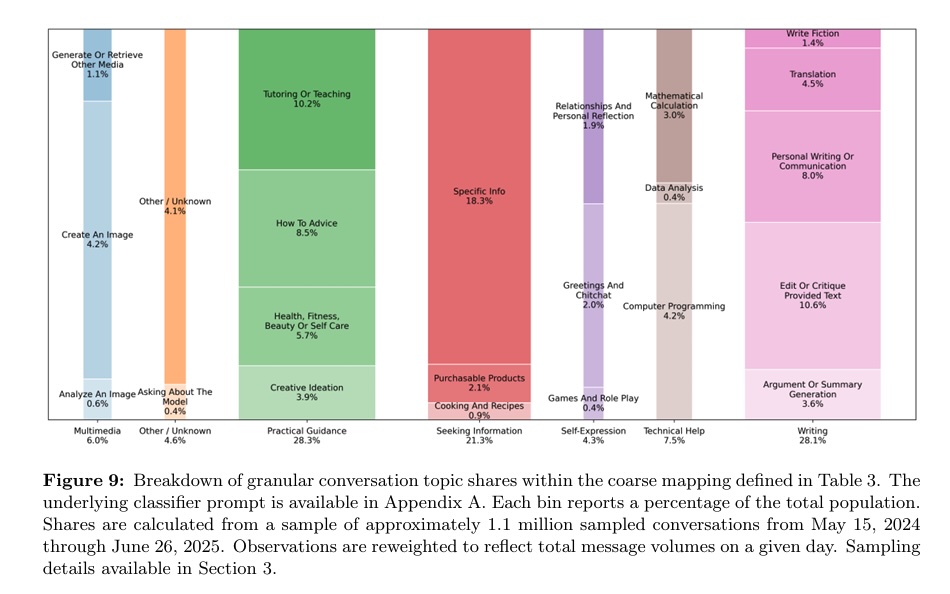
Nearly 80 % conversations fall under three main headings:
- Practical Guidance : about 29 % of uses, including tutoring, teaching and creativity.
- Seeking Information up sharply from 14 % to 24 % in one year.
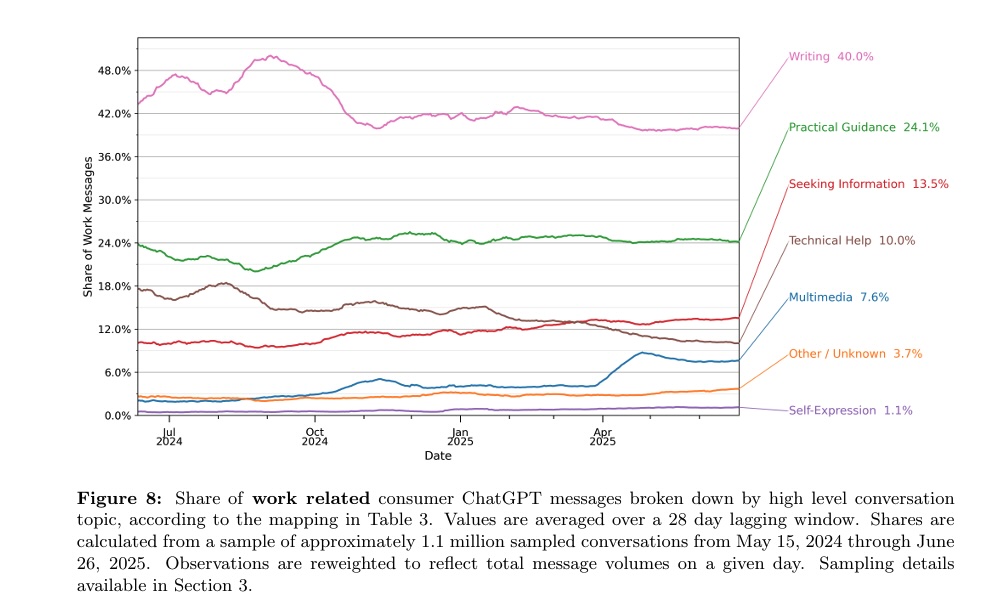
- Writing and editing texts down overall by 36 % to 24 %, but which remains initial professional use (40 % of work-related messages). Two-thirds of these requests concern revision, editing or translation texts supplied by the user.
The programme represents only 4.2 % messages, and conversations of a personal or emotional nature less than 2 %.
Asking, doing or expressing: three major intentions
The study distinguishes three types of intention:
- Asking (ask a question, seek advice or information) : 49 % messages.
- Doing (ask for a task or content to be carried out) : 40 %.
- Expressing (express an emotion or an opinion) : 11 %.
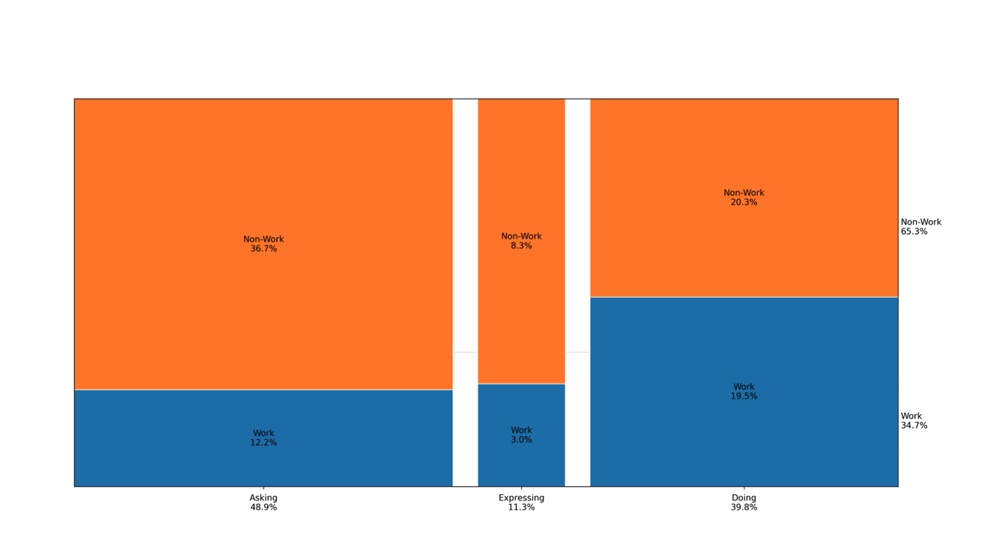
At work, the balance shifts: 56 % of work-related messages are “Doing” messages”, three quarters of which relate to editorial work.
Decision-making and information: the heart of added value
Based on the ONET Work Activities, the researchers show that 58 % professional messages focus on two functions:
- Obtaining, documenting and interpreting information ;
- Make decisions, solve problems, advise and think creatively.
These results underline the fact that the value of ChatGPT lies as much in the decision support than in the production of content.
Who uses ChatGPT? Socio-demographic profiles
| Category | Share of uses | Main features |
|---|---|---|
| Type | 2023: ~80 % men → 2025: parity achieved, women slightly in the majority | Women more uses in writing and practical guidance. Men more in technique (programming, multimedia, information retrieval). |
| Age | ~46 % of messages sent by 18-25 years old | The older you get, the greater the proportion of uses professionals is growing. The over 66s send only 16 % of work-related messages. |
| Country (income) | Faster adoption in low and middle income countries | Stronger growth momentum outside rich countries. |
| Education | < Bachelor's degree: 37 % pro messages Bachelor : 46 % Graduate : 48 % | The higher the level of education, the greater the use. professional and oriented “Asking”. |
| Occupation | Non-professionals: 40 % pro Management/Business: 50 % IT : 57 % Science/Engineering: 48 % | Management : writing = 52 % for professional use. IT : technical assistance = 37 %. Education/Health: writing ~50 %. |
Profiles by occupation: dominant uses
| Type of user | Share of work-related use | Dominant uses |
|---|---|---|
| Manager/Business | 50 % | Writing (52 % pro messages): emails, reports, documents. |
| IT specialist | 57 % | Technical assistance and programming (37 %). |
| Scientist/Engineer | 48 % | Balanced mix of problem solving and practical guidance. |
| Education/Health | ~50 % | Strong presence of writing (almost half of all messages). |
| Non-professionals | 40 % | Diversified use, but writing and useful tips dominate. |
In a nutshell
This global study shows that ChatGPT is used for both everyday life and work. Its three pillars of use are practical advice, finding information and writing. In the professional arena, he is best known as a a co-pilot for reflection and decision support, beyond the execution of tasks.
In your day-to-day work, has ChatGPT become more of a writing assistant, a personalised search engine or a decision co-pilot?.
References :
OpenAI, How people are using ChatGPT - NBER Working Paper, September 2025.
The full working paper: https://www.nber.org/papers/w34255