

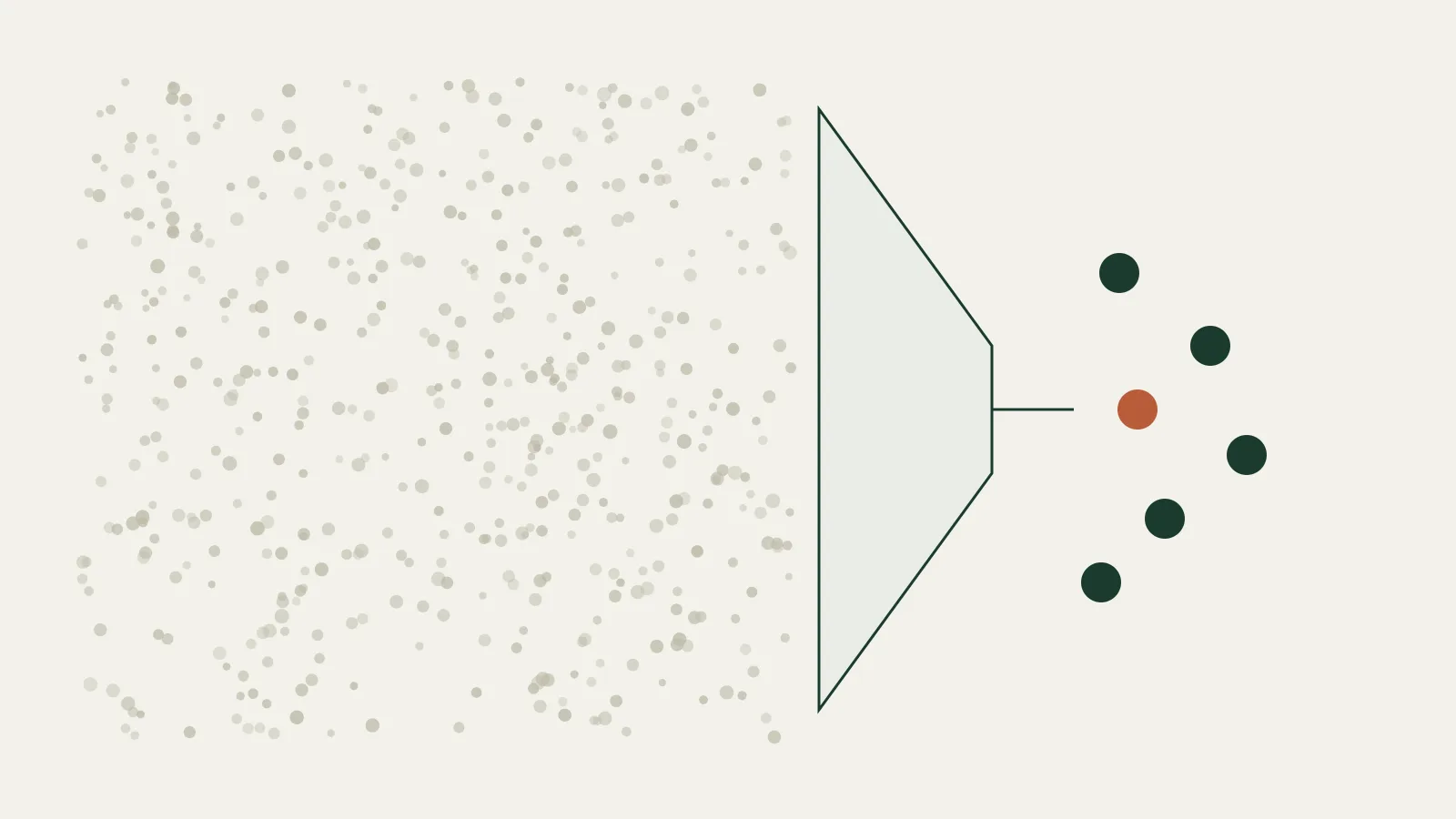
In brief: Of the 9,612 papers published in 2025 and indexed in PubMed that mention probiotics, prebiotics or postbiotics in their title or abstract, 347 are randomised controlled trials: 3.6%. Useful automated monitoring does not summarise everything. It sorts, discards and only puts in front of people what could change a decision.
You can check the figure with one query. Type (probiotic*[tiab] OR prebiotic*[tiab] OR postbiotic*[tiab]) AND 2025[dp] into PubMed: 9,612 records. Add the randomized controlled trial[pt] filter: 347 remain [1]. Query run on 13 October 2026; the total shifts as indexing continues.
Across PubMed as a whole, records dated 2025 exceed 1.88 million [1]. No team reads that flow. Yet the publication-type filter alone cuts the volume by a factor of nearly 28. Most teams do not even read the 347 trials. They read what a supplier, a competitor or a journalist has already selected for them, with their own bias.
The verdict: monitoring that drowns you is badly filtered monitoring
The usual mistake is to set up a broad alert and forward the results to a shared inbox. Three weeks later, nobody opens it any more. The problem is not volume. It is the lack of a sorting rule upstream.
Well-designed automated monitoring answers a single question: which paper this week could change a claim, a formulation, a sales argument or an R&D priority? Everything else is archived and searchable, but not presented.
The three streams to watch (and they are not read the same way)
The scientific literature. PubMed offers saved searches with email or RSS alerts, and an API (E-utilities) [2] that lets you pull records into a tool like Airtable via Make. Filtering by publication type does most of the sorting.
EFSA opinions. Scientific opinions are published in the EFSA Journal [3]. For an ingredient supplier, a Novel Food opinion or an opinion on a competitor’s claim carries more weight than a hundred academic papers.
The Official Journal of the EU. Implementing regulations that authorise a novel food or amend a claim are published here [4]. It is the smallest stream and the one with the most at stake.
Write the sorting rule before you plug in the tool
The sorting rule comes down to four questions, asked in this order for every record.
- Is it a human trial? Preclinical studies are archived, not presented.
- Is it about an ingredient, a strain or an indication in your portfolio? Or in a direct competitor’s.
- Are the dose and the population comparable to yours? A trial at ten times your dose does not support your product.
- Does the result confirm, qualify or contradict what you say today?
The first two questions are settled by filters. The last two need a reader. That is the exact boundary between what can be automated and what cannot, and it deserves to be written down: one page, reviewed every quarter, signed by R&D and marketing.
The architecture: collect, classify, present
| Step | Automatable | Typical tool | Who validates |
|---|---|---|---|
| Collecting records | Yes | PubMed E-utilities, RSS feeds | Nobody |
| Deduplication | Yes | Make, Airtable | Nobody |
| Classification by study design | Yes | PubMed filters | Spot checks |
| Linking to your ingredients | Partly | Keywords, strains, trade names | R&D |
| Summary of a selected paper | With verification | AI assistant on the published abstract | R&D |
| Judging business relevance | No | Marketing and R&D |
The row that matters is the last one. A machine knows that a trial is about your strain. It does not know that the trial contradicts the central argument of your trade show deck.
The three outputs of monitoring that works
Monitoring that ends with “read” changes nothing. Every selected paper should land in one of three boxes.
- No action. The paper is archived with a one-line reason. That trace is worth a great deal six months later.
- To read. The paper is assigned to a named person, with a deadline.
- To integrate. The paper opens a task: update a sales argument, a technical data sheet, a dossier.
Without the third box, monitoring is just reading. With it, you can count each month how many papers actually changed a document. If the answer is zero for a whole quarter, the sorting rule is too broad or the portfolio you watch is too narrow.
What automated monitoring lets slip through
- Recent records with incomplete tagging. A paper that has just entered PubMed may not yet carry all its descriptors. An overly strict publication-type filter will miss it. Keep a “recent, unclassified” queue and review it every month.
- Names that change. A strain cited by its code in one paper and by its trade name in another escapes a single query. Your synonym list is an asset to maintain.
- Negative results published quietly. They exist and they matter for your dossiers. Monitoring that only searches for your benefit keywords will not find them.
- Preprints. They have not been peer reviewed. If you track them, keep them in a separate category.
What this means for your teams
For your R&D team, monitoring becomes a dated register: who read what, when, and with what conclusion. That comes in handy the day a customer asks whether you knew about a study.
For your marketing team, it becomes a source of verified topics rather than a news feed. A relevant trial selected on Monday can feed an article, a post and an updated sales argument within the week.
The real cost is not in the tools. PubMed is free to access, and automation and storage tools cost little next to a salary. What costs is the weekly reading slot: it has to be fixed, in the diary and assigned to one person. Monitoring without a slot stops at the first trade show.
Human time does not disappear. It is concentrated on the one step that automation does not do. Who on your team decides today whether a study is worth reading?
Sources
- National Library of Medicine. PubMed. Queries “(probiotic[tiab] OR prebiotic[tiab] OR postbiotic[tiab]) AND 2025[dp]”, with and without the “randomized controlled trial[pt]” filter, and “2025[dp]”. Accessed 13 October 2026.
- National Center for Biotechnology Information. Entrez Programming Utilities Help.
- European Food Safety Authority. EFSA Journal.
- Publications Office of the European Union. EUR-Lex, Official Journal of the European Union.
FAQ
Do you need a paid subscription to automate PubMed monitoring?
No. PubMed and its APIs are free to access. The costs come from automation and storage tools, and above all from human review time.
Can an AI assistant summarise the selected papers?
Yes, provided it works from the published abstract or text and someone in R&D checks the dose, the population and the primary endpoint. Those are precisely the details an automatic summary distorts.
How often should you review the monitoring output?
Once a week is enough for the scientific literature. The EFSA and Official Journal streams, which are much smaller, can trigger an immediate alert when they concern an ingredient in your portfolio.
How do you stop monitoring from being abandoned after three weeks?
Limit what is presented each week to a few papers, name one person responsible for triage, and link every selected paper to a decision: no action, to read, to integrate.
This monitoring feeds directly into watch and crisis management, and reads alongside the regulatory frame detailed in probiotics and EFSA.