

En bref — The whey shortage has become a procurement leadership issue: European demand (256,500 tonnes in 2024 according to GIRACT) exceeds production despite new capacity coming online, and prices have multiplied fivefold since 2023. The fix isn’t to replace whey but to stretch it: clear plant, collagen, yeast protein and dairy concentrates are taking over applications where whey isn’t essential.
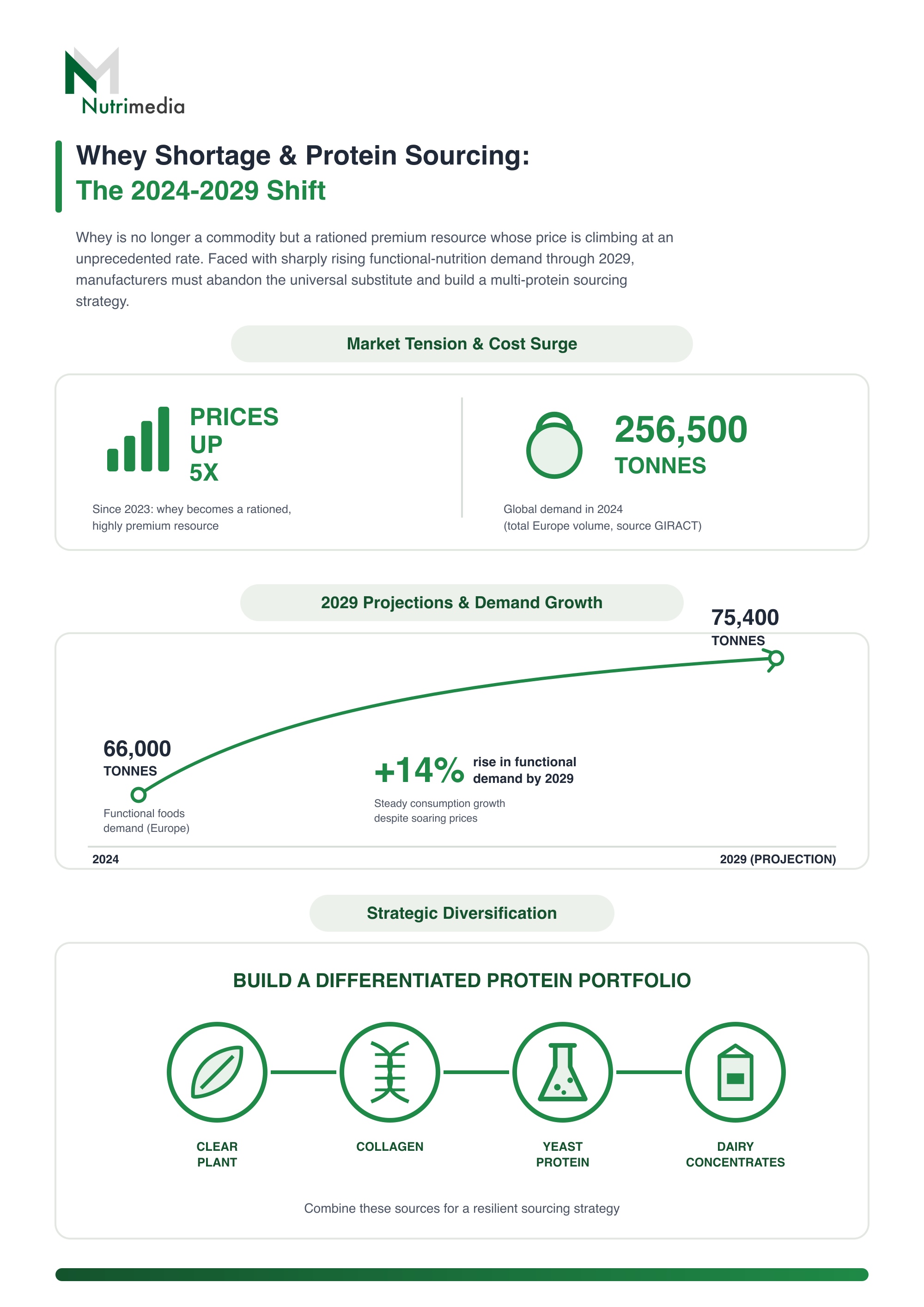
The whey shortage has become a procurement leadership issue, not just an R&D one. GIRACT estimated European whey demand at approximately 256,500 tonnes in 2024, of which 66,000 tonnes went to functional foods, with a projection of 75,400 tonnes by 2029 [1]. At the same time, whey prices have multiplied fivefold since 2023 according to data reported by NutraIngredients [2]. The result: the question is no longer finding “the next whey”, but deciding where whey remains indispensable.
Is the whey shortage here to stay?
Yes, durably so, and this is counterintuitive: rising prices and supply pressure aren’t weakening whey’s position, they’re reinforcing it as the benchmark. On amino acid profile quality, leucine content, digestibility and consumer recognition, no alternative yet matches it.
What’s changing is the trade-off. The whey shortage forces your teams to sort application by application: where whey is non-negotiable, and where a blend or alternative protein does the job at better cost. In short, you’re no longer looking for a universal substitute, you’re building a differentiated protein portfolio.
For your sports nutrition ranges, this shifts the negotiation. Whey becomes a targeted premium ingredient, reserved for formats where its fast digestion profile and image genuinely matter: post-exercise recovery, high-end isolates, leucine claims.
Why is supply pressure happening now?
Sports nutrition is no longer the only player in the whey market. It now competes directly with high-protein dairy products, medical nutrition, healthy ageing and weight management, all drawing on the same raw material streams.
In 2026, most manufacturers acknowledge that global whey demand continues to exceed production, despite new capacity coming online [2]. This overlap in uses explains why the whey shortage doesn’t mechanically resolve itself simply by adding production units.
The demographic shift also plays a role. Sports nutrition is becoming “active nutrition”: proteins developed not just for athletes, but for seniors, occasional exercisers and weight management users. Themes of energy, recovery and healthy ageing are pushing demand upward, further tightening the equation for your sports protein sourcing.
Clear plant, collagen, yeast: the four levers to pull
Diversification doesn’t mean replacing whey wholesale, but placing each protein where it makes sense. Four approaches emerge from the GIRACT material.
Clear whey has already changed how protein is consumed: a light, fruit-flavoured beverage close to a functional water, often in sugar-free, low-calorie RTD format. New in 2026: clarity is no longer limited to dairy. Several companies have launched clear hydrolysed plant proteins to correct grittiness, off-notes and cloudiness. Clear pea, rice and even yeast proteins are being developed for these beverage formats.
Collagen shouldn’t be presented as nutritionally equivalent to whey for muscle protein synthesis: its amino acid profile differs. But it plays a complementary role when the product also targets mobility, connective tissue, beauty or healthy ageing. GIRACT identified a clear product on shelf combining 10g of whey isolate and 10g of collagen peptides per serving [1].
Yeast protein is at an earlier stage, but its expected growth exceeds 10% per year in functional foods [1]. Several supplier studies are exploring yeast-whey combinations: the idea isn’t to remove whey, but to stretch it. These supplier-led studies don’t amount to independent consensus, but they indicate the direction formulation is heading.
| Protein source | Positioning | 2026 status | Recommended use |
|---|---|---|---|
| Whey (isolate) | AA benchmark, leucine, recovery | Tight, expensive | Targeted premium |
| Clear plant (pea, rice) | Refreshment beverage, vegan | 2026 launches | RTD, refreshment format |
| Collagen | Mobility, beauty, ageing | Mature, blended | Partial substitution |
| Yeast protein | High-protein beverage | Emerging, +10%/year | Blend with whey |
| Milk concentrate/isolate, casein | Dairy positioning | Available | Bars, shakes, satiety |
Demand for pea protein in European functional foods is projected to grow from 19,300 tonnes in 2024 to 27,100 tonnes in 2029 according to GIRACT [1]. The opportunity is no longer limited to vegan powder: improved solubility and taste are opening up formats to plant proteins that were previously closed to them.
Barriers to overcome before reworking your specifications
Diversifying isn’t free. Three obstacles come up repeatedly, with concrete workarounds.
- The nutritional gap. Collagen and plant proteins don’t offer whey’s leucine profile. The workaround: confine them to applications where rapid muscle synthesis isn’t the central argument (satiety, evening use, mobility), or combine them with whey rather than removing it.
- Cost and scale of fermentation. Precision fermentation offers supply diversification not dependent on dairy, and investment in alternative proteins jumped in 2026, with fermentation driving most of the growth [2]. But the number of deals fell: investors are concentrating on technologies with credible scale-up potential. Cost, regulation and consumer acceptance remain open questions.
- Reformulation complexity. Taste, format, protein quality, claims, price and supply resilience all need to align. The workaround: think in terms of a use-case matrix rather than a single substitution.
Dairy remains an option too often overlooked. Faced with a whey shortage, the alternative isn’t always plant-based: milk protein concentrate, milk protein isolate and micellar casein retain a dairy positioning. Casein’s slow digestion gives it a natural role in evening and satiety products.
What whey scarcity is redistributing for your procurement
For your procurement leadership, the lesson is the end of single-protein sourcing. Securing supply chains now means building a portfolio of sources where each protein covers a specific use, cushioning price shocks on any single stream.
For your R&D, the work shifts towards blends: whey-collagen to broaden positioning, whey-yeast to stretch the resource, clear plant to win beverage formats. Europe adds a circular economy angle: most yeast extract producers recover both protein and beta-glucan from the same base, a stream not tied to milk availability.
For your marketing, the constraint becomes an argument. A whey-collagen system reduces the whey required while opening up mobility or beauty claims. The whey shortage is thus forcing a repositioning that can add value to a range rather than diminish it. Next step for your teams: map out, format by format, where whey remains non-negotiable and where a blend delivers on the promise at better cost. What share of your sports catalogue could you reformulate without touching your leucine claims?
References
- GIRACT. Estimates of European demand for whey, pea and yeast protein in functional foods (2024 data, 2029 projections). Cited by NutraIngredients, 2026.
- Royer E. Whey is expensive, scarce and more important than ever in sport nutrition. NutraIngredients. 2026.
FAQ
Why have whey prices risen so sharply?
Global demand continues to exceed production despite new capacity, and sports nutrition now competes with high-protein dairy, medical nutrition and healthy ageing for the same raw material. Prices have multiplied fivefold since 2023 according to NutraIngredients (2026).
Should I replace whey entirely in my formulations?
No. Whey remains the benchmark for amino acid profile, leucine content and digestibility. The dominant approach in 2026 is partial substitution or blending: keeping whey where it’s essential, and stretching or supplementing it elsewhere.
Can collagen replace whey for muscle mass?
No, its amino acid profile differs and it isn’t equivalent for muscle protein synthesis. It makes sense alongside a product also targeting mobility, connective tissue, beauty or healthy ageing. GIRACT identified a product on shelf combining 10g of whey isolate and 10g of collagen peptides per serving.
Is clear protein limited to dairy?
Not any more in 2026. Several companies have launched clear hydrolysed plant proteins that correct grittiness, off-notes and cloudiness. Clear pea, rice and yeast proteins are being developed for refreshment-style beverages.
What’s the value of yeast protein for my sourcing strategy?
Its expected growth exceeds 10% per year in functional foods according to GIRACT, and it isn’t tied to milk availability. European producers are recovering both protein and beta-glucan from the same base, offering a diversification stream rooted in circular economy principles.
Will precision fermentation solve the shortage quickly?
Not in the short term. Cost, regulation, scale and consumer acceptance remain open questions. Investment in alternative proteins jumped in 2026, driven by fermentation, but the number of deals fell: capital is concentrating on technologies with credible scale-up potential.
Are non-whey dairy proteins a credible alternative?
Yes, for certain applications. Milk protein concentrate, milk protein isolate and micellar casein retain a dairy positioning. Casein’s slow digestion suits evening products, meal replacements and satiety concepts where the rapid absorption of whey isolate isn’t required.