


In short — A University of Toronto trial (74 adults, 12 weeks, Journal of Nutrition, 2026) shows that three daily portions of whole dairy products do not worsen weight, cholesterol or insulin resistance, and improve blood pressure. The explanation: the dairy matrix modulates nutrient absorption, which renders the equation «saturated fats = risk» obsolete.
Three portions of whole-milk dairy products per day for twelve weeks, with no increase in weight, fat mass, cholesterol or insulin resistance — and a falling blood pressure. That is the result of a controlled trial led by Professor Harvey Anderson (University of Toronto), published in The Journal of Nutrition in 2026.
The fact disrupts a guideline in place for forty years: preferring fat-free or low-fat to limit saturated fats. The dairy matrix — the way caseins, whey, lipids and micronutrients are physically bound within the product — would explain why a food rich in saturated fatty acids behaves differently from its saturated lipids taken in isolation. For dairy ingredient manufacturers and formulators, this represents a rare window for repositioning: rehabilitating whole dairy instead of skimming it by default.
What does the Toronto trial really measure?
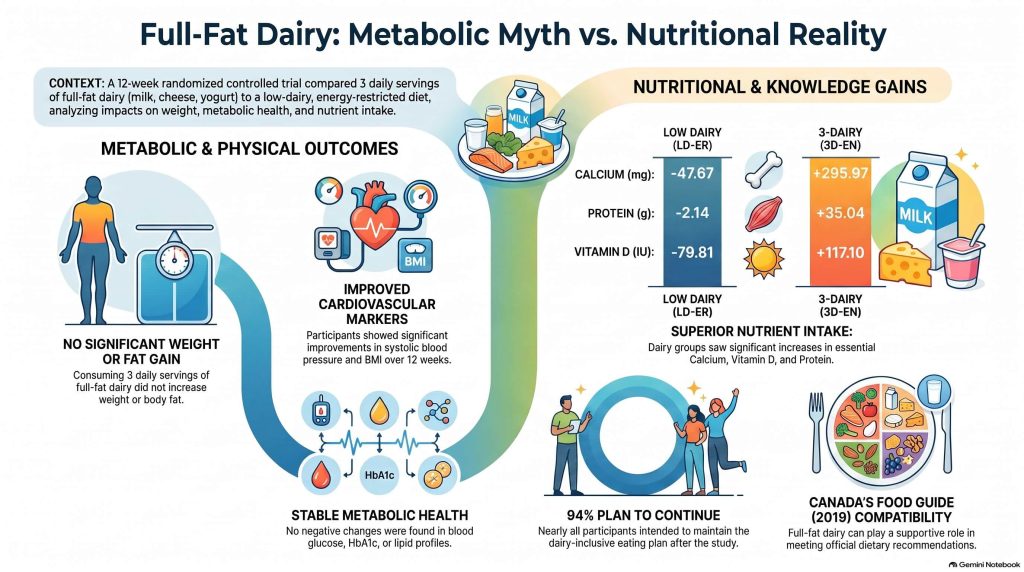
Researchers randomly assigned 74 overweight or obese adults into three arms over twelve weeks. One group followed a low-dairy, calorie-restricted diet; a second group an iso-energetic diet with three daily portions of full-fat dairy products; a third group an ad libitum diet also including three portions. All received the recommendations of the Canada's Food Guide.
Objective result: no notable difference in weight gain, body composition or cholesterol between the low-dairy group and those consuming three portions a day. «Those who ate three portions of dairy had neither unfavourable cholesterol or blood lipids, nor any sign of insulin resistance», Anderson summarises. Dairy consumers also had better blood pressure and higher intakes of calcium, protein and vitamin D.
My reading: an essay of this size remains modest, but it aligns with several studies on human cohorts that have not found the expected link between whole dairy products and cardiovascular risk. It is convergence, not the isolated attempt, that shifts the line.
The dairy matrix, a mechanism and not a slogan
La dairy matrix refers to the physical organisation of the components of a dairy product: two proteins, casein and whey (whey), linked to the fat, with distributed micronutrients overall. According to Anderson, this structure delivers nutrients to the body progressively.
In other words, the health effect of a food depends on the interaction of its components — not just the amount of one nutrient taken in isolation. This is what is known as the hypothesis of the dairy matrix. It explains why the digestion and absorption of saturated fats from cheese differ from those of the same dose of saturated fats added to another food.
The consequence for R&D is direct: reducing a dairy product to its saturated fat content amounts to ignoring the variable that matters. The dairy matrix becomes a fully-fledged formulation ingredient in its own right, in the same way as a protein profile or texture.
- Casein + whey: two fat-bound proteins in the structure.
- Protein-bound lipids: gradual nutrient release.
- Integrated micronutrients: calcium, vitamin D and protein delivered together.
- Structure preserved: skimming or reconstitution alters these interactions.
Should we rethink the «light» portfolio?
For two decades, skimming has been a reflex of health positioning. The Toronto trial undermines this reflex: if whole dairy products do not impair blood lipids or fat mass over twelve weeks, the argument «less fat = better for health» loses its mechanistic foundation.
Here are the parameters that change from a low-dairy diet to three portions of whole dairy, according to the trial data.
| Parameter | Dairy-free diet | 3 portions of whole milk products per day |
|---|---|---|
| Weight / body fat | Reference | No notable difference |
| Cholesterol / blood lipids | Reference | No deterioration |
| Insulin resistance | Reference | No sign |
| Blood pressure | Reference | Improved |
| Calcium, protein, vitamin D | Reference | Higher intakes |
A methodological point to keep in mind: the study was funded in part by Dairy Research Cluster 3 (Canadian AgriScience program) and by Mitacs Accelerate. Industry funding does not invalidate peer-reviewed data, but it means one must await independent replications before building a marketing claim. dairy matrix remains a hypothesis currently being consolidated, not an established dogma.
Seniors as a commercial entry point
Anderson focuses on a specific demographic: older people. With age, energy requirements decrease while needs for protein and micronutrients remain the same. The same meal must therefore provide more nutrients per calorie.
The whole dairy product ticks these boxes — energy, protein, calcium, vitamin D — in a food that is already familiar, without, it is said, increasing the risk of diabetes or other chronic diseases. For an ingredient supplier or a brand, the nutritional density for seniors becomes a concrete development focus: whole dairy products, formats adapted to reduced satiety, and a «longevity nutrition» positioning rather than a «fatty indulgence» one. The ageing market is absorbing this proposition better than the slimming segment, where skimmed products maintain their stronghold.
Towards a «whole food» rather than «isolated nutrient» formulation»
Anderson’s message is simple: «Keep it simple, eat a varied diet and not too much of anything.» Behind the formula lies a methodological shift — judging a food by its overall structure, not by a nutrient taken out of context.
This framework also applies to research linking whole milk to a lower risk of childhood obesity led by Professor Kozeta Milliku (Temerty Medicine). For industrial partners, the challenge is to translate the dairy matrix Specifications: preserve the natural structure, document the rate of absorption, and move away from the race to achieve «0–% fat content» as proof of health. The key takeaway from the Toronto trial can be summed up in a single line: three portions of whole milk a day for twelve weeks, and none of what the saturated fat theory predicted actually happened.
References
FAQ
What actually is the dairy matrix?
This is the physical organisation of the components of a dairy product: casein and whey bound to fat, with calcium, vitamin D and other micronutrients distributed throughout the structure. According to Harvey Anderson (University of Toronto), this architecture delivers nutrients progressively, which modifies their digestion and absorption compared with the same nutrients taken in isolation.
Does the study prove that whole milk dairy products are good for health?
No. The trial (74 adults, 12 weeks, Journal of Nutrition, 2026) shows no adverse effect on weight, fat mass, cholesterol and insulin resistance, plus improved blood pressure. This is a neutral-to-positive short-term result, not proof of a long-term protective effect. As the study was funded in part by the Canadian Dairy Research Cluster, independent replications are needed.
Why do dairy saturated fats not behave as expected?
Because the dairy matrix hypothesis suggests that the health effect depends on the interaction of components, not just the quantity of saturates. In cheese or whole milk, the lipids are bound to proteins and released gradually, which explains a metabolic behaviour different from that of an equivalent dose of isolated saturates.
Should we stop developing diet product ranges?
Not mechanically. Skimmed milk retains its relevance in the weight-loss segment and for certain regulatory or cost constraints. But the «less fat = healthier» argument is losing its mechanistic basis for dairy products. A balanced portfolio can now promote whole milk for its nutritional density rather than defaulting to low-fat.
Why target seniors with full-fat dairy products?
As we age, energy requirements decrease while protein and micronutrient needs remain high. Whole milk provides energy, protein, calcium and vitamin D in a familiar food. Anderson believes it helps meet these needs without increasing the risk of diabetes or other chronic diseases—a stronger positioning than the weight-loss segment.
What precautions should be taken before building a health claim on the dairy matrix?
The dairy matrix remains a hypothesis undergoing consolidation. Industry funding of the trial means that independent replications must be awaited. Any claim should be based on dossiers complying with regulatory frameworks (EFSA in Europe) and document the actual absorption kinetics of the finished product, supported by preserved structure.