


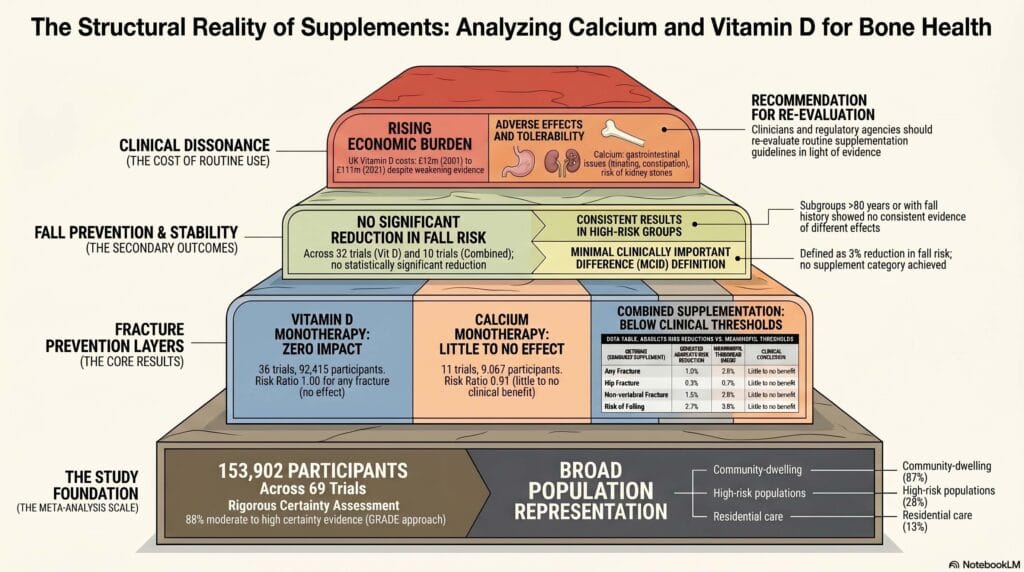
153,902 participants. A systematic review and meta-analysis published in The BMJ in May 2026. Conclusion: calcium and vitamin D or their combination provide little to no clinically significant benefit in preventing fractures and falls in the majority of older people. This is not a scoop – it’s a consolidation. And it forces a re-examination of the question the industry avoids: systematic supplementation, for whom, for what?
The foundational misunderstanding about calcium and vitamin D, and how it has survived for so long
Le Calcium is a major structural component of bone. Vitamin D promotes its absorption in the intestines. These two biological facts are undisputed and recognised by all health authorities. The problem arose from the logical conclusion the market drew from this: if these nutrients are necessary for bone, supplementing them must reduce fractures. This reasoning conflates two distinct levels: physiological necessity and additional clinical benefit. A nutrient can be essential for the body’s functioning without producing a measurable effect when more of it is given to people who are not deficient. This is precisely what the literature has been accumulating for a decade – and what the BMJ 2026 meta-analysis has crystallised.
What the BMJ 2026 meta-analysis shows and what it doesn’t say
Published on 20 May 2026, the review by Mass et al. assesses the effects of calcium alone, vitamin D alone, and their combination on fractures and falls in older adults living in the general population (1). With 153,902 participants, the analysis achieves statistical power that makes the results difficult to dismiss.
The authors introduced an important methodological distinction: they examined not only the statistical significance of the observed effects but also their clinical relevance. An effect can be statistically detectable in a large cohort without altering individual risk to an actionable level. The answer to this dual question is cautious: little to no clinically significant benefit for fractures for calcium and vitamin D – including hip fractures – nor for falls, in the general elderly population studied.
This finding is consistent with the existing body of evidence. A meta-analysis of seven randomised controlled trials involving 71,899 patients, published in 2024 in the Journal of General Internal Medicine, showed no significant reduction in the overall fracture rate with vitamin D alone (RR 1.03; 95% CI 0.93–1.14), and even reported an increased risk of hip fractures in healthy older women (RR 1.34; 95% CI % 1.06–1.70) (2).
What the BMJ meta-analysis doesn’t say: that calcium and vitamin D are useless. It says that mass supplementation in people without a documented deficiency does not produce the preventive effects that market discourse implies.
Three levels not to be confused for calcium and vitamin D
Editorial rigour requires distinguishing what the article calls into question from what it confirms:
| Level | What science says |
|---|---|
| Besoins nutritionnels de base | Indispensable. Calcium and vitamin D are necessary for bone metabolism — a consensus recognised by ANSES, EFSA and WHO |
| Correction of an identified deficit | Relevant. In cases of documented deficiency, low sun exposure, malabsorption, or high bone risk, supplementation remains justified. |
| Systematic supplementation in the general non-deficient population | Low to negligible clinical benefit according to recent literature — it is this third level that the BMJ 2026 meta-analysis calls into question |
Where calcium and vitamin D supplementation retains a real place
The absence of a massive benefit in the general population does not negate the logic of an individualised approach. Supplementation remains relevant in several documented contexts: low dietary intake, insufficient sun exposure (institutionalisation, northern winters, wearing a veil), biologically confirmed vitamin D deficiency, proven osteoporosis, or drug treatment affecting bone metabolism.
The difference in benefit-risk assessment between an institutionalised elderly person with insufficient intake and an independent adult with a balanced diet is substantial. The problem isn’t the product – it’s the uniformity of the recommendation.
What this changes for brands and formulators
- First signal Implied claims such as «supports bone strength» coupled with a promise of fracture prevention become untenable without qualification. Recent evidence does not support a universal benefit — and the EFSA regulatory risk exists for any claim not supported by a solid dossier.
- Second signal Communication about these ingredients would benefit from being repositioned to target audience profiles rather than broad promises. A product formulated for seniors with low sun exposure or documented deficiency risk has a defensible scientific rationale. A product presented as fracture-protective for all women aged 50 and over exposes the brand to increasing criticism.
- Third signal The food matrix is regaining value. Dairy products, calcic mineral waters, green vegetables, and fortified foods cover the needs of the majority of adults without supplementation. For functional ingredient players, the argument «dietary source of bioavailable calcium» is more robust than an isolated supplement in a context of saturation of contradictory evidence.
The topic that comes up in your meeting rooms
This meta-analysis will fuel debates among your clients, in the mainstream media, and likely before European regulatory bodies. The question will not be «should calcium be banned?» but «how to justify your supplementation recommendation?»
Brands that have anticipated this transition – by building targeted arguments for populations with a documented need, rather than a universal promise – will be in a position to explain rather than defend themselves.
Bone health doesn’t depend on a single nutrient in isolation. It relies on a triumvirate: nutritional intake tailored to the individual’s profile, weight-bearing physical activity, and medical management of individual risk. Positioning a supplement as the primary answer to this triumvirate is no longer defensible with an informed buyer.
FAQ
Does the BMJ 2026 meta-analysis mean vitamin D is useless?
No. It means that routine supplementation in older adults without a documented deficiency does not provide a clinically significant benefit regarding fractures and falls. Vitamin D remains essential for bone metabolism, and its correction is justified in cases of proven insufficiency.
Can a calcium ingredient still carry an EFSA bone claim?
Yes, but on specific grounds. The EFSA has authorised claims on calcium in relation to the maintenance of normal bone health – not the prevention of fractures. The distinction is regulatorily and scientifically important.
Why have vitamin D prescriptions risen so much despite mixed evidence?
The inertia of institutional recommendations, ease of prescription, and confusion between biological role and additional clinical benefit. The BMJ 2026 meta-analysis explicitly identifies this discrepancy.
Are the results transferable to European populations?
Given that the population studied is mainly of a community-based, non-institutionalised type, the results a priori apply to elderly adults living at home without treated bone pathology — which covers the vast majority of marketing targets for consumer supplements.
What is the best approach for a formulator working with these ingredients?
Segment. Build arguments by target profile (institutionalised seniors, people with low sun exposure, menopausal women with risk factors) rather than universal communication. Nuance is a scientific and commercial asset.
References
de Souza MM et al. Vitamin D Supplementation and the Incidence of Fractures in the Elderly Healthy Population: A Meta-analysis of Randomized Controlled Trials. J Gen Intern Med. 2024;39(14):2829–2836. DOI: 10.1007/s11606-024-08933-1. PMID: 38997531.
Tan L, He R, Zheng X. Effect of vitamin D, calcium, or combined supplementation on fall prevention: a systematic review and updated network meta-analysis. BMC Geriatrics. 2024. DOI: 10.1186/s12877-024-05009-x. 35 RCTs, 58,937 participants.