


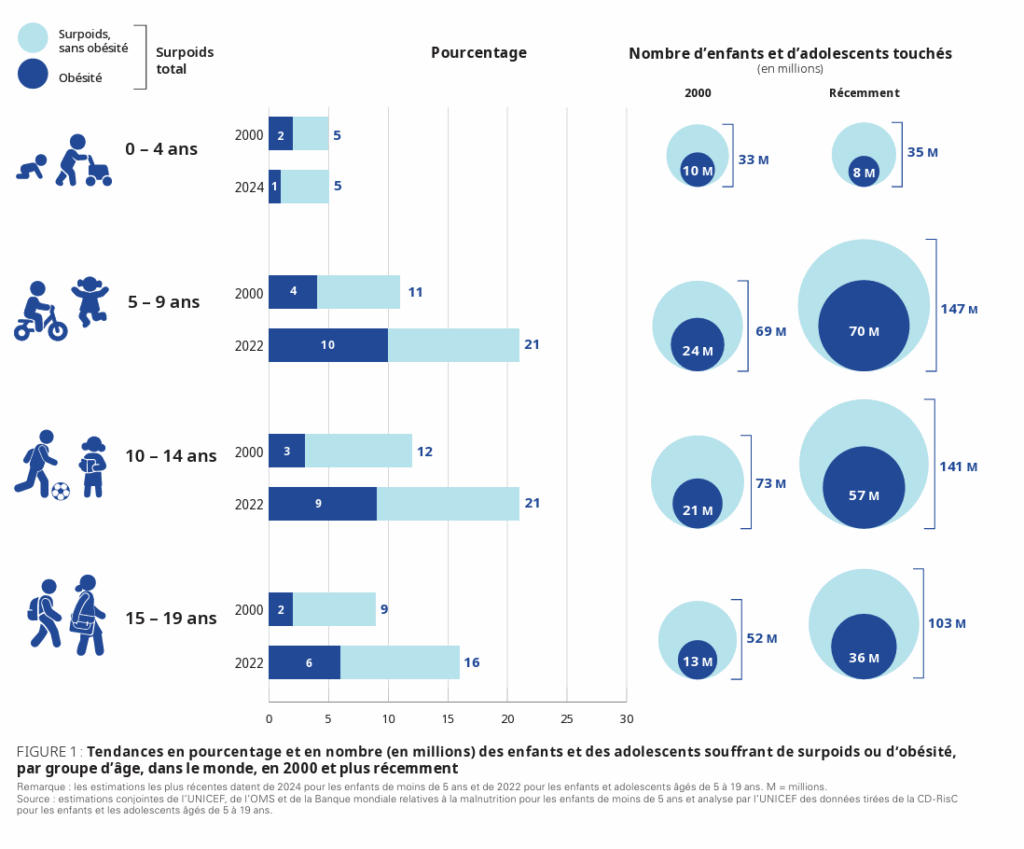
In 2025, for the first time, UNICEF is witnessing a historic shift: obesity now affects more children and adolescents than underweight. Nearly 188 million young people aged between 5 and 19 (9.4 %) are living with obesity, compared with 9.2 % who are underweight. This trend in child obesity marks a major turning point in global malnutrition and highlights the direct impact of food environments dominated by ultra-processed products.
UNICEF video
A silent, fast-growing pandemic
The figures are indisputable. Since 2000, the number of overweight children and adolescents has doubled, from 194 million to 391 million. Of these, 163 million are already obese, representing 42 % of overweight cases, compared with 30 % in 2000. In other words, the increase is not just quantitative, it is also qualitative: obesity is taking a growing share and is harder to reverse.
If we zoom in by region, South Asia illustrates this change: its prevalence of overweight increased fivefold between 2000 and 2022. East Asia and the Pacific, Latin America and the Middle East also show an increase of at least 10 percentage points over two decades. These dynamics reveal a shift in the problem towards low- and middle-income countries, which today bear 81 % of the global burden of overweight (compared with 66 % in 2000).
Striking geographical contrasts
The report highlights extreme disparities. In some Pacific island countries, Child obesity is reaching record levels: 38 % in Niue, 37 % in the Cook Islands and 33 % in Nauru. These rates have doubled since 2000, as a direct result of the abandonment of traditional diets in favour of imported foods that are high in calories but low in nutrients.
In high-income countries, the situation remains worrying 27 % of Chilean children, 21 % of Americans and 21 % of Emiratis are obese. Here, the correlation with poverty is marked: the most modest families are the most exposed to an unbalanced diet, due to a lack of access to affordable fresh produce.
The massive influence of food environments on childhood obesity
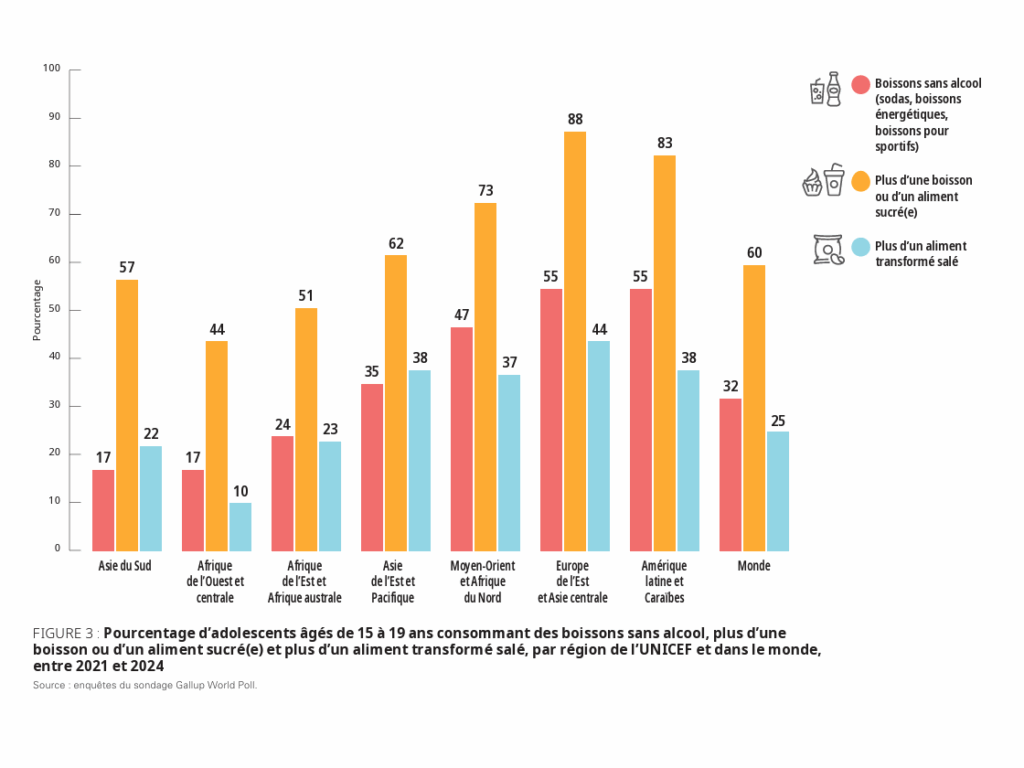
UNICEF insists that children’s food choices are no longer individual but structured by environments dominated by ultra-processed foods. These represent up to 50 % of the energy intake of adolescents in Australia, Canada, the United States and the United Kingdom. In Argentina, Belgium, Chile and Mexico, they already account for more than a third of daily intake.
UNICEF
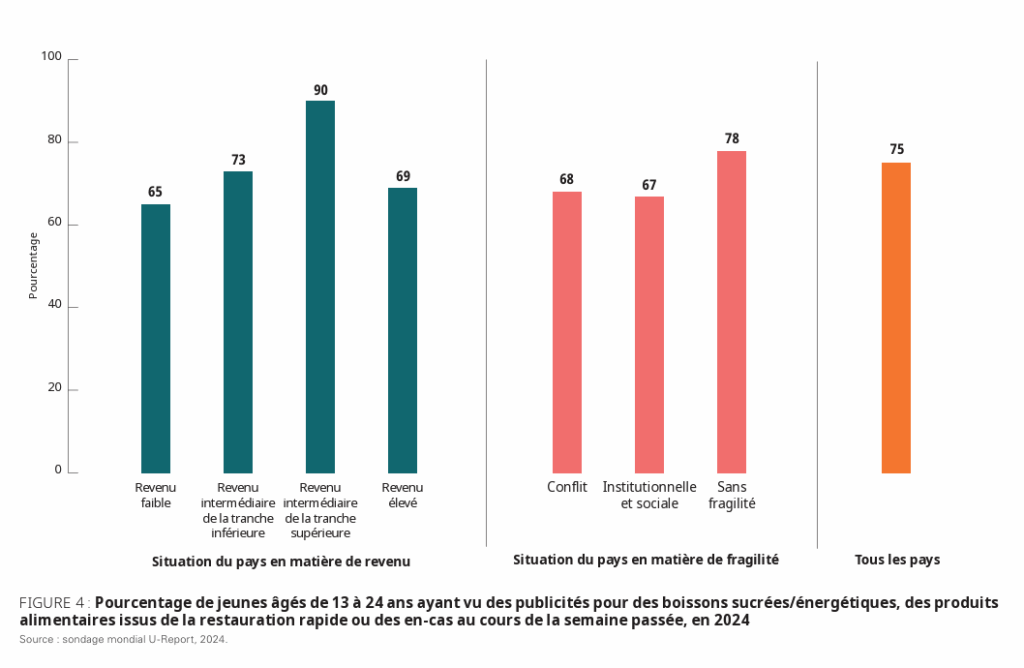
These products, which are often cheaper thanks to agricultural subsidies (maize, wheat, soya), are invading supermarkets, infiltrating schools and benefiting from a marketing targeted advertising. The result: in 2024, 75 % of 13 to 24 year olds surveyed in 171 countries said they had seen adverts for sugary drinks, snacks or fast food in the past week. In upper-middle income countries, this figure rises to 90 %. Even in countries in conflict, 68 % of young people say they are exposed. So marketing doesn’t stop in times of war…
A colossal health and economic cost
Childhood obesity is not just a weight issue. It increases the risk of type 2 diabetes, of cardiovascular diseases and certain cancers in adulthood. In the short term, it also takes its toll on young people’s mental health, with fragile self-esteem, anxiety and depression.
For families, the bill is heavy: increased medical costs, loss of income to care for children. For governments, the costs are staggering: 210 billion dollars in Peru alone, and more than 4,000 billion dollars a year by 2035 worldwide if no action is taken.
Glimmers of hope: the example of Mexico
Some public policies show that it is possible to reverse the trend. In Mexico, where sugary drinks and ultra-processed foods account for 40 % of children’s calorie intake, a law now bans their sale and distribution in state schools. More than 34 million schoolchildren are benefiting from this measure, which is making a tangible improvement to their eating environment.
Countries such as Chile and Brazil have also put in place robust regulatory frameworks, combining clear front-of-pack labelling, soda taxation and marketing restrictions. These systemic approaches are beginning to inspire other regions.
@Unicef Video
UNICEF’s key recommendations on child obesity
The 2025 report proposes eight major avenues for transforming food environments:
-
Applying the International Code of Marketing of Breast-milk Substitutes and strictly supervise the promotion of infant foods.
-
Implementing compulsory and comprehensive measures These include taxation of harmful products, clear labelling, bans on sales in schools and reformulation.
-
Improving the affordability of nutritious food via agricultural subsidies geared towards fresh, local produce.
-
Protecting public policy from industrial interference, with transparency and control of lobbying.
-
Reinforcing social and behavioural campaigns to raise awareness among families and communities.
-
Extending social protection to ensure that the most vulnerable have access to healthy food.
-
Including young people in food policies, by amplifying their voice and their demands.
-
Improving data collection and monitoring to measure progress and adjust actions.
Outlook for players in the food sector
For food companies, this report sends out a clear signal: societal tolerance of the practices of the ultra-processed food industry is being eroded. UNICEF’s recommendations pave the way for increasingly restrictive policies.
But there is also an opportunity: develop and make accessible nutritious, local and affordable alternatives. Players capable of redirecting their R&D, sourcing and communication towards this emerging demand will have a head start in a market where consumers, public authorities and investors are demanding greater responsibility.
Conclusion: a call for collective action against childhood obesity
The 2025 edition of the Child Nutrition Report is a warning. For the first time, obesity is outstripping underweight. The equation is clear: without rapid change, the human and economic cost will be unsustainable. But recent history shows that ambitious measures can work.
And you, in your organisation, have you begun the shift towards healthier eating environments for younger generations?
Reference
To access the report in several languages: https://www.unicef.org/reports/feeding-profit