



The race for attention has become the sinews of war in marketing. And yet we still often use dated indicators - time spent, clicks, impressions - to judge the effectiveness of our content. McKinsey's 2025 report changes all that. It shows that the real value lies not in the quantity of attention, but in its quality. Based on a study of over 7,000 consumers worldwide (including 3,000 in the United States), “The Attention Equation” introduces a predictive model capable of explaining 80 % of monetisation variations between media formats. An enlightening read for any B2B company looking to optimise its marketing investments in a content-saturated environment.
The heart of the model: focus + intention = value
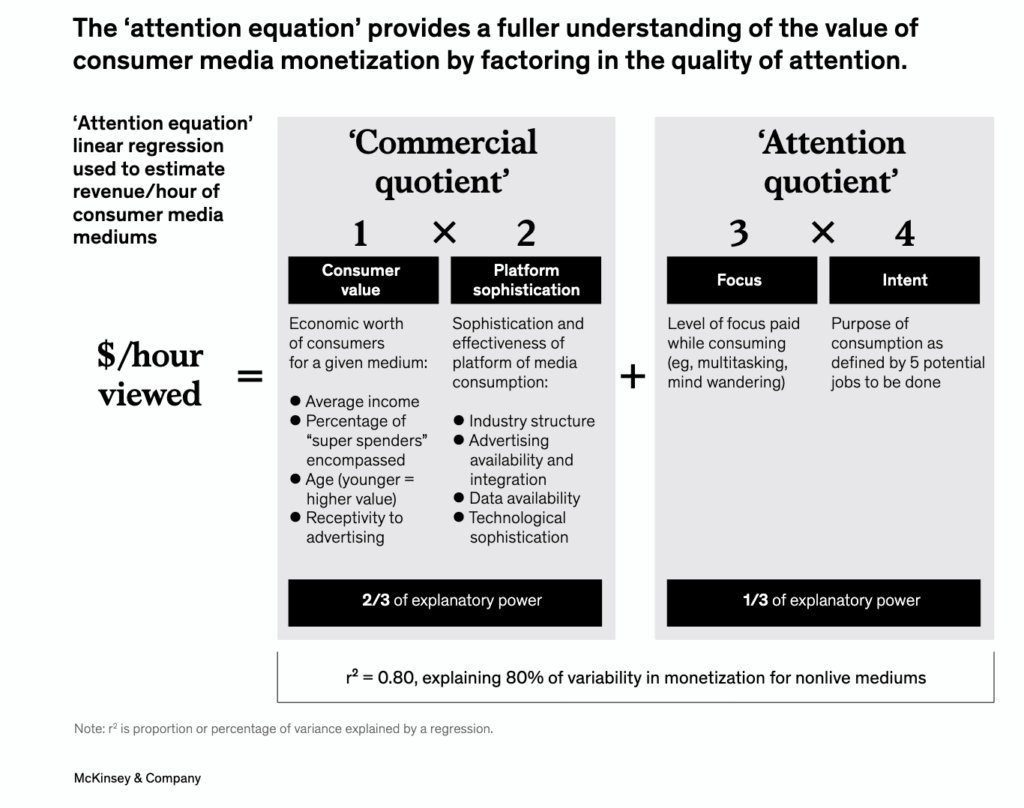
What this diagram says:
The McKinsey equation combines two dimensions: the “commercial quotient” (consumer economic value) and “attention quotient” (quality of attention: focus + intention). Together, they predict up to 80 % of monetisation.
McKinsey defines the quality of attention according to two variables:
- The focus, This is the actual level of concentration a consumer has when consuming content (without distraction or multitasking).
- The “job to be done”, In other words, the consumer's underlying intention (to be entertained, informed, relaxed, etc.).
And the conclusion is clear: the more attentive and motivated a person is, the more likely they are to spend.
For the same amount of consumption time, a person who is focused and involved gives off up to 2x more economic value.
What this study means in concrete terms for marketing
1. Not all your content is created equal: carry out an attention value audit“
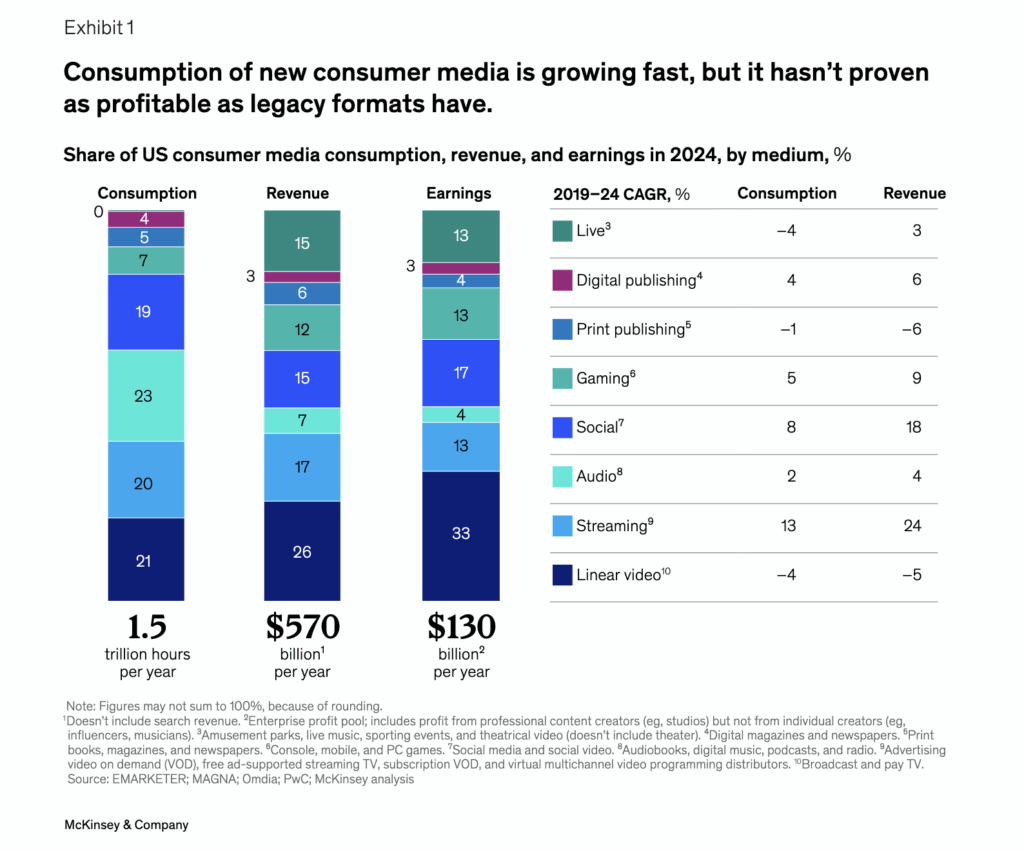
What this diagram says:
Consumption is exploding on digital media (streaming, social, audio), but traditional formats (linear TV, printed press) remain much more profitable. For the same volume, one medium can generate 10 times more value than another.
A podcast listened to in the background does not generate the same value as a webinar viewed actively.
According to McKinsey, the average revenue from a podcast is 0.05 $ per hour, against 17 $ for a live concert or 1.50 $ for a printed book.
RECOMMENDATION :
Make an inventory of your content formats (podcasts, articles, LinkedIn posts, newsletters, trade shows, webinars, etc.) and identify :
- those that generate a high level of active attention (length, immersion, interaction),
- those that respond to a high-value “job to be done” (e.g. “learn”, “get inspired”).
Potential B2B ingredients:
- Well-targeted white papers,
- Long, interactive case studies,
- Themed webinars with Q&A sessions,
- Hybrid formats (event + replay + newsletter + downloadable slides).
2. Measure better: “useful time” is more strategic than “gross reach”.”
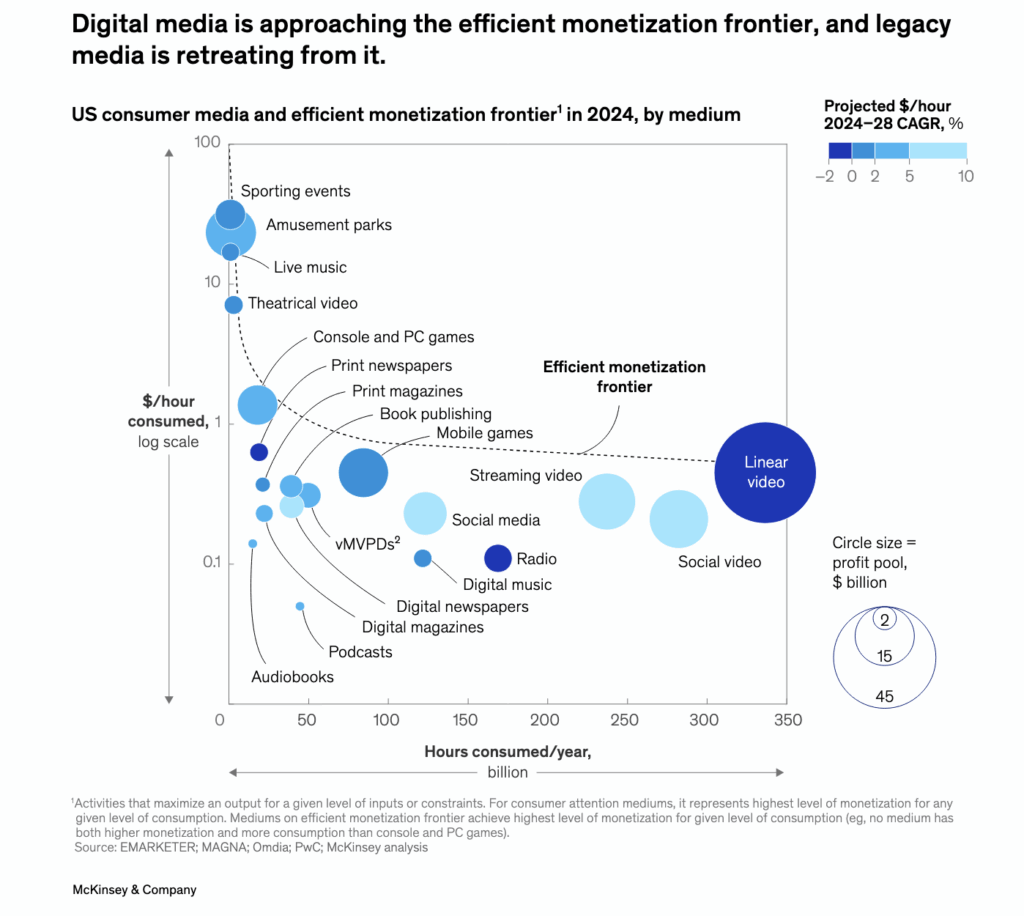
What this diagram says:
The media on the top left (live events, concerts, video games) monetise every hour of attention very effectively. Media on the bottom right (social networks, podcasts) consume a lot of attention... without generating as much revenue.
McKinsey shows that traditional measures (duration, volume, views) are not enough to explain a medium's economic performance.
The best predictors are :
- the actual concentration (e.g. active reading vs. passive scrolling),
- intention to consume (e.g. reading for education vs. for entertainment),
- the capacity of each target segment to transform this attention into action (purchase, subscription, info request).
RECOMMENDATION
- Add attention quality indicators to your dashboards: scroll depth, average reading time, number of rereads, active viewing time, clicks on interactive elements.
- Set up simple surveys: “Why did you read this article?” or “What did you learn?.
3. Know your “high attention segments”: don't target everyone
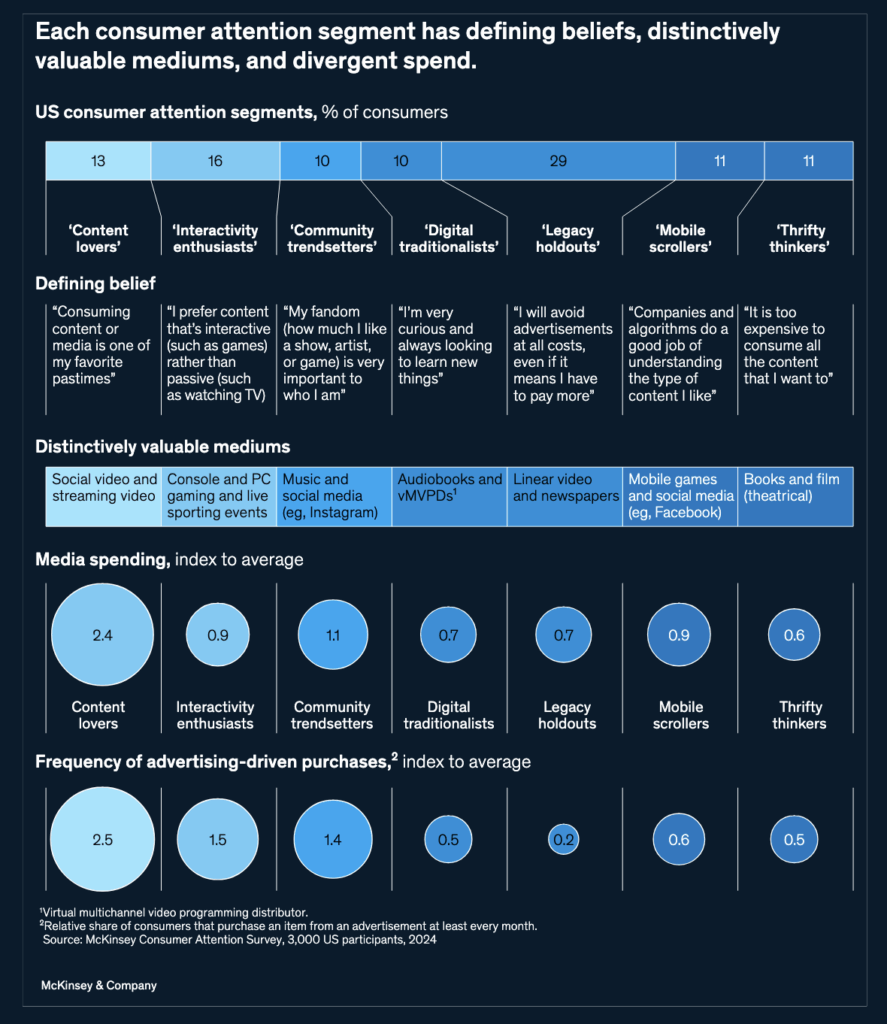
What this diagram says:
The study identifies 3 consumer segments with very high attention value :
- The content lovers (13 %): passionate, multi-media, curious, big consumers.
- The interactivity enthusiasts (16 %): gamers, lovers of challenges, keen on engaging experiences.
- The community trendsetters (10 %): influencers, social influencers, trendsetters.
In B2B, these segments may correspond to :
- R&D or innovation managers who are hungry for new ideas and scientific proof,
- sales people or buyers looking for efficiency,
- marketers who are curious, connected and sensitive to storytelling and immersive formats.
RECOMMENDATION :
- Adapt your content to these profiles: offer interactive, segmented, visual formats with high added value.
- Target them as a priority in your media campaigns, trade shows or LinkedIn publications.
4. Think “perceived usefulness” to increase the value of your content
McKinsey identifies 5 main types of intention (or “jobs to be done”):
- Loving something (passion, loyalty),
- Education/information,
- Creating social links,
- Relaxation/entertainment,
- Creating a background atmosphere (e.g. radio).
RECOMMENDATION :
- Focus on intentions to high perceived value I learn“, ”I get inspired“, ”I discover“.
- Avoid “passive” content (mood videos, podcasts that are too general), which generate little real engagement.
5. Avoid flattering but hollow metrics
The report highlights that :
- the large consumers are not necessarily the best customers,
- only 36 % of the biggest “media consumers” are also in the top “spenders”,
- but 50 % of the “content lovers” in the top 10 % are also top spenders.
RECOMMENDATION :
- Don't be seduced by vanity metrics (followers, views).
- Focus on content and channels that engage people good profiles, even if they are smaller in volume.
An opportunity for the food ingredients sector too
In a B2B sector like ingredients, where decision cycles are long and technical, useful attention is a strategic asset. What this report teaches can help you :
- better prioritise your investments (events, content, channels),
- design content with very high engagement value,
- create a stronger link with your potential customers through the right media, at the right time, with the right intention.
And above all, it encourages you to change your approach: no longer talk to everyone, but to those who can really turn their attention into sales action.
Conclusion: This is not a war for attention. It's about finding your true worth.
Far from the alarmist rhetoric about the fragmentation of attention, the McKinsey report invites us to better understand the dynamics of engagement. It's not about shouting louder, it's about being more relevant.
In a world saturated with content, those who know how to create immersive, targeted and useful experiences will be ahead of the game.
And you, what is your targets' attention really worth?
Source
The Attention Equation - McKinsey & Company (June 2025) - NB: All the diagrams in this article are taken from the McKinsey study.