



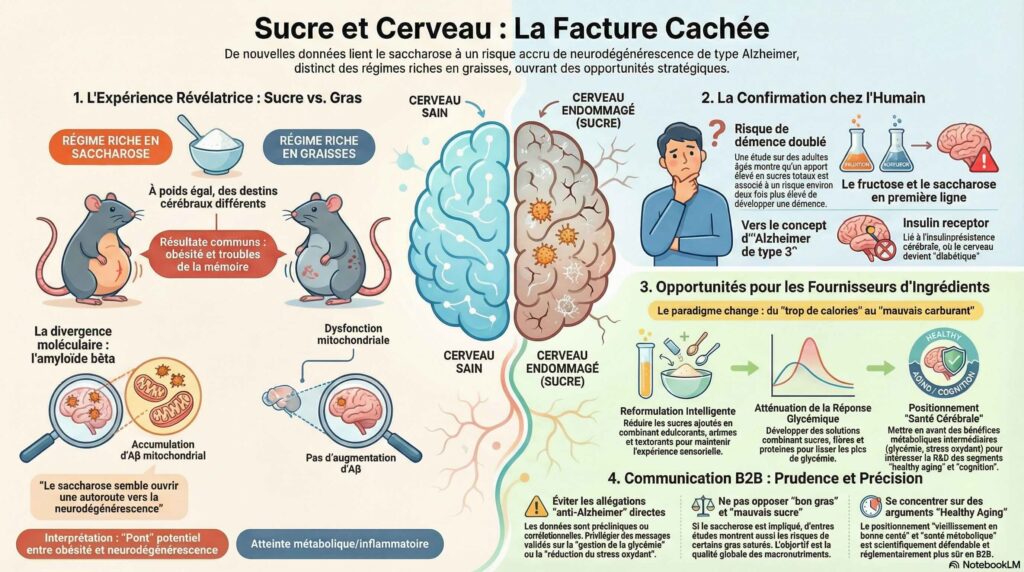
Same weight on the scales, different fate for the brain. This is the counter-intuitive conclusion of a Mexican study comparing two high-calorie diets in rats: sugar versus fat. Both groups put on the same amount of weight and lost the same amount of memory - but only the sucrose group accumulated beta amyloid in their cerebral mitochondria. The molecular signature of Alzheimer's, in short. Fat makes the belt bulge; sugar, on the other hand, seems to open up a direct shortcut to neurodegeneration.
Sugar no longer just attacks the waistline
We thought we had understood the equation: too much sugar = obesity = diabetes = problems. Simple, linear, almost reassuring in its predictability. The latest scientific data complicates this comfortable picture.
A Mexican team compared two high-calorie diets in rats: one rich in sucrose, the other rich in fat. The expected result was that both groups became obese, developed metabolic syndrome and memory problems. The unexpected result: only the «sugar» group accumulated beta amyloid in the brain mitochondria - the pathological signature of Alzheimer's disease.
In other words, for equal obesity, sucrose seems to open up a highway to neurodegeneration that fat does not.
Sugar vs fat: two routes, two cerebral destinations
The researchers fed rats for several months on three different diets: standard, sucrose-enriched or fat-enriched. The two high-calorie diets led to comparable abdominal obesity, a disturbance in carbohydrate metabolism and a measurable decline in spatial memory.
The discrepancy appears at the molecular level. In the hippocampus and cortex of the «sugar» rats, beta amyloid accumulates in the mitochondria - these cellular energy centres become dumping grounds for pathological proteins. The «fat» group? Mitochondrial dysfunction too, but no amyloid.
The authors propose that sucrose creates a specific «bridge» between obesity and neurodegeneration, via oxidative stress and disruption of amyloidogenesis. Fat makes you fat and tires out your metabolism; sugar does the same. more something specifically neurotoxic.
Table - Sugar vs fat: two damage profiles
| Dimension | Sugar-rich diet (sucrose) | High-fat diet |
| Effect on weight | Abdominal obesity and metabolic syndrome | Comparable abdominal obesity |
| Spatial memory (rats) | Significant decline | Similar decline |
| Oxidative stress / mitochondria | Dysfunction + accumulation of Aβ | Dysfunction without excess Aβ |
| Alzheimer's type markers | High mitochondrial Aβ (hippocampus, cortex) | No increase in Aβ |
| Interpretation | «Potential »bridge" between obesity and neurodegeneration | Metabolic/inflammatory disease |
Human cohorts confirm the signal
The animal data are not isolated. A study of older adults shows that a high intake of total sugars is associated with an approximately doubled risk of developing dementia during follow-up - independently of APOE ε4 status, physical activity or the overall quality of the diet.
In analyses by type of sugar, participants in the highest quintile of fructose and sucrose consumption presented a significant excess risk compared with the lowest quintile. Another study focusing on women suggests a particular vulnerability of the female brain to excess sugars - consistent with observations on other metabolic pathologies.
These human data reinforce the concept of 'Alzheimer's type 3″ : a form of neurodegeneration linked to cerebral insulin resistance, where the brain literally becomes «diabetic» even before peripheral blood sugar levels go off the rails.
What this means for ingredient suppliers
The scientific narrative is shifting. We are no longer just talking about «too many calories» but about «too many calories".« bad fuel for the brain« . For suppliers of sweetening ingredients, this development creates additional pressure - but also opportunities for differentiation.
- Intelligent reformulation. Reducing added sugars and free sugars while maintaining the sensory experience. Solutions combining high-purity sweeteners, flavourings and texturisers are becoming strategic.
- Reduced glycaemic response. Sugar/fibre/protein combinations capable of smoothing blood sugar peaks and, potentially, the metabolic drifts associated with fast sugars.
- Brain health« positioning. Within regulatory limits, promote intermediate metabolic benefits (glycaemia, insulin sensitivity, oxidative stress) that are of interest to industrial R&D customers in the healthy ageing and cognition segments.
R&D: three concrete levers for sweetening portfolios
Exploring alternatives to sucrose/fructose. Slow-release sugars, targeted polyols, new-generation intense sweeteners, rare sugars. The criterion is no longer simply «less sweet» but «less glycaemic, less pro-oxidant».
Working with matrices. Soluble fibres, proteins and structured lipids that modulate absorption kinetics. The aim is to transform a «fast» sugar into a «slow» sugar by means of a matrix effect.
FAQ: Sugar, the brain and dementia
Can we talk about «neurotoxic sugars» in B2B? With caution. Animal models show sucrose-specific Alzheimer's-type lesions, and human cohorts confirm the association between sugars and dementia. But these are correlations and preclinical data - not definitive causal evidence. Stick to metabolic messages («managing blood sugar», «reducing oxidative stress») rather than anti-Alzheimer's claims.
Are fats «less dangerous» for the brain? In this study, yes - fat does not induce the accumulation of amyloid observed with sugar. But other studies show that certain lipid profiles (saturated fats in particular) are also associated with cognitive decline. It's not a question of pitting «good fat» against «bad sugar», but of working on the overall quality of macronutrients.
Should «dementia» be included in health arguments? In B2B, the «healthy aging» and «metabolic health» positioning is defensible, based on the literature linking carbohydrate load and insulin resistance. Explicit claims to reduce the risk of Alzheimer's disease still need to be confirmed by interventional clinical trials before they are tenable in regulatory terms.
Which ingredients are the most promising? Sweeteners enabling a sharp reduction in added sugars, progressive sugar-stepping solutions, fibre/protein combinations to reduce glycaemic load. Dossiers that include advanced metabolic markers will be the most convincing to major clients.
In a nutshell
References
- High-sugar diets may mimic Alzheimer's pathology more closely than high-fat diets, PsyPost, 2025. PsyPost
- Sucrose-rich diet and mitochondrial amyloid-beta accumulation, PubMed, 2025. PubMed
- Sugar intake and incident dementia in older adults, Journal of Alzheimer's Disease, 2023. SAGE Journals
- Dietary sugar and cognitive decline, PMC, 2024. PMC