


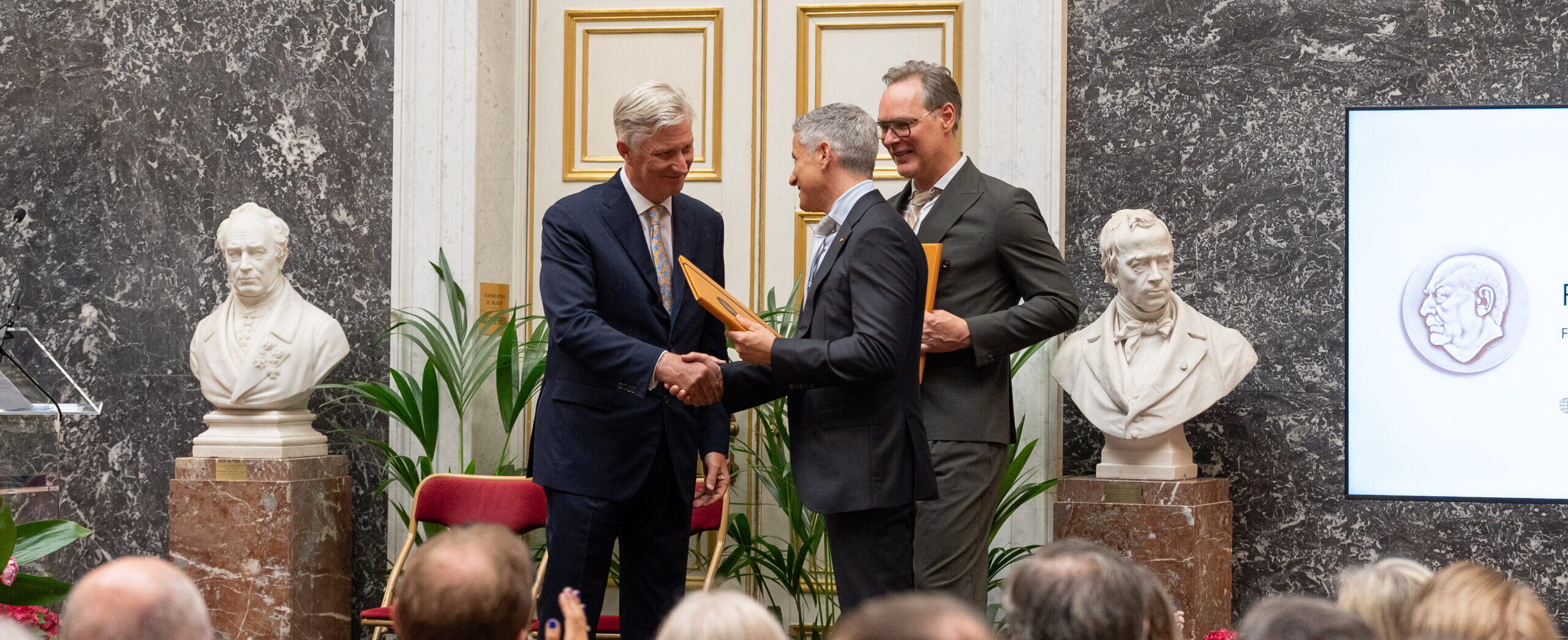
There are researchers whose work goes beyond the academic sphere to enter, discreetly but lastingly, into our understanding of health. Patrice Cani belongs to this rare category. By receiving the Francqui-Collen Prize 2026, often described as the «Belgian Nobel Prize», the UCLouvain professor sees his scientific work, which has profoundly transformed our perspective on the gut microbiota, metabolism, and modern chronic diseases, recognised.
This award not only honours a brilliant career. It rewards a vision: that of a scientist who understood very early on that the bacteria in our gut are not simply invisible companions, but decisive players in our metabolic balance, our immunity and, more broadly, our long-term health.
It also rewards a true friend who, much like his research, never gives up, remains grounded despite honours, and dedicates his intelligence and kindness to others, with a generosity, humility, and simplicity that command respect.
A Belgian Nobel for twenty years of pioneering
Le Francqui-Collen Prize 2026 comes to greet nearly twenty years of research at the border between microbiota intestinal health, nutrition and metabolic diseases. Patrice Cani is a professor of physiology, metabolism and nutrition at UCLouvain. He is also Honorary Research Director at FRS-FNRS-WELBIO and has for several years been ranked among the top 1% most cited researchers in the world according to Clarivate.
This career demonstrates a rare consistency: from the outset, his research programme has focused on the intimate interaction between our diet, our gut bacteria and serious pathologies such as obesity, type 2 diabetes, cardiovascular diseases and certain cancers. At a time when the microbiome was still an emerging field, he gambled on this subject with a perseverance that is paying off today.
When the microbiome becomes a therapeutic lever
One of the great strengths of Patrice Cani's work lies in his ability to make the microbiota a genuine lever for action, and not just an object of study. His research has played a major role in highlighting the bacterium Akkermansia muciniphila, henceforth considered a key player in metabolic health and the gut barrier.
More recently, his team helped to identify Dysosmobacter welbionis, a bacterium associated with beneficial effects on glucose metabolism, inflammation, and even certain cancer-related processes in preclinical models. These findings pave the way for next-generation nutritional or probiotic approaches, potentially capable of altering the course of highly prevalent metabolic and cardiometabolic diseases.
Connecting laboratory, clinic, and public health
Beyond isolated discoveries, what is striking about Patrice Cani's career is his ability to link fundamental biology, preclinical studies, and early clinical trials. His work illustrates translational science, where one starts with the intimate mechanisms studied in mice to question what they concretely mean for human health.
This integrated approach allows us to address very current issues: how does diet change our microbiota? How do these changes translate into risks or protection against obesity, type 2 diabetes, cardiovascular diseases, or certain cancers, such as breast cancer? Underlying this is a clear ambition: to put science at the service of more targeted, more personalised, more effective prevention strategies.
An inspiring figure for nutrition and biotech
For players in nutrition, ingredients, biotech, or food-tech, Patrice Cani's work is more than an academic subject: it outlines a roadmap. It shows that it is possible to design food solutions and ingredients that truly interact with the microbiota, based on identified bacterial targets and solidly documented mechanisms.
This «Belgian Nobel» also recognises a particularly dynamic Belgian scientific ecosystem, capable of generating innovations with high potential for commercialisation in the sectors of probiotics, postbiotics, medical nutrition, or personalised prevention. Through the recognition of Patrice Cani, it is an entire vision of R&D in nutrition and health that gains legitimacy.
Why his work will count more and more
As metabolic diseases continue to spread worldwide, the scientific programme led by Patrice Cani is reaching a crucial turning point. The idea that finely modulating the microbiome – through diet, targeted ingredients, or solutions derived from beneficial bacteria – can reduce cardiometabolic risk or improve the response to certain oncological treatments is no longer science fiction.
This perspective feeds a form of lucid optimism: no, we do not control everything, but yes, we have powerful levers in the very heart of our gut. It is this promise, both scientific and profoundly human, that the Francqui-Collen Prize 2026 recognises. And it is also what makes Patrice Cani a name to follow very closely for all those in the industry looking to reconcile innovation, nutrition, and real health impact.
FAQ — Patrice Cani, the Francqui Prize and the microbiota
Who is Professor Patrice Cani?
Patrice Cani is a professor of physiology, metabolism and nutrition at UCLouvain, a researcher at WELBIO and an Honorary Research Director at the FRS-FNRS. He ranks among the top 1% most-cited researchers in the world, with over 390 scientific publications and an h-index of over 100.
What is the Francqui-Collen Prize?
The Francqui-Collen Prize is one of Belgium's highest scientific honours, often described as a «Belgian Nobel». It recognises frontline research work, in this case in biomedical sciences, and was awarded in 2026 to Patrice Cani (UCLouvain) and Diether Lambrechts (KU Leuven/VIB).
What does Patrice Cani's research consist of?
His work focuses on the interactions between the gut microbiota, nutrition and metabolic diseases such as obesity, type 2 diabetes, cardiometabolic disorders and certain cancers. He studies how gut bacteria influence metabolism, inflammation and the body's response.
Why the bacterium Akkermansia muciniphila Is it important?
Akkermansia muciniphila is one of the signature bacteria studied by Patrice Cani's team, associated with a better intestinal barrier and a more favourable metabolic profile. It is now considered a promising avenue for the development of nutritional interventions or probiotic/postbiotic products with a metabolic aim.
What is Dysosmobacter welbionis ?
This is a bacterium recently identified by Patrice Cani's group, with potential effects on glucose metabolism, inflammation, and certain cancer-related mechanisms in experimental models. This discovery illustrates the emergence of new microbiota-derived targets for prevention and, ultimately, for innovative therapeutic approaches.
What is the impact on the ingredients and nutrition industry?
Patrice Cani's work provides a solid scientific foundation for designing ingredients, supplements, food formulations, or nutritional solutions that modulate the microbiota in a targeted way. It reinforces the legitimacy of microbiota-based approaches in the prevention of obesity, diabetes, and other cardiometabolic diseases.