


Three portions of chips a week increase the risk of type 2 diabetes by 20%. The same amount of potatoes, whether boiled, baked or mashed: no measurable effect. It is not the tuber itself that is the problem, but what we subject it to at high temperatures. For the food industry, catering and clinical nutrition, this distinction is no longer a matter of opinion. It is backed by the world’s largest cohorts. Admittedly, the study dates from 2025, but it is so hard to resist chips that I wanted to take a serious look at the issue for once.
The potato isn't the problem, the frying is
For decades, the potato has worn the hat: it makes you fat, it must be avoided, whatever its form, etc. Recent data is overturning the verdict: the risk factor is the cooking method, not the vegetable. The nuance changes everything for those who formulate, cook, or advise. Nothing surprising, you might say? For the first time, a study establishes (almost) a causal link with a chronic disease.
The benchmark on the subject was published in the BMJ in August 2025, authored by a team from the Harvard T.H. Chan School of Public Health. Three American cohorts of caregivers feed into it: the Nurses’ Health Study (1984-2020), the Nurses’ Health Study II (1991-2021) and the Health Professionals Follow-up Study (1986-2018). In total, 205,107 participants free from diabetes, cardiovascular disease and cancer at the start, with dietary questionnaires updated every four years, more than 5.1 million person-years of follow-up. Over this period, 22,299 cases of type 2 diabetes were documented.
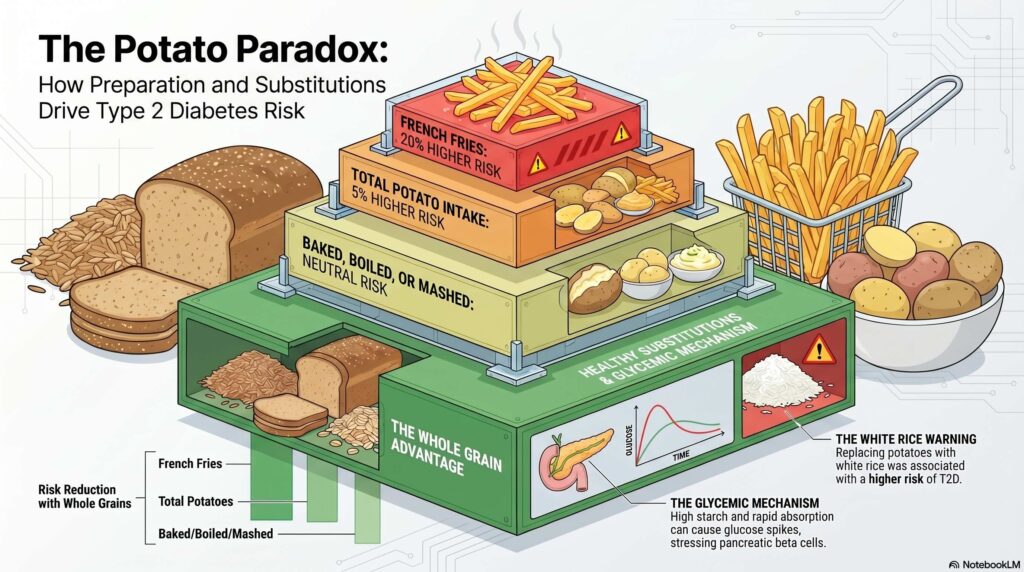
Overall, potato consumption increases the risk by just 5% for every three portions consumed per week (HR 1.05; 95% CI: 1.02–1.08). However, this average masks two contrasting realities. French fries alone are associated with a 20% increase in Q3 (HR 1.20; 95% CI for Q3: 1.12–1.28). Boiled, baked or mashed potatoes show no significant association (HR 1.01; 95% CI: 0.98–1.05). The risk does not lie in the potato itself. It lies in frying.
The authors incorporated these data into a dose-response meta-analysis of thirteen prospective cohorts, comprising 587,081 participants and 43,471 cases of diabetes. The finding holds true: each additional three portions of chips per week remains associated with a 16% increased risk (HR 1.16; 95% CI: 1.09–1.23).
Finally, the study measures the effects of substitution: replacing three weekly portions of chips with whole grains reduces the risk by 19 %. Replacing all potatoes with whole grains: 8 % less. However, replacing them with white rice increases the risk. The overall carbohydrate quality of the diet matters just as much as cutting out a food.
Mechanisms: acrylamide, AGEs and inflammation
A review published in Foods in September 2025 describes the combined effects of acrylamide and advanced glycation end products (AGEs) formed during high-temperature frying. The Maillard reaction, triggered above 120 °C, simultaneously generates acrylamide (classified 2A, probable human carcinogen by the IARC) and AGEs. These molecules are associated with neurotoxicity, insulin resistance, chronic inflammation and accelerated ageing. Their effects are amplified: acrylamide lowers glutathione, the first line of antioxidant defence, which enhances the ability of AGEs to activate inflammatory pathways via RAGE receptors.
A clarification is needed. A study published in Scientific Reports in April 2025 measured blood and saliva biomarkers in 107 students according to their dietary intake of acrylamide. It found no significant association between acrylamide intake and markers of oxidative stress. Research is advancing; public communication must remain cautious.
Cardiovascular disease and carcinogenesis: a wider spectrum
In May 2026, the European Society of Cardiology published a clinical consensus in the European Heart Journal, synthesising ten years of research on ultra-processed foods (UPF), a category to which industrially produced chips belong. Adults who consume the highest amounts of UPF have up to a 19% increased risk of heart disease, a 13% increased risk of atrial fibrillation (HR 1.13; 95% CI: 1.02–1.24) and up to a 65% increased risk of cardiovascular death.
With regard to cancer, a prospective study published in JAMA Oncology in January 2026 (the Nurses’ Health Study II cohort, 29,105 women, 24 years’ follow-up) found that the heaviest consumers of UPFs had a 45% higher risk of early conventional colorectal adenomas, occurring before the age of 50 (AOR 1.45; 95% CI: 1.19–1.77).
Three operational areas emerge.
- Cooking method. Alternatives to deep frying (steaming, oven, pulsed electric field) reduce the formation of acrylamide and AGEs. Incorporating natural antioxidants and polyphenols helps counteract the Maillard reaction. Note: the air fryer reduces oil, not necessarily acrylamide. It's the temperature and final colour (aim for light golden) that drive the reduction, regardless of the method.
- Carbohydrate quality. The BMJ study shows that the risk is not unifactorial: the nature of the substitute carbohydrates is as important as foregoing chips. Whole grains emerge as the most protective alternative.
- Communication. In a demanding European regulatory framework (Nutri-Score, nutrition claims), differentiating chips from other potato cooking methods is a lever for responsible communication. Promoting cooking methods, displaying a controlled temperature or an acrylamide content below EFSA reference thresholds can become a competitive advantage.
The art of cooking the potato
Between August 2025 and May 2026, publications converge: the chip, as a product of high-temperature deep frying, concentrates multiple health risks (type 2 diabetes, cardiovascular disease, early precancerous lesions, chronic inflammation). The tuber itself is not to blame. The molecular transformations from frying are: acrylamide, AGEs, degradation of the lipid profile.
The real question for your teams is not to ban the potato. It is knowing what cooking method and what accompaniment you specify in your tender documents, and if you can prove it by measurement. Where are you with your latest acrylamide audit?
Sources
- Mousavi SM, Gu X, Imamura F, et al. Total and specific potato intake and risk of type 2 diabetes: results from three US cohort studies and a substitution meta-analysis of prospective cohorts. BMJ. 2025;390:e082121. DOI 10.1136/bmj-2024-082121.
- Rasool A, Luo X, Zhang Q, et al. Acrylamide and Advanced Glycation End Products in Frying Food: Formation, Effects, and Harmfulness. Foods. 2025;14(19):3313. DOI 10.3390/foods14193313.
- Čebeková K, Hodosy J, Celec P, et al. Association of acrylamide dietary intake with glycation and oxidative status biomarkers. Scientific Reports. 2025;15:14881. DOI 10.1038/s41598-025-98285-5.
- Guasti L, Bonaccio M, Abreu A, et al. Ultra-processed foods, lifestyle management, and cardiovascular diseases: a clinical consensus statement of the ESC. European Heart Journal. 2026;ehag226. DOI 10.1093/eurheartj/ehag226.
- Wang C, Du M, Kim H, et al. Ultraprocessed Food Consumption and Risk of Early-Onset Colorectal Cancer Precursors Among Women. JAMA Oncology. 2026;12(1):49-57. DOI 10.1001/jamaoncol.2025.4777.
- Ibsen DB, Zhang Y. Potatoes and risk of type 2 diabetes (editorial). BMJ. 2025;390:r1557. DOI 10.1136/bmj.r1557.
- Navruz-Varli S, Mortas H. Acrylamide formation in air-fried versus deep and oven-fried potatoes. Frontiers in Nutrition. 2024;10:1297069. DOI 10.3389/fnut.2023.1297069.
FAQ : Questions fréquentes
Are chips actually more dangerous than other potatoes?
Yes, according to current data. The Harvard-BMJ study (2025) involving over 205,000 people shows that three portions of chips per week increase the risk of type 2 diabetes by 20%[1], whereas the same amount of boiled, baked or mashed potatoes shows no significant increase [1]. The difference lies in the molecular changes caused by deep-frying at high temperatures.
What is acrylamide and where is it found in chips?
Acrylamide is a compound formed during the Maillard reaction when starchy foods are heated above 120°C. The IARC classifies it as 2A, a probable human carcinogen [2]. Levels vary significantly depending on the raw material, temperature, and cooking time. Fries are among the foods with the highest levels of acrylamide in the common diet, alongside crisps. [Precise numerical values to be verified with EFSA data before publication of a figure.]
Can risks be reduced with an air fryer?
Not automatically. A study published in Frontiers in Nutrition (2024) even measured a slightly higher acrylamide content in the air fryer than in deep-frying (12.19 vs 8.94 µg/kg), but on only 24 samples and with no statistically significant difference [7]; a published commentary has since questioned the reliability of these measurements. Other work finds the air fryer to be lower. To remember: the air fryer reduces oil, not necessarily acrylamide. It is the temperature and the final colour (aim for light golden) which drive the reduction, regardless of the method. In this study, oven baking generated the least acrylamide.
Do these risks also apply to industrial frozen chips?
Yes. Frozen fries often undergo a double cooking process (pre-frying at the factory, then final frying) which amplifies the formation of acrylamide and AGEs. They also fall under the category of ultra-processed foods, a category directly associated with cardiovascular and carcinogenic risks identified by the ESC (2026) and JAMA Oncology (2026) [4,5]. Reformulation with high thermal stability oils and acrylamide-reducing treatments is a lever for improvement.
What quantity of chips can be consumed without major risk?
There is no clearly established risk threshold: the association increases with consumption frequency [1]. Current data suggest that chips should be reserved for occasional consumption, and that aqueous cooking methods (steaming, boiling) or low-temperature dry cooking should be preferred. This recommendation applies to consumers and institutional menus alike.
Which ingredients or additives reduce the formation of acrylamide?
Several approaches are documented. Asparaginase (an enzyme) hydrolyses asparagine, a key precursor in the Maillard reaction. Polyphenols (rosemary extract, green tea catechins) and antioxidants inhibit the reaction. Soaking potatoes before cooking reduces the content of reducing sugars. Finally, controlling frying temperature (not exceeding 175°C) and aiming for a light golden colour remain simple measures to include in specifications.