



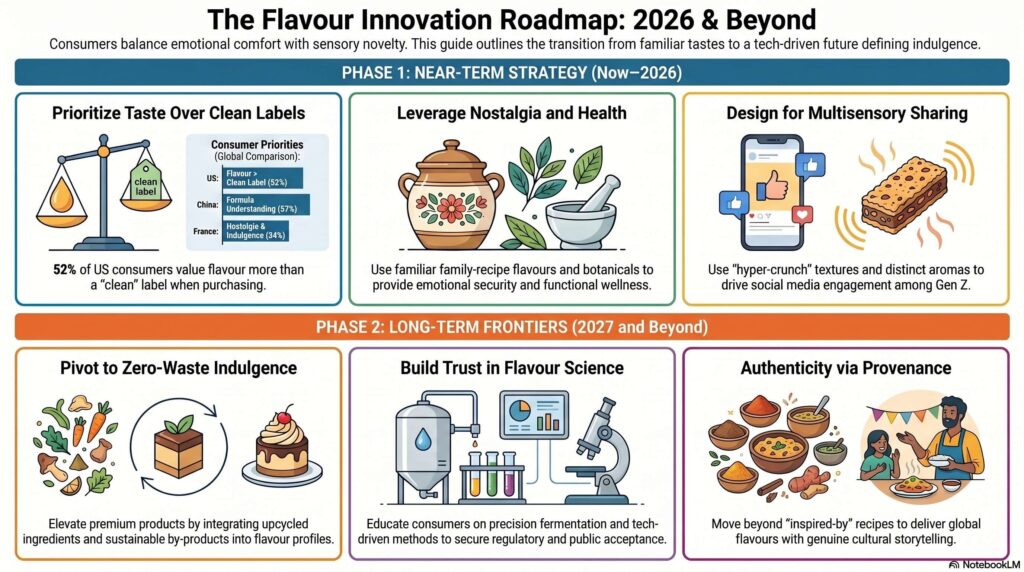
52% of US consumers consider taste to be more important than a product’s ‘clean label’ status (Mintel, The Future of Flavours 2026).
Clean label has won. And after?
For ten years, remove a additive Controversial was enough to differentiate. This time dedicated to clean label is over. The «free-from» promise has become so widespread it's almost invisible: when the entire shelf displays a short ingredient list, a short ingredient list no longer sells anything. It qualifies, it doesn't convert.
The problem is that reformulating towards natural almost always opens up a sensory gap. A synthetic aroma holds up better to heat, preservation and cost than its natural equivalent. Replacing it without preparation risks a product that's cleaner on the label and less pleasant in the mouth.
Mintel summarises the tension of a formula that should be displayed in every R&D department: «Everything is chemicals, but consumers need reassurance.». Everything is chemistry; the consumer doesn't ask for the absence of molecules, they ask to be reassured. A decisive nuance.
Transparency does not mean giving up.
Consumers are reading labels more than ever before. In China, 57% of shoppers believe it is necessary to understand the formula and ingredients of a health product in detail (Mintel, The Future of Flavours 2026However, scrutinising a list doesn't mean accepting a bland product. The two requirements coexist: understanding what we're eating (clean label is therefore a necessity), and wanting it to taste good.
This is where the flavourings sector is undergoing a fundamental shift, moving away from synthetic ingredients towards naturally derived ones. The shift is real; it is not straightforward. Mintel identifies two major obstacles: explaining increasingly complex technologies to the general public, and securing regulatory approval across different jurisdictions. The difficulty is therefore no longer technical. It is educational and regulatory.
Three ways to tie the two ends
Mintel points to three levers for delivering naturalness without sacrificing sensory profile:
- La precision fermentation, which produces aromatic compounds targeted via microbial pathways rather than petrochemical synthesis.
- The botanical origin, which transforms the plant origin of an extract into proof of naturalness and a narrative.
- Upcycling, which draws aromas from hitherto lost co-products, aligning taste and sustainability.
A concrete example. French plant extract specialist Plantex has launched SmokEXTRACT, a natural alternative to traditional smoke flavourings. The process recreates the smoky profile without PAHs by combining heated wood extracts with complementary ingredients. The result delivers the base notes and sensations expected of a smoked product, without the undesirable compounds. Here, naturalness becomes a sensory and health benefit, not a compromise.
What it means for your wallet
For an ingredient supplier, the hierarchy is becoming clearer. Clean label is a prerequisite; without it, you're not even in the running. With it alone, you won't be chosen. Differentiation is achieved one step further, based on two capabilities:
- Bridge the taste gap that natural reformulation creates for your customer.
- Provide the narrative that allows its brand to transform a label constraint into a desirable argument.
The supplier who sells natural commodifies. The one who sells natural, which tastes better than what it replaces, with the story to prove it, sets their price. This is the difference between an ingredient and a solution.
The real question, therefore, is not whether your latest ingredient is clean. The whole market is. It's about what sensory gap your latest natural reformulation has filled in the finished product, or widened. Did you measure this gap before shipping it to the customer?
FAQ
Has clean label become an unnecessary selling point?
No. It remains indispensable, but its status has changed. It qualifies you to enter the shop floor; it is no longer enough to trigger a purchase. Without it, you're off the short-list; with only it, you won't be the winner.
Do we have to choose between naturalness and flavour?
The three levers described – precision fermentation, botanical provenance, and upcycling – show that it's possible to achieve both. The question isn't technical, but budgetary: how much are you investing in sensory R&D to bridge the gap, rather than accepting it?
Are these figures for the European market?
To be treated with caution. The percentages cited are taken from American and Chinese surveys; the only French data in the Mintel summary relates to nostalgia (34 %). Treat the «taste before label» hierarchy as a strong directional indicator, not as a measure that can be applied directly. Validate this on your own European panels before using it as a sales pitch.
Find out all the details in this video
Sources
- Mintel. The Future of Flavours 2026 — summary. Mintel Group Ltd, 2026.
- Mintel. Data for the United States (52-week rolling period), taste takes precedence over clean labelling. Sample: 2,000 internet users aged 18 and over. Mintel survey waves 2024–2025, cited in [1].
- Mintel. Data for China (Q3 2023), requires an understanding of the methodology. Sample: 3,000 internet users aged 18–59. Mintel survey waves 2024–2025, cited in [1].