



40% of American adults are obese. Cardiovascular disease remains the leading cause of death worldwide. And the American Heart Association (AHA) has just updated its dietary recommendations for the first time since 2021 — with direct implications for the B2B ingredients industry.
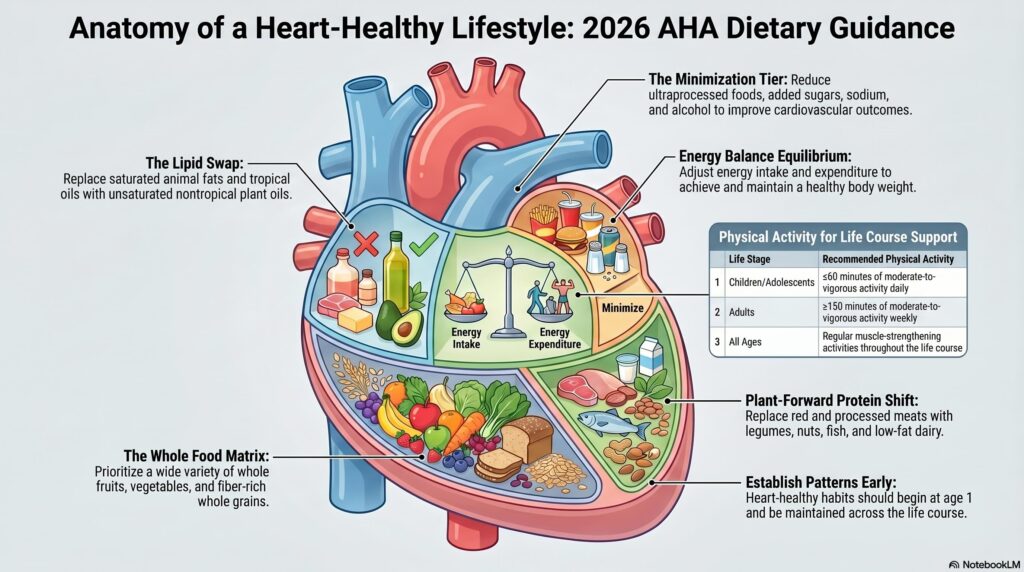
Published on May 5, 2026, in Circulation, the new AHA Scientific Statement (Lichtenstein et al., 2026) outlines nine dietary priorities for reducing Cardiovascular risk. It is not a revolution. It's a scientific consolidation with some notable turns — notably on alcohol, dairy fats and ultra-processed foods — which are reshaping market spaces for formulators and ingredient suppliers.
What the 9 recommendations say and what they don't say
The document replaces the 2021 Statement and is aimed at the entire adult population, including individuals with established cardiovascular risk. It promotes a dietary pattern approach – meaning overall diet – rather than focusing on isolated nutrients. This is the first strong signal for the sector: single-ingredient product claims carry less scientific weight.
The nine AHA 2026 features in summary
| Recommendation | Ingredient prompt | |
| 1 | Energy balance for maintaining a healthy weight | Filling ingredients, fibre, vegetable protein |
| 2 | Abundance of vegetables and fruits, in variety | Concentrates, powders, FOS/vegetable prebiotics |
| 3 | Wholegrains rather than refined ones | Wholemeal |
| 4 | Healthy sources of protein (plant-based preferred) | Legumes, oilseeds, fish, low-fat dairy products |
| 5 | Unsaturated fats instead of saturated fats | Non-tropical vegetable oils (rapeseed, soya, olive) |
| 6 | Minimally processed foods versus ultra-processed foods (UPF) | Clean label ingredients, natural texturisers, additive reducers |
| 7 | Added sugars minimised | Natural alternatives, fermentable fibres, polyols |
| 8 | Low sodium, potassium favoured | Salt substitutes (KCl), sodium-free flavour enhancers |
| 9 | Alcohol: do not start, limit if already consumed | No product opportunity here — firm stance from the AHA |
The inflections to remember
- On the UPFs Feature 6 is the most structuring for the industry. The Statement explicitly cites the NOVA classification and the evidence base linking ultra-processed foods to obesity, cardiovascular disease, type 2 diabetes, and all-cause mortality. The AHA does not define UPFs by their nutritional profile but by the degree of industrial processing and the presence of «cosmetic» additives. This is a clear regulatory signal: «healthier» reformulation claims must target the food matrix, not just a nutrient.
- On dairy fats The stance remains cautious but nuanced. The AHA maintains its recommendation to favour low-fat or skimmed dairy products, while acknowledging that evidence on butter/dairy fat substitution remains limited. The avenue of fermented milks (yogurt, kefir) as a potential source of cardiovascular benefits via the microbiota is mentioned — without a definitive clinical conclusion.
- About alcohol The stance is hardening. Randomisation studies have not confirmed the cardiovascular protective effect of moderate consumption. The 2025 AHA/ACC blood pressure guideline now recommends avoiding alcohol to prevent or treat hypertension. Unambiguous position: do not start, reduce if existing consumption.
- Regarding salt substitutes Feature 8 explicitly introduces potassium-enriched salt substitutes as a lever for action – with a caveat regarding the theoretical risk of hyperkalaemia for populations with reduced urinary potassium excretion. This is a growing ingredient innovation space, but one that requires population profiling.
What this changes for your R&D and your B2B marketing
- Cereal fibres and whole grains The statement confirms the association between regular consumption of whole grains and a reduced risk of cardiovascular disease, coronary heart disease, stroke, type 2 diabetes, and metabolic syndrome. Randomised controlled trials show that replacing refined grains with whole grains improves cardiovascular risk factors. For suppliers of oats, beta-glucans or wholemeal flour: this body of studies is robust and can be directly cited in your client files.
- Plant proteins The meat/legume substitution dynamic is supported by several recent meta-analyses cited in the Statement. The caution regarding Plant-based meat alternatives The rest: many are ultra-processed and bring sugars, sodium, stabilisers and preservatives. The «plant-based» label is no longer sufficient – the matrix matters.
- Omega-3 fatty acids The Statement notes that fish oil supplementation alone does not reduce cardiovascular risk in healthy adults, and may be associated with an increased risk of atrial fibrillation. The favourable association remains linked to the consumption of non-fried fish within an overall dietary context – not the isolated ingredient. A point to be aware of for omega-3 marketing claims.
FAQ — what your customers really want
Can an ingredient carry a cardiovascular claim based on this statement?
Not directly. This document is not an EFSA or FDA regulatory database. It strengthens the body of scientific evidence that supports the dossiers for claim applications, but it does not replace the regulatory process. Your dossiers must be based on clinical studies in the target population, with validated endpoints.
Does plant-based remain a strong argument after this statement?
Yes, provided that the ingredient or final product is not ultra-processed according to the NOVA classification. The recommendation promotes whole or minimally processed legumes and nuts – not plant-based meat alternatives heavily fortified with additives.
Is potassium a real opportunity?
The AHA explicitly recommends combining sodium reduction and potassium increase to prevent and control hypertension. Salt substitutes enriched with KCl benefit from a robust clinical trial (NEJM 2021). The opportunity is real — with a safety profile to document for populations at risk of renal impairment.
Are dairy saturated fats still a target?
AHA maintains a precautionary stance. The recommendation is to favour low-fat dairy products and to replace dairy saturated fats with sources of unsaturated fats. Evidence regarding fermented milk as a medium for specific cardiovascular benefit is promising but not conclusive.
Are keto or low-carbohydrate diets compatible with these recommendations?
The Statement explicitly states that some popular diets may produce short-term benefits but have uncertain long-term cardiovascular impact and can worsen risk factors. A case series published in 2023 documents dramatic elevations in LDL cholesterol on a ketogenic diet. Cautious stance from the AHA.
References
[2] Lichtenstein AH et al. 2021 Dietary guidance to improve cardiovascular health. Circulation. 2021;144:e472–e487. DOI: 10.1161/CIR.0000000000001031
[3] Monteiro CA et al. Ultra-processed foods and human health. Lancet. 2025;406:2667–2684. DOI: 10.1016/S0140-6736(25)01565-X
[4] Chen Z et al. Ultra-processed food consumption and risk of type 2 diabetes. Diabetes Care. 2023;46:1335–1344. DOI: 10.2337/dc22-1993
[5] Gardner C et al. Food Sources of Saturated Fat and Risk of Cardiovascular Disease: A Systematic Review. USDA; 2024.
[6] Nestel PJ, Mori TA. Dairy foods: beneficial effects of fermented products. Curr Nutr Rep. 2023;12:478–485. DOI: 10.1007/s13668-023-00476-x
[7] Carr S et al. A ‘burden of proof’ study on alcohol consumption and ischaemic heart disease. Nat Commun. 2024;15:4082. DOI: 10.1038/s41467-024-47632-7
[8] Jones DW et al. 2025 AHA/ACC guidelines for blood pressure management. Hypertension. 2025;82:e212–e316. DOI: 10.1161/HYP.0000000000000249
[9] Neal B et al. Effect of salt substitution on cardiovascular events and death. N Engl J Med. 2021;385:1067–1077. DOI: 10.1056/NEJMoa2105675
[10] Hu H et al. Consumption of whole grains and refined grains and the associated risk of CVD. Am J Clin Nutr. 2023;117:149–159. DOI: 10.1016/j.ajcnut.2022.10.010
[11] Huang H et al. The impact of whole grain consumption on metabolic health. Food Funct. 2025;16:8925–8942. DOI: 10.1039/d5fo03240g
[12] Mendes V et al. Intake of legumes and cardiovascular disease. Nutr Metab Cardiovasc Dis. 2023;33:22–37. DOI: 10.1016/j.numecd.2022.10.006
[13] Simojoki M et al. Partial substitution of red meat with plant-based foods and CVD risk. Eur J Epidemiol. 2025;40:517–525. DOI: 10.1007/s10654-025-01232-x
[14] Gouela M et al. Nutritional composition of meat and plant-based meat alternatives. NPJ Sci Food. 2025;9:217. DOI: 10.1038/s41538-025-00577-7
[15] Djuricic I, Calder PC. N-3 fatty acids and cardiovascular health. Curr Atheroscler Rep. 2025;27:116. DOI: 10.1007/s11883-025-01363-2
[16] Manson JE et al.; VITAL Research Group. Marine n-3 fatty acids and the prevention of cardiovascular disease. N Engl J Med. 2019;380:23–32. DOI: 10.1056/NEJMoa1811403
[17] Sacks FM et al. Effects on blood pressure of reduced dietary sodium and the DASH diet. N Engl J Med. 2001;344:3–10. DOI: 10.1056/NEJM200101043440101
[18] Gardner CD et al. Popular dietary patterns: alignment with the AHA’s 2021 dietary guidance. Circulation. 2023;147:1715–1730. DOI: 10.1161/CIR.0000000000001146[19] Schmidt T et al. Dramatic rise in LDL cholesterol following a ketogenic diet. Am J Prev Cardiol. 2023;14:100495. DOI: 10.1016/j.ajpc.2023.100495