


Same calorie intake, same macronutrients, same sugar, salt and fibre content. And yet: nearly 500 kcal consumed daily in addition and around 0.9 kg gained in two weeks on an ultra-processed diet. This result, placed at the centre of a summary commentary published in June 2026 in npj Metabolism and Health, This shifts the problem. Evaluating a product based solely on the sugar-salt-fat triad is no longer sufficient. The transformation itself has become a health variable.
The paradox of matched calories
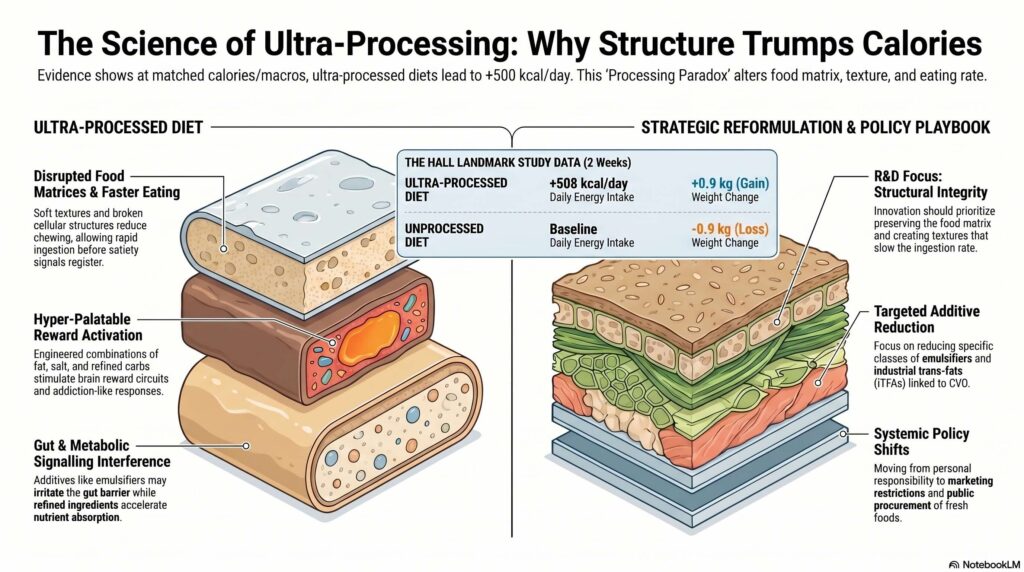
The most worrying signal for the industry does not come from epidemiology, but from a controlled trial. In a confined environment, with matched nutritional composition, a diet rich in ultra-processed foods led to overconsumption of approximately 500 kcal per day and a weight gain of nearly 0.9 kg in two weeks [2]. The commentary by Hayley O’Neill, published in June 2026 in npj Metabolism and Health, use this result in a strategic reading: the effects of ultra-processed foods go beyond their nutritional composition alone [1].
Observational data complete the picture. A high consumption of ultra-processed foods is associated with Obesity, to type 2 diabetes, to cardiovascular diseases and all-cause mortality [1]. The author nevertheless reminds us that the level of certainty varies according to study designs and the inherent limitations of nutritional epidemiology [1]. This is an expert commentary that synthesises the evidence, not a systematic review: a solid basis for discussion, not a full stop.
What, in the transformation, is problematic
Several plausible and convergent mechanisms. Softer textures and deconstructed matrices reduce the effort of chewing and speed up eating: we eat faster, therefore more before satiety signals set in [1]. Hyperpalatability adds its contribution, with combinations of sugar, fat, salt and flavourings calibrated to stimulate reward circuits [1].
This is coupled with the relative dilution of proteins, the possible effect of certain emulsifiers on the intestinal barrier, and associations between high consumption of ultra-processed foods and changes in brain regions linked to reward [1]. Finally, industrial refining alters the integrity of the food matrix and modifies the availability of substrates for the microbiota [1]. The common denominator is not a nutrient. It is a structural characteristic.
The formulation becomes the playground
The direct consequence is that a product can no longer be evaluated solely on its sugar, fat, and salt content. The level of processing, texture, energy density, speed of ingestion, and certain additives enter the equation [1].
For R&D teams, it’s less a constraint than an innovation space. Slowing down ingestion with texture, preserving matrix integrity, reducing energy density without sacrificing enjoyment, limiting hyper-palatability: these are all measurable technical levers. The useful question isn’t «processed or not,» but «which technological attributes pose a risk, and which are correctable.».
A gradual approach, not demonisation
The commentary does not argue for the end of all processing [1]. It proposes a gradual approach: initially targeting the most problematic categories, setting reduction targets for added sugars, sodium, and certain classes of emulsifiers, and preserving the matrix from the design stage [1]. In terms of public policies, it points to public procurement, marketing restrictions aimed at children, and the accessibility of minimally processed foods [1].
For a brand, treating reformulation as a lever for innovation, rather than a forced compliance measure, changes its competitive stance. One question remains to be settled before aligning R&D and marketing: is your next reformulation aimed at removing an ingredient from the label, or at correcting the technological attribute that actually carries the risk?
FAQ
Pourquoi un produit qui est « équilibré » sur le plan nutritionnel peut-il toujours poser problème ?
Because at matched calorie and macronutrient levels, an ultra-processed diet led to overconsumption and weight gain in a controlled trial. The product's structure, not just its composition, influences intake.
Does the text state that all processed foods should be avoided?
No. It highlights the heterogeneity of ultra-processed foods and advocates for a targeted approach, focusing on the riskiest attributes and categories where evidence is strongest [1].
What concrete priorities for formulators?
Reduce certain additives, preserve the food matrix, lower energy density, and design textures that slow down the speed of ingestion [1].
Can we rely on this text alone as definitive proof?
No. It combines controlled trials and observational studies but highlights the limitations of duration, sample size, and dietary measurement. A robust basis for discussion, not a final point [1].
Sources
[2] Hall KD, Ayuketah A, Brychta R, et al. Ultra-processed diets cause excess calorie intake and weight gain: an inpatient randomised controlled trial of ad libitum food intake. Cell Metabolism. 2019;30(1):67-77.