


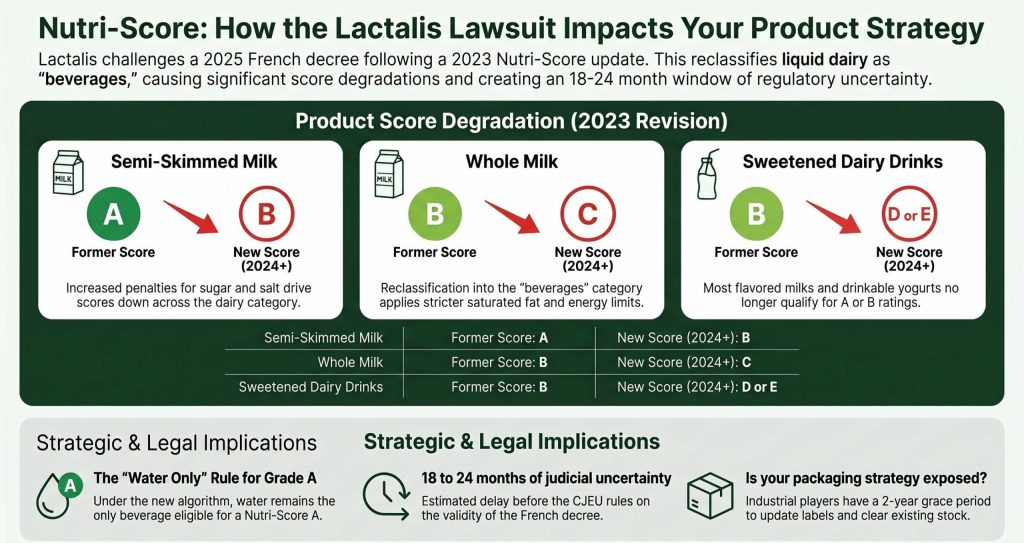
Semi-skimmed milk has gone from A to B, whole milk from B to C, and only water can achieve an A in the drinks category. This reclassification, resulting from the revision of the algorithm Nutri-Score, which is taking Lactalis to the European Union's highest court. The Nutri-Score trial The dairy giant's attempt aims to annul the French decree from 2025 that formalised the new scale.
For the agri-food industry, the case goes beyond the dairy sector. It calls into question the room for manoeuvre left by European law for front-of-pack labelling systems – and the legal certainty of any product strategy calibrated on these scores. According to the consultancy Altius, Regulation (EU) No 1169/2011 is «a cornerstone of European food law». Nutri-Score trial It tests the limits precisely.
Why the
The Nutri-Score rates products from A (green) to E (red) according to their nutritional profile. Before 2023, milk and dairy products were all treated as «general foods» by the algorithm. The 2023 revision switched liquid dairy products into the «beverages» category.
This change in category modifies the calculation method. Measured result: many dairy products have seen their scores decrease. Semi-skimmed milk dropped from A to B, whole milk from B to C. In the «drinks» grid, only water reaches an A.
This reclassification is the starting point for the dispute. In 2024, Danone – an early adopter of the system – left the scheme, citing its disagreement with the algorithmic revision. The Nutri-Score designers retorted in November 2025, suggesting that Danone products were not as healthy as the group claims.
Lactalis is seizing upon the same loophole, but going further. Katia Merten-Lentz, a partner at the firm Food Law Science and Partners, summarises: «Lactalis argues that the revised scoring system unfairly penalises certain dairy products, particularly cheeses and other traditional dairy foods.» The group also disputes the classification of certain dairy products as beverages rather than foods, due.
What is the legal basis for the case?
Food information in the EU is governed by Regulation (EU) No 1169/2011. This text requires each product to display an ingredients list, the net quantity, and details of energy/nutrients – the «nutrition declaration».
Decisive point: the regulation does not set out detailed rules for front-of-pack labelling, only a general framework, leaving the modalities to the Member States. According to Altius, this was a deliberate choice by the drafters. It is this article on front-of-pack labelling that is at the heart of the Nutri-Score trial.
Lactalis claims that Nutri-Score, which functions as a nutritional declaration, must respect the regulation's distinction between nutrients and energy value — and that it illegally merges them. The group also objects that the score mobilises elements absent from mandatory nutritional information: the proportion of fruit, nuts and vegetables, or the presence of sweeteners.
Bregt Raus outlines the issue: «In summary, Lactalis asserts that Nutri-Score goes beyond its limits by grouping elements into a single synthetic score in a way that the regulation does not permit. In other words, the case is about the degree of flexibility the regulation leaves to front-of-pack labelling systems.»
The procedural pathway in brief
- 2023 Review of the Nutri-Score algorithm, reclassification of liquid dairy products as beverages.
- 2024 Danone is exiting the system.
- 2025 (decree) France officially adopts the new algorithm.
- September 2025 Lactalis seizes the Council of State, which refers the question to the Court of Justice of the EU (CJEU) for interpretation.
- 18 months to 2 years Usual duration of a preliminary ruling procedure before the CJEU before judgment.
What the decision commits you to for your product choices
The regulatory risk that the verdict redistributes
If the CJEU rules in favour of Lactalis, it would restrict the latitude of Member States to impose a front-of-pack synthetic score. For R&D and marketing managers, this directly impacts reformulation roadmaps: a large number of fat or sugar reduction projects are currently calibrated to improve by one letter on the A-E scale.
Le Nutri-Score trial This creates uncertainty regarding the timeframe. Building a packaging strategy on a tariff whose legal basis is being challenged before the CJEU exposes one to a U-turn in 18-24 months. Conversely, ingredient suppliers focused on improving nutritional profiles – sodium reducers, fat substitutes, fibres – retain their value regardless of the outcome: the pressure on nutritional quality will not disappear with a label change.
A device already weakened before the Nutri-Score trial
Danone’s withdrawal in 2024 was not an isolated incident. In May 2025, Nestlé stopped using Nutri-Score in its home market. The European Commission itself has distanced itself from mandatory implementation.
Italy has long opposed the system. The distributors, meanwhile, continue to support it: in April 2025, several chains maintained the score despite Brussels's backtracking. The picture is therefore mixed – in-store acceptance, industrial defection.
| Actor | Recent position | Year |
|---|---|---|
| Danone | System output | 2024 |
| Nestlé | Abandoned on the domestic market | 2025 |
| Lactalis | Appeals to the CJEU | 2025 |
| European Commission | Withdrawal of obligation | 2025 |
| Distributors (EU) | Maintenance of the device | 2025 |
For those in the nutrition sector, this context changes how they read the Nutri-Score trial It's not arriving in a stable system, but in a setup where industrial commitment is already crumbling. A favourable decision for Lactalis would amplify this movement; an unfavourable decision would consolidate the score as a lasting product design constraint in Europe.
What to watch out for before the judgment?
Three signs warrant regular monitoring. Firstly, the substance of the preliminary questions referred by the Council of State to the CJEU: these will define the exact scope of the debate on Regulation 1169/2011. Secondly, any defections or adhesions from other industrialists, which will affect the legitimacy of the system. Finally, the position of the states that have adopted Nutri-Score — France, Belgium, Luxembourg, Netherlands.
The pragmatic route is to decouple your reformulation tradeoffs from the score logic alone. Optimising a real-world nutritional profile remains rewarding, regardless of the verdict of the Nutri-Score trial. Indexing the entire marketing strategy in a letter that has a legal basis before the CJEU is much less so.
References
- Lactalis embarks on a crusade against Nutri-Score
- The European Court of Justice will examine the Nutri-Score following a request from Lactalis
FAQ
The legal text invoked in the Nutri-Score lawsuit is the European Union regulation on the provision of food information to consumers (Regulation (EU) No 1169/2011).
Regulation (EU) No 1169/2011 on the provision of food information to consumers. Lactalis argues that Nutri-Score illegally merges nutrients and energy value and uses elements beyond mandatory labelling (fruits, vegetables, sweeteners), exceeding what the regulation permits.
When is a decision expected?
The Council of State has just referred the case to the CJEU (referred in September 2025). A preliminary ruling procedure usually takes 18 months to 2 years between referral and judgment, longer for complex cases.
Why are dairy products degraded?
The algorithm revision in 2023 reclassified liquid dairy products as beverages, where only water achieves an A. Semi-skimmed milk has moved from A to B and whole milk from B to C.