



Primates with longer thumbs have larger brains on average. This is the conclusion of a study published on 26 August 2025 in Communications Biology, which provides the first direct evidence of a co-evolution between manual dexterity and cerebral development in the order of primates, of which we are a part.
The hand and the brain, a linked evolution
The hypothesis had been around for a long time: our dexterous fingers and brains voluminous would not be the fruit of chance, Two mutually reinforcing traits. The team from the University of Reading, in collaboration with Durham, has just provided quantified proof of this after analysing 95 fossil and living species, covering the full diversity of primates - from lemurs to modern humans.
Why is this on-the-spot discovery so important?
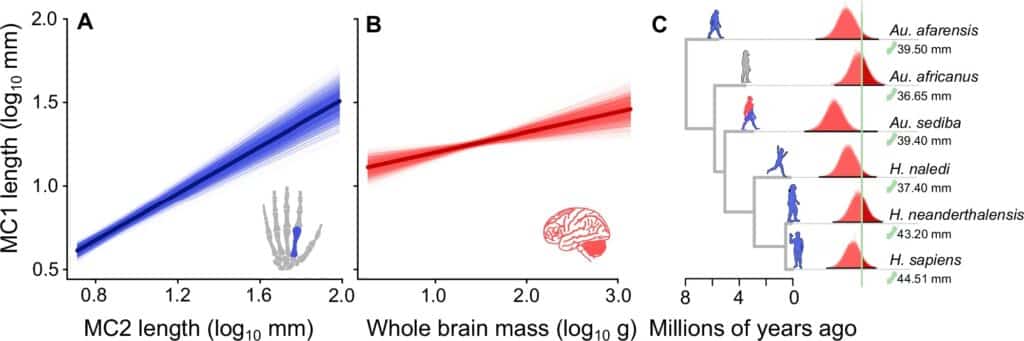
The researchers measured the proportions of the thumb (first metacarpal) in relation to the index finger, then correlated this data with brain mass. Result: a significant positive correlation across the entire primate order. And even after removing the human species from the models, proving that the relationship is not a human exception.
Among hominins, only Australopithecus sediba and Australopithecus africanus differ slightly from the general model, suggesting particular selective pressures.
Surprise: the correlation is with the size of the neocortex, The brain is the seat of cognition and sensory processing, and not the cerebellum, traditionally associated with motor control. This suggests that fine manipulative skills are as much a matter of cognition as motor skills.
Another key finding is that tool-using primates do not systematically have longer thumbs than other primates. Anatomy alone is therefore not enough to predict material culture.
Implications for human evolution
Hand-brain coevolution
These results confirm a historical co-evolution between dexterity and cognition, This involves high energy and neural costs. As Dr Joanna Baker sums up: «Our big brains and nimble fingers did not evolve separately. When our ancestors became more skilful, their brains had to adapt».
The fact that the proportions of the hominid hand precede the systematic use of tools suggests that the long thumbs were already an evolutionary advantage in themselves, making them easier to handle and extending the range of interactions with the environment.
The researchers also measured ’maximum manipulation space« (the ability to move a small object between thumb and forefinger). Here again, long thumbs and large brains are excellent predictors of dexterity.
A broader look at the evolution of primates
For the evolutionary sciences, this study opens up a new perspective: the hand and the brain must no longer be studied separately, but as an integrated system. As Professor Robert Barton (Durham) points out: «This is the first time that we have directly linked two of the most distinctive characteristics of humans: the anatomy of the hand and the size of the brain».
This research sheds new light on human and primate evolution: our thumbs and brains have grown together, paving the way for the cultural and technological complexity that will follow.
What do you think: did our tools shape our brains, or did our brains pave the way for the tools?
Reference
Baker J., Barton R. A., Venditti C. (2025). Human dexterity and brains evolved hand in hand. Communications Biology. https://doi.org/10.1038/s42003-025-08686-5