


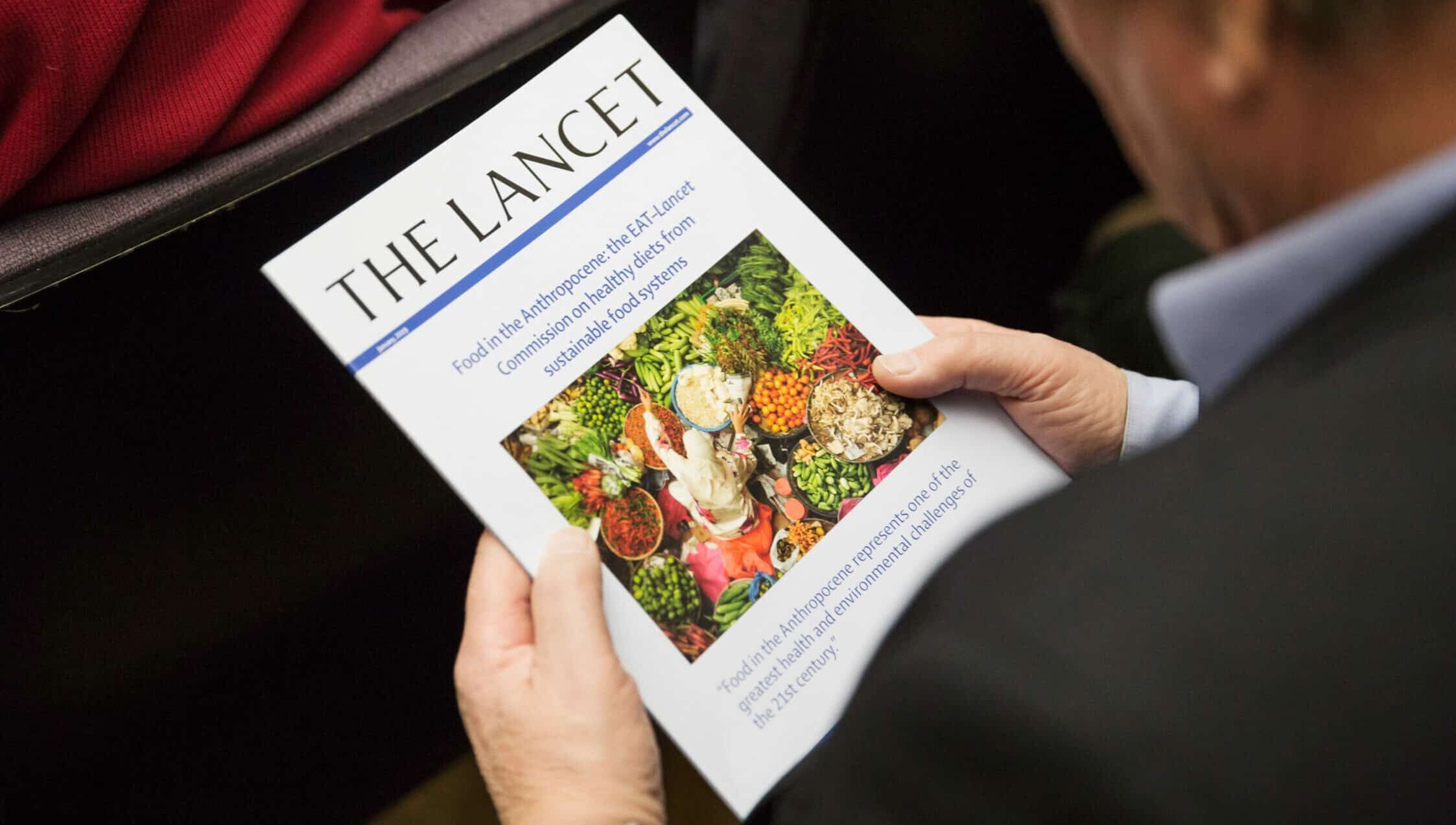
EAT-Lancet 2025 no longer theorises: it gives instructions for use. If we are to maintain public health, the climate and purchasing power between now and 2050, we need to activate four levers in tandem: tipping the balance towards the Planetary Health Diet (PHD), producing better (agro/eco-intensification, decarbonisation, water, N/P), reducing losses and waste (FLW) and guaranteeing access (prices, formats, public policies). Taken in isolation, no single lever is sufficient. The 2025 report therefore translates global limits into sectoral objectives for food, and includes justice as a design constraint. The question for ingredient suppliers is what to do from January 2026?
The health-climate-access triptych becomes practicable
Le PHD is a flexible envelope: more wholegrain cereals, pulses, nuts/seeds, fruit/vegetables; unsaturated oils; moderate amounts of dairy products/eggs/fish/poultry; less red meat and added sugars. Recent data confirms that reduces chronic risks and mortality. At the same time, EAT-Lancet 2025 allocates to food a share of measurable safe and fair space’ (climate, land, water, N/P flows, biodiversity). Access is no longer a CSR score: it has become a success criterion.
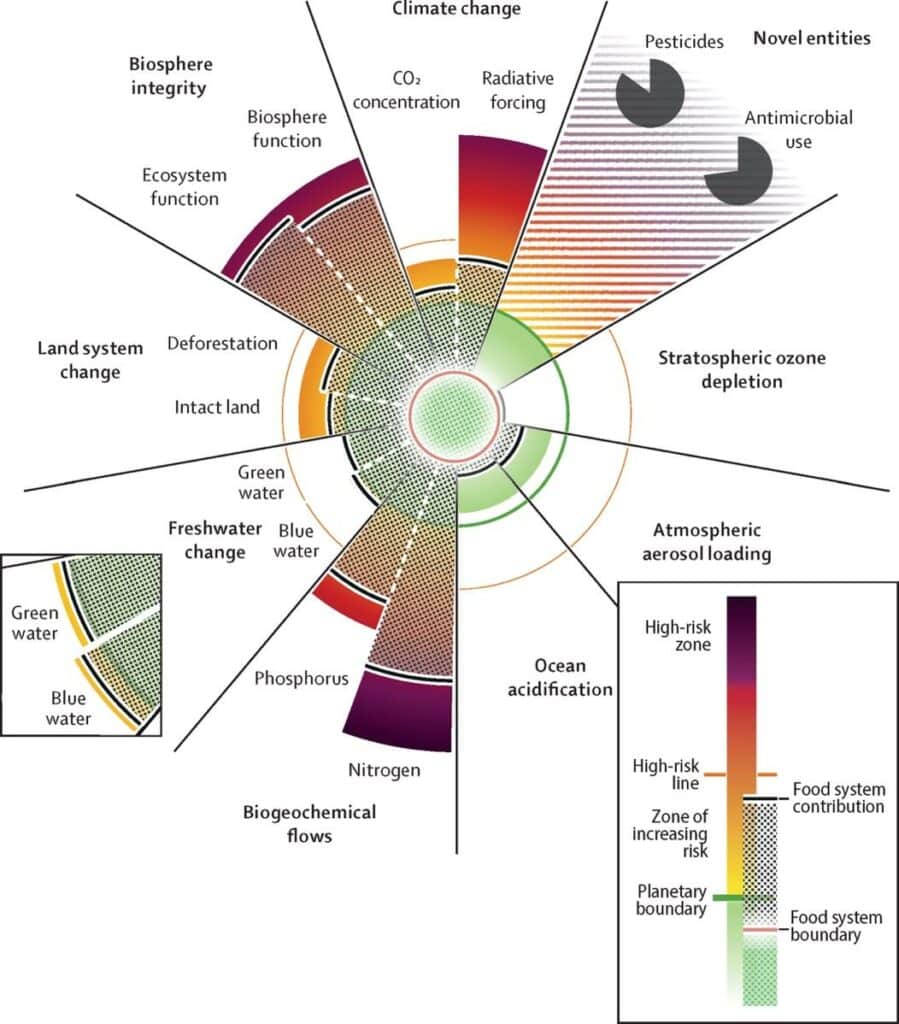
Source: EAT-Lancet 2025.
What's in the Eat-Lancet 2025 report - without the jargon
- PHD population benchmarks (Table 1): the beaches to guide policies and offerings, without prescribing the individual.
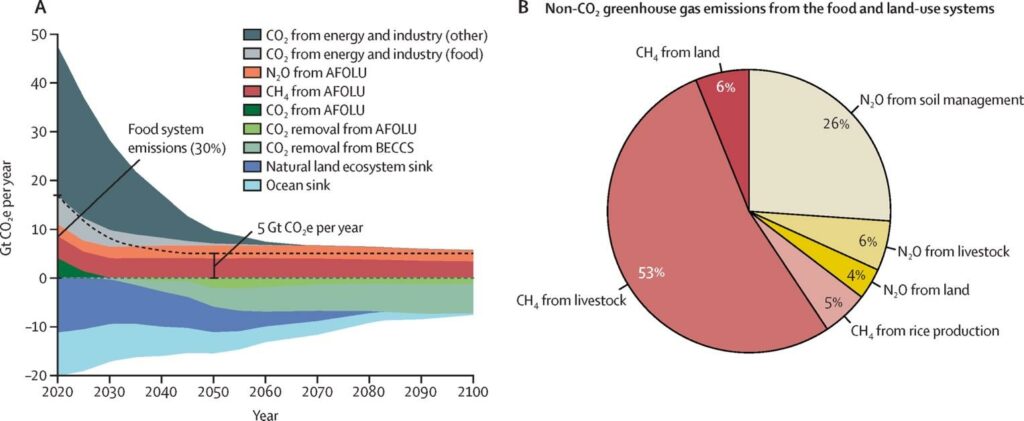
- Food system boundaries Sectoral ceilings (e.g. GHG budget < ~5 Gt CO₂e/year, zero net conversion intact ecosystems, compatible water withdrawals, N/P surplus ceilings).
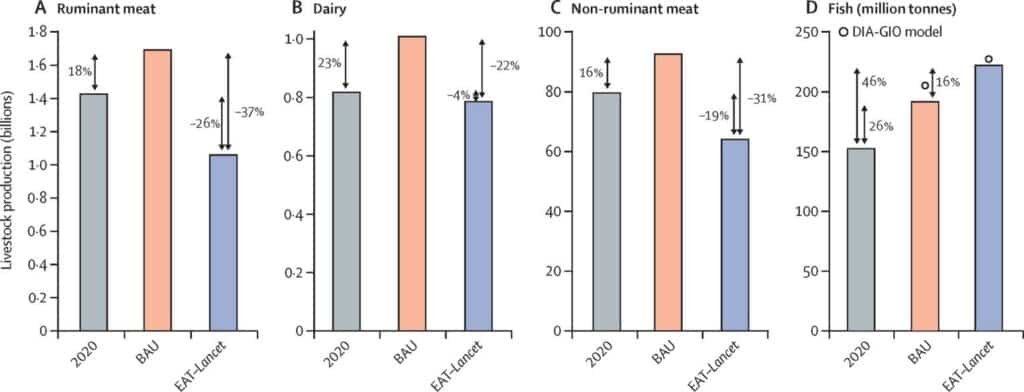
- 2050 trajectories BAU vs. combinations of levers ; no single lever balances health, climate and price.
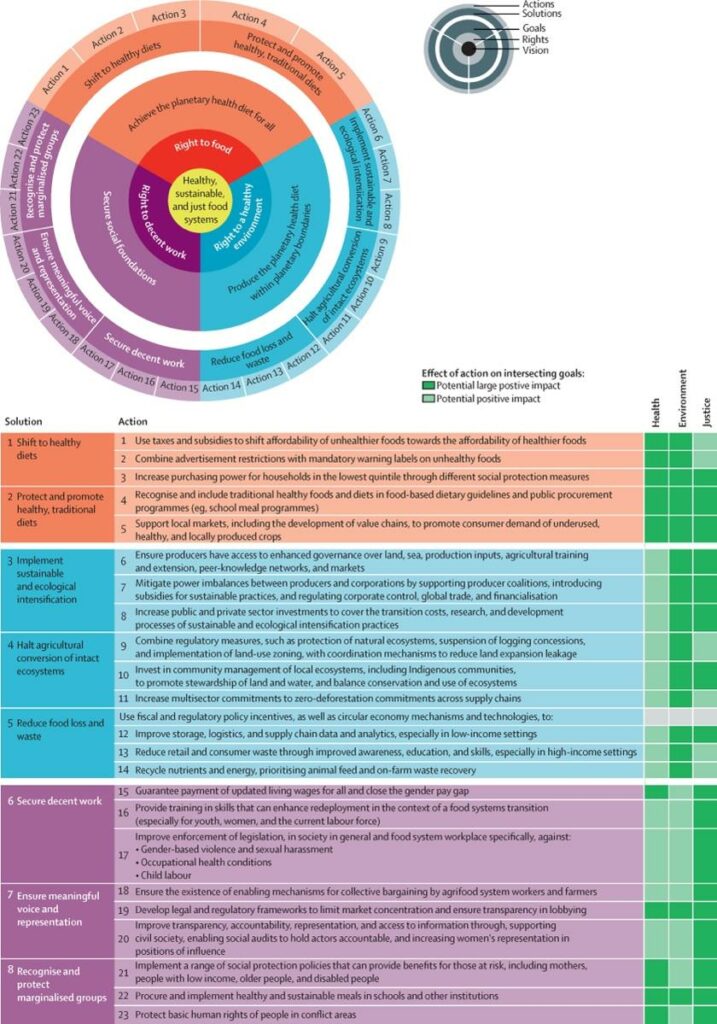
- Justice s activities: targeted subsidies, public procurement, cold chain, logistics; the’access becomes a strategic prerequisite.
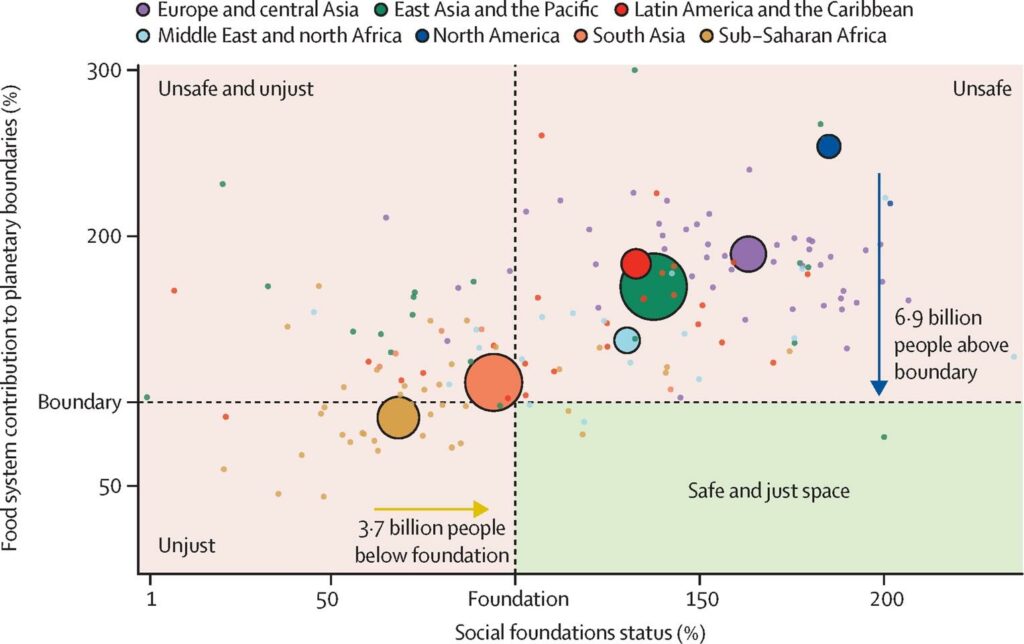
Source : EAT-Lancet 2025.
Four levers - together or nothing
- Changing the plate (PHD) Pulses/fibres/nuts/wholegrain cereals, - red meat/added sugar.
- Producing better Rotations with legumes, cover crops, agroforestry, biocontrol, low-carbon energy, fine management of water and nutrients.
- FLW post-harvest losses, cold chain, specs, date/portion labelling, recovery of co-products.
- Access prices, formats, public policy and infrastructure.
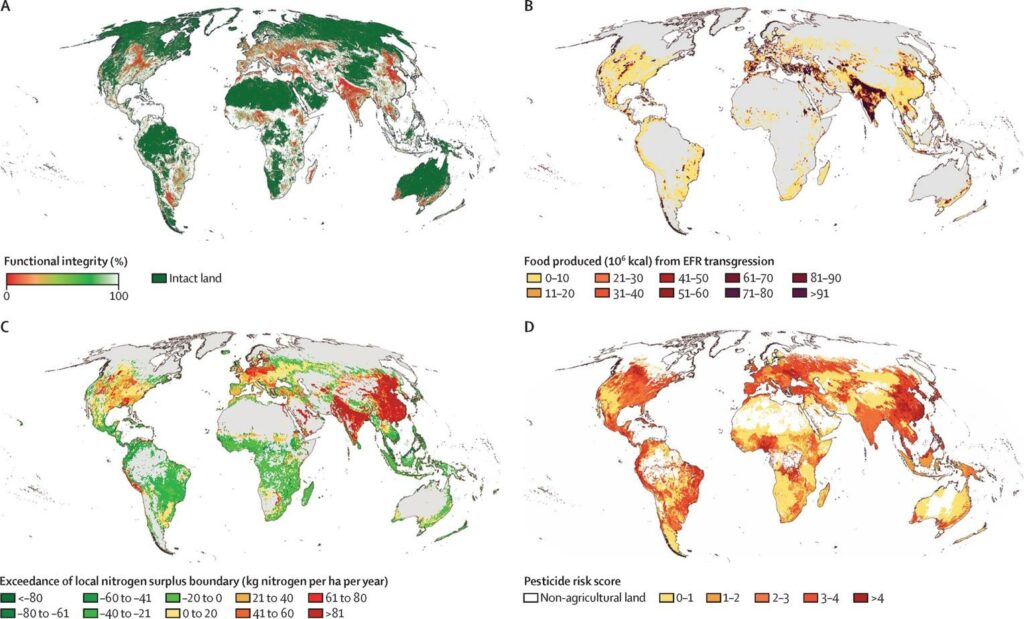
Source : EAT-Lancet 2025
Taken in isolation, a carbon/foundry signal often makes the basket more expensive; ; combined to the other three, it becomes sustainable and effective.
Source : EAT-Lancet 2025.
Operational roadmap (ingredient suppliers, Europe)
Rethinking the portfolio - health and footprint
Source : EAT-Lancet 2025.
- Plant proteins EU (peas, beans, lentils, EU soya): aim for functionalities (gels/emulsions/textures), digestibility, costs extrusion/fermentation.
- Fibre & wholegrain cereals mainstream integration (bread-making, pasta, snacks) without making lists too long; increased nutritional density.
- Unsaturated oils & blends (oilseed rape/olive/ HO sunflower): reduction AGS without any loss of stability/enjoyment.
- Targeted micronutrition (iron/iodine/calcium/vit. D/B12 if relevant); fermented matrices/yeast for bioavailability.
- Vegetable/fermented/cultivated alternatives Nutritional transparency; low-salt/sugar/AGS recipes.
Secure sourcing - the proof of the pudding
- Eco-intensive farming : leguminous rotations, cover crops, agroforestry, biocontrol; «zero expansion» clauses on intact habitats; index-linked premiums, etc. N/P and biodiversity.
- Energy & Processes PPA/biogas/exhaust heat, electrification where relevant; ; ACV ISO 14040/44 third parties.
- Water & nutrients The new technologies: out-of-basin stress, precision irrigation, tolerant varieties; N/P management, making the most of by-products.
- Refrigeration & packaging low-GWP fluids, optimised charge rates, circular packaging.
- Traceability data lot-level (origin, practices, water, N/P), independent auditability.
Creating demand - reformulation & intelligent policies
- Roadmaps by category (snacks, ready meals, drinks): + pulses + fibre, - salt - sugars - SFA; rigorous sensory tests.
- Foodservice & public procurement : offers for canteens/hospitals, recipe kits, training; public procurement = accelerator adoption.
- Anti-FLW relevant sizes/portions/dates, intelligently standardised specs, reuse of co-products.
- Advocacy : aid for pulses/nuts/VFN, nutritional taxation revenue neutral, nutrition × ecosystem standardisation.
Managing risk - figures, not slogans
- Resilience double EU sourcing, energy/input indexation clauses, buffer stocks.
- Compliance & proof These include enhanced technical data sheets, digital traceability and supplier audits.
- Acceptability clean label, allergens, impeccable texture and taste; end-customer R&D co-development, consumer panels.
- Equity These include social clauses, responsible payment terms and technical support for small producers.
Summary table - 4 levers, objectives, actions, KPIs
| Lever | 2050 target (spirit of the report) | Actions on the supplier side | Monitoring KPIs (quarterly) |
| Diet (PHD) | Plant part ↑, public health ↑ | EU plant protein, fibre/whole grain, unsaturated oil ranges; reformulation - salt/sugar/AGS; targeted fortification | % PHD-aligned recipes; g fibre/100 g; compliance with salt/sugar/AGS thresholds; share of «PHD-positive» sales» |
| Sustainable productivity | Footprint/unit ↓ in terminals | Leguminous rotations, cover crops, agroforestry; low-carbon energy; non-critical basins; sober refrigeration | g CO₂e/kg ; % EnR ; m³ blue water/kg ; kg N/P per tonne |
| FLW | Losses/waste ↓ | Standardisation of specs, intelligent formats/portions/dates, recovery of co-products, efficient cold chain | % upstream/downstream losses; recovered co-products; cold chain performance |
| Access/Price | Affordable & available healthy basket | Value« SKUs rich in pulses/cereals; Foodservice offers; participation in public procurement; advocacy | Value« basket price (€/1000 kcal); Foodservice/public volumes; SME payment terms |
Roadmap 2026-2030 - the non-negotiable agenda
| Year | Structuring actions | Measurable milestones |
| 2026 | Portfolio LCA; pilot legume rotations; 3 PHD reformulations; anti-waste plan; first PPAs | Baseline established; -10 % FLW warehouse; PPA signed |
| 2027 | Eco-intensive sourcing extension; 2 fibre/protein ranges | Secure canteen/hospital procurement contracts |
| 2028 | 60 % volumes traceable by batch; publication of water/N-P KPIs | -20 % FLW; public ESG reporting |
| 2029 | 80 % PHD aligned portfolio (key categories) | Structuring retail partnerships |
| 2030 | Climate/water/N-P milestones achieved | Integrated reporting (financial + impact), third-party auditing |
FAQ - the 10 questions you'll be asked
- Is the PHD culturally realistic? Yes: adaptable framework. Progressive substitutions are essential.
- Should we ban ultra-processing? Not in principle; look at nutritional density, salt/sugar/AGS, list of ingredients, transparency.
- Are plant-based alternatives «better»? Generally better for climate/terroir; nutrition varies according to formulation.
- Cultured/fermented meat? Dependence on decarbonised electricity, costs and acceptability still uncertain.
- Will prices explode? Mitigation alone: likely to rise. PHD + productivity + FLW : depreciation, or even decline depending on the region.
- Quick wins anti-waste? Cold chain, VFN post-harvest losses, specs, dates/portions, co-products.
- R&D priorities? Legume texturisation, oil stability, micronutrient bioavailability, fermented matrices, robust LCA.
- How can we prove it? Third-party LCAs, batch traceability, published KPIs, clear scope.
- Regulatory risks? No unvalidated claims, alignment of labels and standards, preparation for public procurement and standardisation.
- Where to start? 3 PHD/category reformulations, 2 EU legume chains secured, -15/-20 % FLW warehouse.
Conclusion - from rhetoric to evidence
EAT-Lancet 2025 provides a feasible trajectory: PHD + better production + FLW + access. Suppliers who line up portfolio, sourcing and auditable evidence will have the upper hand from 2026. Next step: Published quarterly KPIs and concrete offers for distribution, foodservice and public procurement.
Source : EAT-Lancet 2025
References
- The EAT-Lancet Commission on healthy, sustainable, and just food systems. The Lancet, October 2, 2025. DOI : 10.1016/S0140-6736(25)01201-2
- Page Commission : https://www.thelancet.com/commissions-do/EAT-2025
- EAT Forum (PHD) : https://eatforum.org/eat-lancet-commission/