



15% of B2B marketers say they struggle to generate qualified leads. In the food & nutrition sector, this figure is probably underestimated - between endless sales cycles and over-solicited technical decision-makers. Here's what really works in B2B ingredients marketing, with the data to back it up.
B2B ingredient marketing has changed (and not just a little)
For years, B2B marketing in the food ingredients sector boiled down to a few basics: a stand at the Food Ingredients Europe trade fair or at Vitafoods, A technical brochure and a few advertisements in trade magazines. It worked. Your prospects already knew you, the circle was small, and the salesman did the rest.
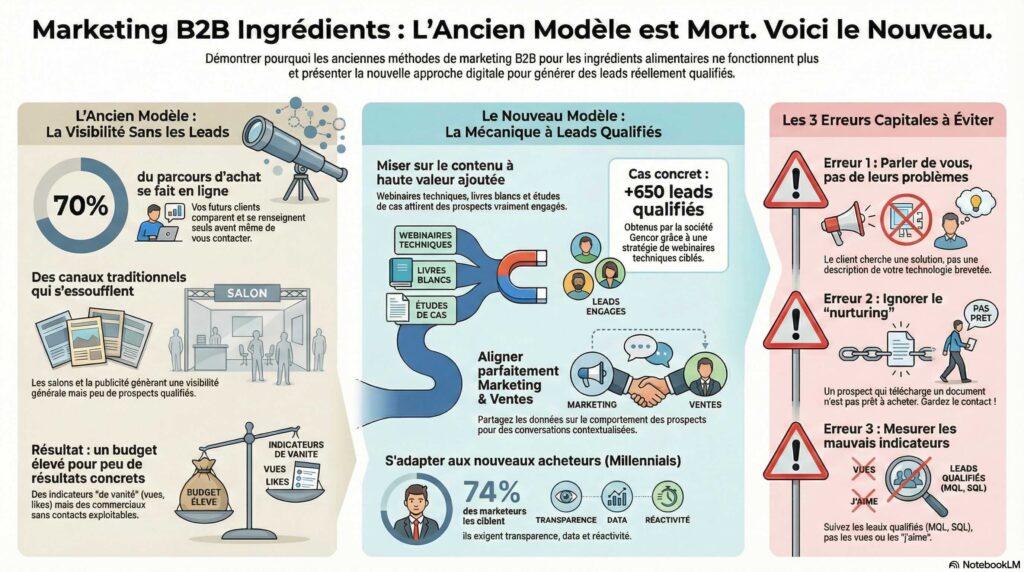
SBut this model is running out of steam. Today's ingredient buyers - R&D directors, category managers, formulation managers - are making a major contribution to the success of their products. 70% of their online buying journey before they even contact you. They compare, download and benchmark. And if you're not visible at that moment, you don't exist.
The problem? Most ingredient suppliers continue to invest heavily in channels that generate visibility... but no qualified leads. The result: substantial marketing budgets, reassuring vanity metrics, and sales people still waiting for their contacts.
Channels that perform (and those that look good)
A survey of 1,400 marketing professionals reveals a reality that many prefer to ignore: the social networks with the highest ROI are not the ones you might think. Instagram, YouTube and TikTok have the best returns on investment - but for B2C. In B2B food & nutrition, LinkedIn remains the playground, with one nuance: performance depends entirely on the quality of the content, not the volume of posts.
What really works to generate qualified leads:
- Technical webinars Gencor, for example, generated over 650 qualified leads via a targeted webinar strategy. Not passive participants - engaged prospects who asked questions and downloaded additional resources.
- Value gated content technical white papers, application case studies, exclusive market data. The key word here is “value”. A 3-page PDF rehashing your website isn't gated content - it's disappointment.
- Specialist B2B platforms. The advantage? You only talk to professionals in the sector, not curious onlookers.
The gap between B2B marketing and sales (and how to bridge it)
According to data from the HubSpot 2025 report on business trends, the main barrier to performance is not budget or tools - it's the business itself.’It's the alignment between marketing and sales teams. The symptoms are classic: marketing generates leads that sales doesn't consider “ready”, sales asks for more leads without exploiting the ones they have, and no one speaks the same language.
The solution? A shared lead intelligence platform. Not just another CRM - a tool that centralises behavioural data in real time. Who downloaded what, who attended which webinar, who visited which product page how many times. These signals of intent transform a cold lead into a contextualised conversation.
L’IA is also emerging as a concrete lever. Tools for analysing sales conversations - which transcribe and analyse exchanges in real time - make it possible to identify recurring objections, arguments that convert and purchase signals.
What B2B food marketers really want to achieve
The data speak for themselves: 74% of B2B marketers want to engage millennials, 67% target Generation X. Baby boomers? Only 27% consider them a priority. This generational shift has direct implications for your channels and your tone.
Millennials in decision-making positions (R&D directors, category managers) have grown up with digital. They don't want a salesperson on the phone - they want accessible, verifiable, comparable information. Your marketing must meet these expectations:
- Data transparency comprehensive technical data sheets, accessible clinical studies, verifiable certifications
- Consumable formats short videos, infographics, downloadable comparisons
- Reactivity responding to requests in hours, not days
The 5 mistakes that plague your lead generation
Creating content that engages, generates traffic AND converts is one of the top three challenges facing B2B marketers. Here are the most common mistakes in the ingredients sector:
- Talk about you instead of their problems Your patented fermentation is of less interest to them than the answer to “how can I reduce sugar without altering the taste?”
- Neglecting technical SEO your magnificent product sheets are useless if they don't appear when a formulator searches for “clean label confectionery texturiser”.”
- Under-investing in conversion attracting traffic without optimised landing pages is like filling a bathtub with holes
- Ignore nurturing A lead who downloads a white paper is not ready to buy. They might be in 6 months - if you keep in touch.
- Measuring the wrong KPIs views and likes don't pay the bills. Track MQLs, SQLs and the cost per qualified lead
Building a B2B digital marketing plan that (really) generates leads
For 2026, the recipe is not revolutionary - but it does require rigour:
- Define your personas precisely Food manufacturers“ is not a persona. ”Marie, 42, R&D manager in a small dairy company, under pressure to reformulate without E additives“ - that's a persona.
- Mapping the buying journey At each stage (discovery, consideration, decision), which content answers which question? Which channel is relevant?
- Investing in substantive content Less generic LinkedIn posts, more technical articles that position your expertise. Evergreen content generates leads for years.
- Intelligent automation Marketing automation is not an end in itself. It's a lever for personalising at scale, nurturing leads according to their actual behaviour.
- Measure, iterate, optimise A marketing plan that doesn't change during the year is a marketing plan that doesn't work. Data tells you what works - listen to it.
Why it's strategic now
The B2B ingredients market is becoming increasingly professional. Digital pure players are emerging, marketplaces are taking shape, and your competitors are investing in their online presence. Waiting means falling behind.
Companies that master the generation of qualified leads today are building their sales pipeline for tomorrow. Those who continue to rely solely on trade shows and word-of-mouth will see their market share erode - slowly, but surely.
The challenge is not to digitise everything overnight. It's about building a lead generation mechanism that continuously feeds your sales force with qualified contacts who have already shown an interest in your solutions.
FAQ : B2B lead generation ingredients
What marketing budget do you need to start generating leads? There is no absolute minimum, but count on between 5 and 15% of your target turnover in the targeted segment. The classic mistake: sprinkling in too many channels. It's better to excel on 2-3 levers than to be mediocre everywhere.
LinkedIn Ads vs Google Ads for B2B ingredients? LinkedIn for brand awareness and targeting by function, Google to capture existing demand (those who are actively searching). The two are complementary - but if you have to choose, start with Google if you have high intent keywords.
How long before I see results? B2B content marketing is a marathon. Allow 6 to 12 months to build up a system that generates leads on a regular basis. Paid channels can speed up the start, but they are no substitute for hard work.
Should you insource or outsource? Both have their advantages. Internalise strategy and market knowledge. Outsource technical execution (SEO, automation, content creation) if you don't have the skills in-house. The hybrid approach often works best.
Video summary
Sources
- SmartCore Digital, B2B Food and Nutrition Marketing Report 2024-2025
- HubSpot 2025 Sales Trends Report :
- HubSpot 2026 State of Marketing Report :
Are you structuring your B2B lead generation strategy?
→ A specific question? Our AI assistant can help you quickly: Talking to the assistant
→ Need structured support? Find out more about our intervention formats - from one-shots to editorial partnerships: See the offers
→ Want to discuss it face-to-face? 30 minutes to define your needs, with no obligation: Reserve a slot