



A Cochrane meta-analysis published in February 2026 has pulled the rug out from under an entire category: intermittent fasting is no better than a conventional diet for weight loss. For manufacturers who have built a narrative around the «magic» of meal timing, this is a strong signal. For those who back nutritional quality and evidence, it's an opening.
Intermittent fasting caught up by science (no surprise there)
The Cochrane Review is the world's leading authority on the synthesis of medical literature. Its verdict on intermittent fasting is unequivocal: no greater benefit for weight loss compared to a well-managed classical calorie restriction, nor even compared to the absence of a structured programme.
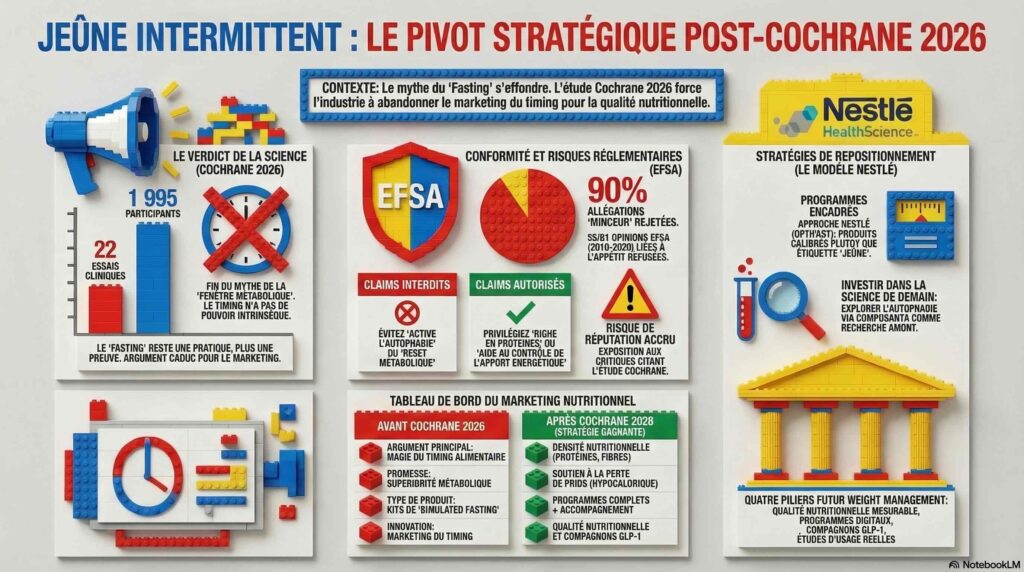
The study concerns 22 randomised controlled trials and 1,995 participants. The authors« conclusion: intermittent fasting »does not appear to help overweight or obese adults lose more weight than conventional dietary advice".
This outcome does not destroy consumer demand – people will continue to practice 16:8 and 5:2.
- Le 16:8 consists of fasting 16 hours a day and to eat only during a 8-hour window (for example, from 12pm to 8pm).
- Le 5:2 works on a weekly basis: 5 days of normal eating and 2 day very low-calorie (approx. 500–600 kcal).
However, the Cochrane study undermines an implicit promise that had crept into dozens of products, programmes and marketing materials: the idea that the eating window had an intrinsic power beyond just the caloric balance.
For industrialists, the question isn't «is intermittent fasting dead?» but «what is our argument really based on – and does it hold water?»
Three product territories of intermittent fasting in the spotlight
An implicit category has been structured around fasting in recent years, without always explicitly claiming it on the packaging:
- Meal replacements (shakes, powders, bars) used in meal replacement products, with promises of satiety and high protein content.
- Nutrient-dense snacks (high in protein, low in sugar, sometimes fortified with fibre or MCTs) marketed as «16:8 compatible».
- Simulated fasting kits«, multi-day programmes that claim to replicate certain metabolic effects of fasting without complete cessation of eating. This segment is growing, but clinical evidence remains limited.
The Cochrane review does not question the relevance of these products. It questions the narrative associated with them when it implies that meal timing does the work instead of nutritional quality and quantity.
What Nestlé already understands (and why it’s instructive)
In Canada, Nestlé Health Science has never prominently featured the term «intermittent fasting» on its boxes.’Optifast. And it's probably a lucid strategic decision.
The group built its credibility on a broader and more defensible territory: evidence-based weight management, with structured programmes, professional support, and products calibrated for nutritional intake. This positioning fares very well against the Cochrane review – because it did not promise what science cannot deliver.
Even more interesting: as part of his partnership with the Australian Catholic University, Prof. Karagounis explicitly poses the scientific question that will define the next decade – namely, whether specific dietary components could amplify fasting-induced autophagy. Not as a marketing argument, but as an upstream research programme.
This is the archetype of the smart pivot: investing in the science of tomorrow (metabolism, longevity, autophagy as a research field), while anchoring current products on defensible promises — nutritional quality, support, clinical evidence — rather than on the storytelling of meal timing.
The real risk: claims that no longer pass the regulatory test
The Cochrane review sets a precedent that regulators will undoubtedly note. In Europe, the EFSA already strictly regulates health claims related to weight management. Its track record is eloquent: out of 61 opinions published between 2010 and 2020, 55 claims related to’Enjoy your meal, satiety and slimming have been rejected.
In concrete terms, the risky formulations are now even more exposed:
- «Activate autophagy»
- «Metabolic reset»
- «Superior to the classic diet»
The defensible formulations remain:
- «Energy intake control assistance»
- «High in protein»
- «Weight management support as part of a calorie-controlled diet»
This is not a question of marketing cynicism. It's a question of compliance and the long-term sustainability of the promise.
The post-Cochrane opportunity: nutritional quality returns to its rightful place
The weight management market isn't going to disappear. What's evolving is the competitive landscape. The manufacturers who will emerge victorious from this reframing are those who:
- Investing in measurable nutritional quality – protein profiles, dietary fibre, micronutrient density – rather than the timing of meals.
- Build framed programmes rather than isolated products – long-term commitment is built with coaching, digital tools, and follow-up.
- Accompanying the revolution GLP-1 — the demand for companion products to maintain lean body mass and nutritional coverage in the context of reduced appetite is real and growing.
- Document their usage studies — rather than promising spectacular effects of fasting, show that consumers are actually using the product and achieving their goals.
The market isn't disappearing – it's maturing. And the players who anticipated this maturation by building on a solid foundation have a head start.
FAQ — Intermittent Fasting Post-Cochrane: What the Pros Are Really Asking
Is intermittent fasting dead as a marketing lever?
No – but the discourse of being «superior to classic diets» is dead. Consumer demand remains strong; it's the implicit promise of an intrinsic advantage of timing that no longer holds. Refocus on practicality, nutritional quality, and support.
Should «fasting friendly» products be removed from the catalogue?
Not necessarily. A product that is high in protein, low in sugar, with a good fibre profile remains relevant for someone practicing 16:8 – provided you don't promise them that timing does all the work. Nutritional quality sells itself.
What is the concrete risk if one maintains a strong «fasting» discourse?
Two combined risks: regulatory (allegations non-compliant with EFSA if promises overstep into unproven metabolic effects) and reputational (a competitor or journalist citing the Cochrane review against your communications, it will happen).
Video summary
Sources
1. Garegnani LI et al. — Cochrane meta-analysis, PMID 41692034, Feb 2026 — https://pubmed.ncbi.nlm.nih.gov/41692034/
2. Cochrane.org — institutional communiqué, Feb 2026 — https://www.cochrane.org/about-us/news/evidence-behind-intermittent-fasting-weight-loss-fails-match-hype
3. NutraIngredients — Nestlé Health Science × ACU incubator, 18 Feb 2026 — https://www.nutraingredients.com/Article/2026/02/18/nestle-health-science-australian-catholic-university-set-up-start-up-incubator/
4. Nestlé.com — ACU partnership, official statement — https://www.nestle.com/about/research-development/news/women-nutrition-health-longevity
5. Nestlé Health Science — Optifast Programme — https://www.nestlehealthscience.com/brands/optifast
6. EFSA — Health claims, Regulation (EC) 1924/2006 — https://www.efsa.europa.eu/en/topics/topic/health-claims
7. EFSA — Guidance on weight management and satiety claims — https://www.efsa.europa.eu/en/applications/health-claim
| Are you repositioning your weight management portfolio in light of new scientific data? Do you have a specific question? Talking to the assistant → Need structured support? See the offers Would you like to discuss it in person? Book a slot (30 min) |