


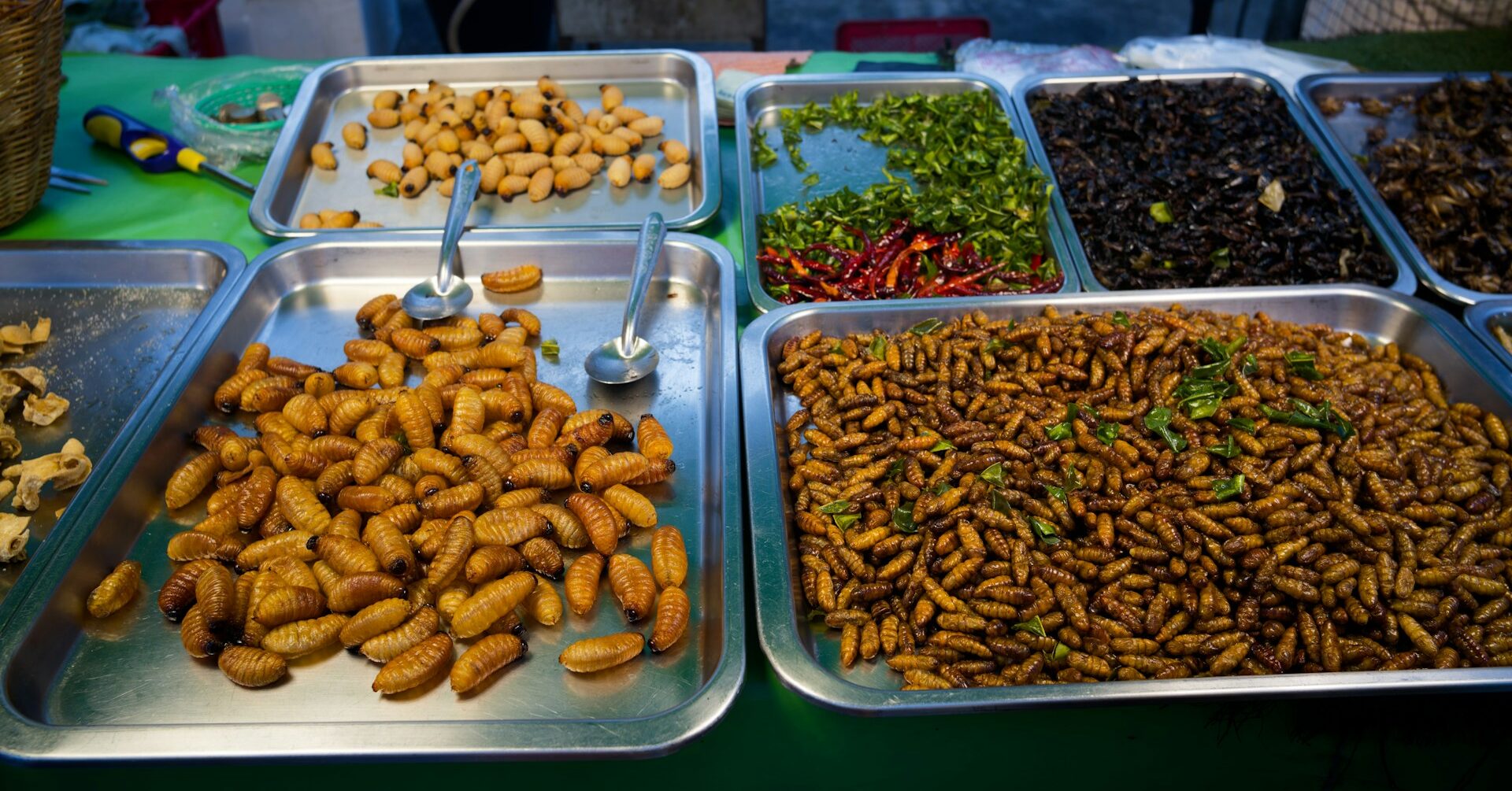
A study published in Science Advances in June 2026 reveals that the rejection of entomophagy in Northern European populations isn't solely cultural: it appears to be inscribed in the genome dating back at least 9,000 years. A discovery that questions the strategies of the edible insect industry.
Disgust may have an evolutionary history
For several years, edible insects have been considered a future solution for the food industry: rich in proteins, resource-light, they tick many boxes for the transition to sustainable food systems. Yet, attempts to integrate them into Western diets consistently hit a wall: disgust. Until now, this barrier was largely attributed to cultural, religious, or aesthetic factors. A study published on June 5th, 2026, in Science Advances is challenging this interpretation.
Conducted by researchers from the Institute of Evolutionary Biology (IBE, CSIC-Pompeu Fabra University, Barcelona), it provides genomic and archaeological evidence that this aversion has much deeper biological roots than previously thought.
The method: fossil dental calculus and chitinase genes
To reconstruct the food history of Eurasian populations, the team led by researcher Pablo Librado combined two complementary approaches.
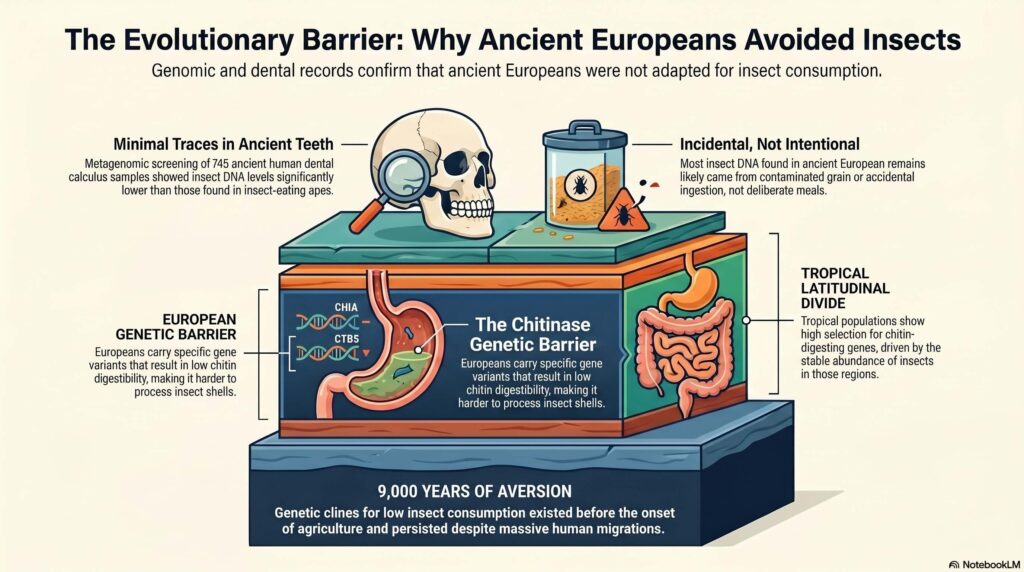
- First approach: The analysis of fossil dental calculus. Researchers examined 745 samples of dental calculus taken from anatomically modern individuals, dating up to 33,000 years ago. Dental calculus acts as a biological archive: it traps traces of DNA from regularly consumed species. Result: in northern Eurasian populations, traces of insects are rare and correspond to accidental ingestion—via contaminated water or food—rather than deliberate consumption.
- Second approach: Analysis of chitinase genes. Chitin is the structural polysaccharide of insect exoskeletons. To digest it, mammals have specific enzymes, chitinases, notably acidic chitinase (CHIA) and chitobiase (CTBS), expressed in the stomach. Genomic analysis reveals that populations in northern Eurasia carry genetic variants associated with reduced expression of these enzymes – and have for at least 9,000 years, since the advent of agriculture.
A clear latitudinal gradient
One of the most striking observations from the study is the existence of a latitudinal gradient in chitinase gene expression: the further populations live from the equator, the lower their ability to digest insect exoskeletons. Conversely, tropical populations – where insects are abundant, diverse, and part of the traditional diet – maintain high expression of these digestive enzymes.
This gradient has been maintained stably for at least nine millennia. The scarcity of insects available in temperate and boreal zones would have led, over generations, to a relaxation of evolutionary pressures favouring insect digestion. In other words, lacking insects to digest regularly, the genes involved gradually deactivated.
And Neanderthals?
The study holds a surprise: Neanderthals carried variants of the chitinase gene favourable for insect digestion. This ability was also identified in the sole Denisovan specimen analysed, belonging to an archaic hominin lineage. This suggests that entomophagy may have been more widespread among our evolutionary cousins than in Homo sapiens in Europe.
This information is not anecdotal: it raises the question of the diversity of dietary practices within the genus Homo and points towards a progressive specialisation of modern populations towards other protein sources as they colonised latitudes less rich in entomological fauna.
What this changes for the industry
For players in the edible insect market — a global market estimated at $2.16 billion in 2026, projected to reach $13 billion by 2030 — this study warrants close reading. It complicates the belief that European disgust is solely a communication issue. While this rejection is partially rooted in biological reality, approaches like «awareness campaigns» or «blind tastings» have structural limitations. This points towards two concrete industrial avenues:
The invisibility of insects in food matrices: flours and protein isolates freed from their exoskeleton allow the problem of chitin to be circumvented. Differentiated geographical targeting: tropical and subtropical populations, which have retained their enzymatic capacity, constitute naturally more receptive markets, both culturally and biologically.
Questions that remain open
This study raises as many questions as it answers. The correlation between genetic variants and subjective tolerance to the taste or texture of insects has not yet been established. Its real impact on contemporary human digestion remains to be clinically quantified.
It is also too soon to conclude that Europeans are doomed to reject insects: the plasticity of eating behaviours, acculturation and technological innovations play a considerable role. But this study imposes an additional humility on industry professionals and researchers in the sector: the European consumer may not be «poorly educated». They may simply, in part, be biologically different.
Reference :
FAQ
Why do Europeans reject edible insects more?
According to the study cited in the article, this aversion is not solely cultural: it could also be linked to a lower biological capacity to digest chitin, inscribed in the genome of certain Northern European populations for at least 9,000 years.
What is chitin?
Chitin is a structural polysaccharide that makes up the exoskeleton of insects. To digest it, the organism mobilises specific enzymes called chitinases, notably CHIA and CTBS.
What does the analysis of fossil dental calculus show?
The study analysed 745 dental calculus samples from anatomically modern humans dating back up to 33,000 years. In Northern Eurasian populations, insect traces observed appear to correspond more to accidental ingestion than to regular voluntary consumption.
What is a latitudinal gradient in this context?
Researchers observed that the higher the latitude of populations, the more reduced the expression of genes related to insect digestion appeared to be. Conversely, tropical populations maintained higher expression of these digestive enzymes.
Did Neanderthals eat insects?
The article indicates that Neanderthals carried variants of the chitinase gene favourable for digesting insects, as did the only Denisovan specimen studied. This suggests that entomophagy may have been more widespread in certain archaic human lineages than in modern Europeans.
Does this mean Europeans will never eat insects?
No. The article points out that it is too early to conclude impossibility, as dietary behaviours continue to be influenced by acculturation, product innovation, and ingredient processing.
What consequences for the edible insect industry?
The study invites industry players to no longer view European rejection as a simple education or communication problem. Instead, it points towards strategies such as rendering insects invisible within food matrices, via flours or protein isolates, and towards more differentiated geographical targeting.
Why is this study of interest to players in food-tech and ingredients?
Because it suggests that the acceptability of insects depends on both cultural, sensory and biological factors. For businesses, this can influence product development, the choice of target markets and the scientific arguments used in communication.