


En bref — The SIAL/Nelly Rodi 2025-2026 White Paper identifies 6 structural factors that are ending the universal food model. Food micro-segmentation shifts supply from broad categories to micro-needs (sleep, cognition, blood sugar), and requires ingredient manufacturers to structure their ranges by functional benefit rather than by product type.
The food market is no longer read through broad categories but through micro-needs: sleep, energy, cognition, blood sugar balance, hormonal health. This is the core of food micro-segmentation described in the SIAL Paris / Nelly Rodi 2025-2026 White Paper, which calls time on the universal food model. For an ingredient supplier, the stake is direct: your ranges will have to be organised by functional benefit, not by product family.
The verdict: food micro-segmentation reorganises your catalogue around benefit
The document says it without softening: “the universal approach no longer holds up against the diversity of profiles”. Six factors are converging to reshape food demand. Food micro-segmentation is the fourth, and the one with the heaviest structural weight for an ingredient manufacturer.
In practice, the market is drifting away from broad categories (“yoghurts”, “bars”) towards physiological micro-needs. The White Paper names them: sleep, energy, cognition, hormonal balance, low glycaemic impact. The text spells out the consequence: “product ranges must be structured by functional benefit rather than by product type”.
For your R&D and category management teams, this moves the basic unit of innovation. You are no longer selling a texturiser or a protein. You are selling a response to a physiological indicator. The adaptogens, postbiotics, functional proteins and hormonal solutions cited in the document are not cosmetic trends. They are the building blocks of this benefit-led logic, where the product becomes, in the words of the White Paper, a “tool: precise, beneficial, tailored”.
Why is the universal model collapsing now and not five years ago?
The rise of food micro-segmentation is not ideological, it is measurable. The White Paper puts figures on the pressure. The global wellness market is worth $2 trillion and keeps growing, according to McKinsey (2025) [1]. Not a niche anymore: a mass arbitration ground.
Second driver: access to biological data. Blood sugar, microbiome, DNA and personal sensors have made the body’s reactions readable. 58% of 18-34 year-olds use an app or tracking tool to measure their physical, nutritional or cognitive performance, according to the McKinsey Health & Tech Consumer Report (2024) [2]. A consumer who measures expects products compatible with their numbers.
Third driver: the acceleration of lifestyles. 48% of people spend less than 15 minutes a day preparing dinner, without agreeing to drop taste or health, again according to McKinsey (2025) [1]. Speed and functional benefit no longer negotiate separately.
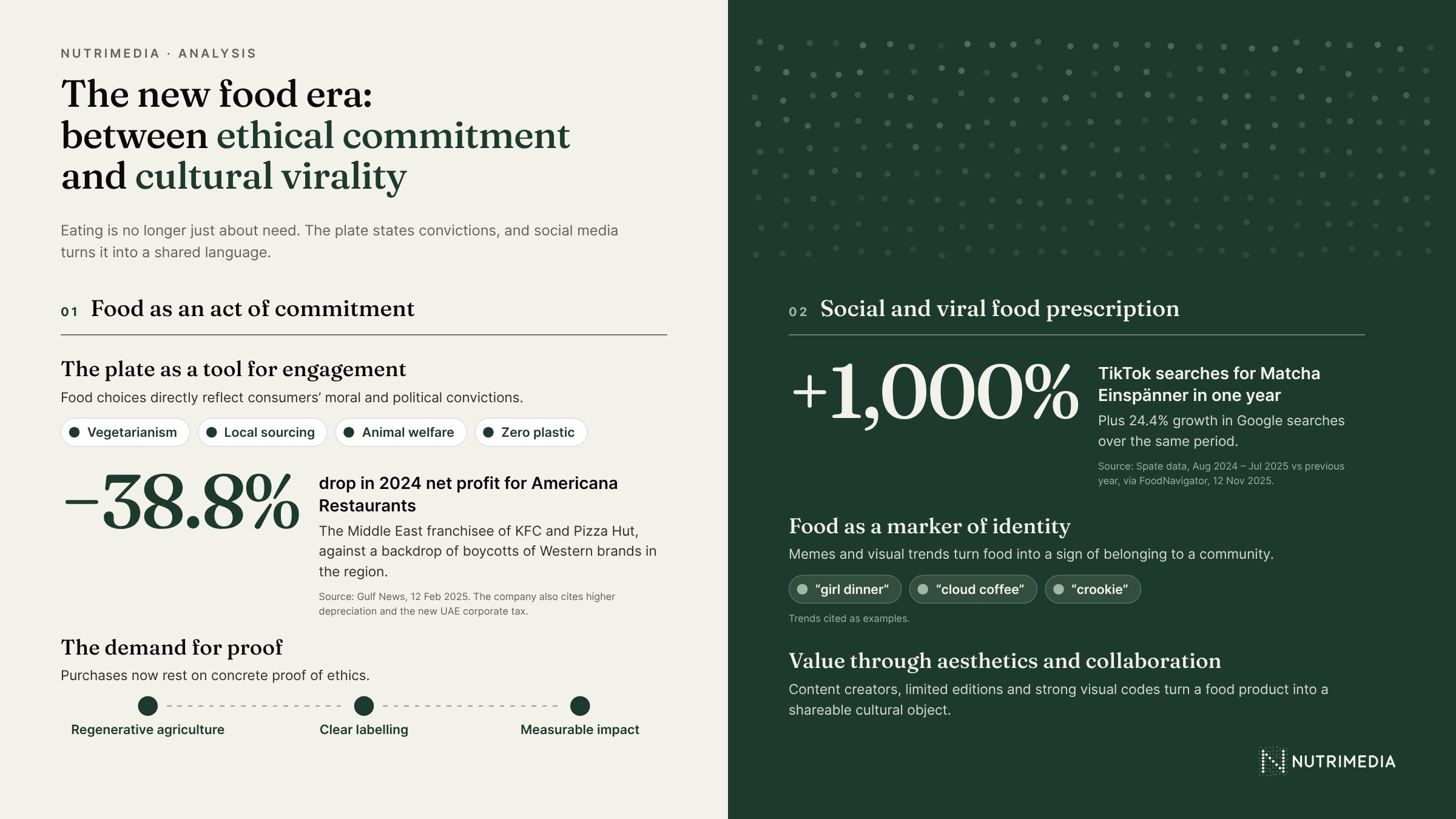
Finally, social influence. 55% of Gen Z say they have already bought a food or drink that went viral on social media, according to Censuswide (2025) [3]. Food micro-segmentation feeds on these micro-communities too, the ones that validate through use rather than top-down prescription.
Food micro-segmentation layers that overlap, rather than replace one another
The White Paper brings a nuance your marketing teams need to absorb: food registers do not succeed one another, they coexist. The document describes a “stratification” of scientific, emotional, ethical and technological layers. Reading this overlap correctly avoids, in the authors’ words, “simplistic readings of the trend”.
Put plainly, your messaging can no longer lean on a single register. The same ingredient has to carry several narratives at once: scientific proof, emotional weight, ethical consistency, compatibility with data. Here is how the White Paper dates these layers, all of them still active in 2026.
| Layer | Dominant register | Purchase logic | Example signals |
|---|---|---|---|
| 1990-2000 | Functionality, scientific | “Eat for your body” | Fortified, source of fibre, light/0% |
| 2010 | Natural, transparency | “Eat to reconnect” | Clean label, guaranteed origin, locavore |
| 2020 | Overall wellbeing, emotion | “Eat to feel good” | Microbiome, adaptogens, glow & mood |
| Recently | Performance, data | “Eat to surpass yourself” | Biohacking, smart nutrition, tracking |
| Tomorrow | Reconciliation, intuition | “Eat to elevate yourself” | Intuitive eating, rituals, hyper-personalisation |
For your portfolio, this grid is a positioning tool. A postbiotic can sit in the 2020 register (wellbeing) and the performance register at the same time. The register you pick decides the format, the evidence expected and the channel, as the document sums up: “formats, evidence, narratives and channels vary depending on the domain”.
The constraints food micro-segmentation places on your industrial setup
Benefit-led logic has a price: it fragments demand faster than a rigid supply chain can follow. The White Paper frames this as an “agile production” challenge, where performance is measured by speed of adjustment, not by volume produced.
Four levers emerge from the document to handle it:
- Micro-batches and modular formats: serving specific segments without overhauling the whole chain.
- Adaptable recipe bases: folding in functional ingredients (probiotics, microbiome actives, new proteins) step by step, without starting from scratch.
- Specialised sourcing and traceability: biological data (DNA, blood sugar, microbiome) becomes a design reference, which raises the bar for quality control.
- Cross-sector partnerships: anchoring the benefit in outside expertise (medicine, microbiology, neuroscience, exercise physiology) to avoid vague promises.
This last point is a safeguard. The White Paper insists that opening innovation to these disciplines “strengthens the legitimacy of benefits”. For your regulatory affairs team, this is also what separates a defensible claim from one the EFSA or FDA will throw out. An unsubstantiated functional benefit is a legal risk, not a selling point.
The three questions to settle before overhauling a range
Three questions to resolve before putting food micro-segmentation on the product roadmap: which precise micro-need (not which category) you are targeting; what dated scientific evidence backs the claimed benefit; which register, among the coexisting layers, carries your narrative. Without these three answers, segmentation stays marketing dressing.
What micro-segmentation redistributes for your ranges
Food micro-segmentation pushes value upstream in the chain. Whoever holds the expert ingredient, the targeted probiotic, the microbiome active, the functional protein, captures the specificity premium. The generic, meanwhile, slides towards commodity.
For your marketing, education becomes part of the product itself. The White Paper puts it flatly: “education is not a marketing add-on, it is a component of the product”. Function, expected effect, time to use, compatibility with a profile: these reference points decide lasting adoption, not just the first purchase.
For your procurement, the challenge is access to differentiating, traceable ingredients, often drawn from specialised supply chains. As biological data enters the specification process, compatibility with sensors and metabolic profiles becomes a sourcing criterion, not an option.
What remains is the question that settles everything. Are your current ranges indexed to product categories or to measurable benefits, and which of your products would pass the test of a consumer reading their blood sugar in real time?
References
- McKinsey & Company. The trends defining the global wellness market. McKinsey Insights. 2025.
- McKinsey & Company. Health & Tech Consumer Report. McKinsey Insights. 2024.
- Nelly Rodi. The New Era of Food: The End of the Universal Model. White Paper SIAL Paris 2025-2026 (Censuswide data, 2025).
FAQ
What is food micro-segmentation for an ingredient manufacturer?
It is the shift from supply organised around broad product categories to supply structured around physiological micro-needs (sleep, energy, cognition, blood sugar balance, hormonal health). According to the SIAL/Nelly Rodi 2025-2026 White Paper, ranges must be conceived by functional benefit rather than by product type.
What are the 6 factors ending the universal food model?
The SIAL/Nelly Rodi White Paper identifies: health and metabolic pressure, access to biological data, the shift of power towards the consumer, micro-segmentation of supply, the acceleration of lifestyles, and social and cultural influence.
Are older trends (clean label, organic) disappearing?
No. The White Paper describes layers that coexist rather than replace one another. Functionality (1990-2000), naturalness (2010) and overall wellbeing (2020) remain active in 2026, overlapping with the performance and reconciliation registers. A single ingredient can belong to several registers at once.
How can an industrial setup be adapted to micro-segmentation?
The document recommends agile production: micro-batch capabilities, modular formats, adaptable recipe bases, gradual integration of functional ingredients, and specialised sourcing. Performance is measured by the speed of adjustment, not by volume produced alone.
Why is biological data becoming a design criterion?
Because 58% of 18-34 year-olds use a physical, nutritional or cognitive tracking tool, according to McKinsey (2024). A consumer who monitors their blood sugar or microbiome expects products compatible with these indicators, which brings data into the specification process.
Does micro-segmentation carry a regulatory risk?
Yes, if the functional benefit is not substantiated. The White Paper recommends cross-sector partnerships (medicine, microbiology, neuroscience) to legitimise benefits. An unproven functional claim remains exposed to EFSA or FDA rejection and constitutes a legal risk.