


En bref — The Green Claims Directive (EU Directive 2024/825, EmpCo strand) applies from 27 September 2026. It bans generic environmental claims (“green”, “climate-friendly”), uncertified labels, and carbon neutrality based on offsetting. For ingredient suppliers, every sustainability claim must now rest on quantified, verifiable evidence.
The Green Claims Directive closes the door on unproven green slogans from 27 September 2026. For an ingredient supplier, the consequence is blunt: a “sustainable” or “clean label” pitch without quantified data will no longer just look dated. It becomes non-compliant.
What does the Green Claims Directive actually ban?
The Green Claims Directive, formally Directive (EU) 2024/825 adopted on 28 February 2024, amends European consumer law to tackle greenwashing [2]. Its operational strand, nicknamed EmpCo (Empowering Consumers for the Green Transition), covers any communication aimed at the consumer, on packaging or online.
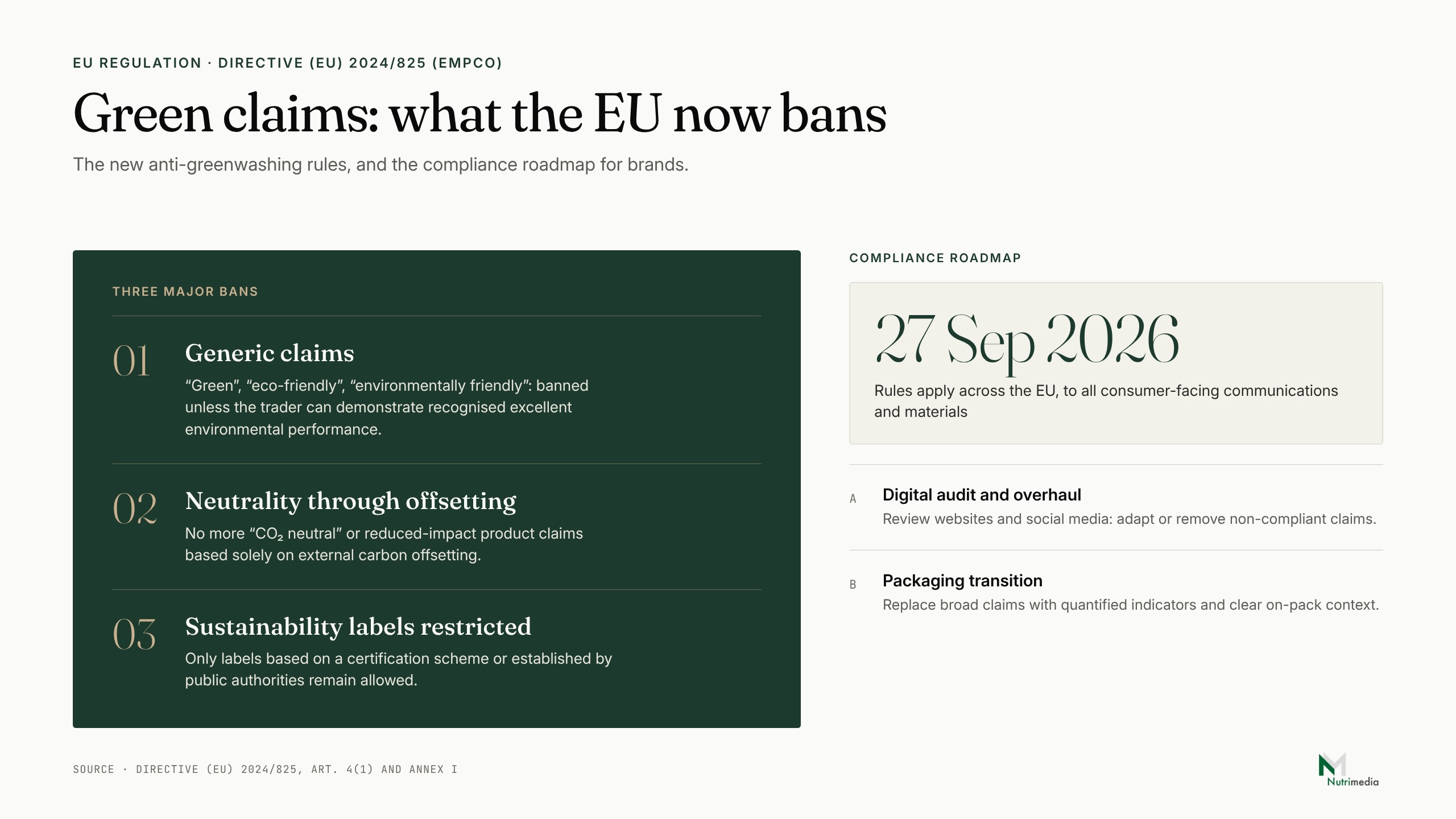
Three categories of claims fall under the ban. First, generic environmental claims with no recognised excellent environmental performance behind them: “green”, “eco-friendly”, “nature-friendly”, “biodegradable”, “bio-based” [2]. The example in the text leaves no doubt: “climate-friendly packaging” is banned, while “100% of the energy used to produce this packaging comes from renewable sources” stays allowed.
Second, sustainability labels not based on a third-party certification scheme or not established by a public authority. Third, carbon neutrality claims that rest on offsetting outside the value chain: “climate neutral”, “certified CO2 neutral”, “positive carbon footprint” can no longer lean on the purchase of credits [2]. A misleading environmental claim now carries a real enforcement risk, not just reputational grumbling.
Why does 27 September 2026 concern your ingredients, not just the brands?
27 September 2026 is the application date of the EmpCo strand across the European Union. Some flexibility is expected, at EU level, for products manufactured before this deadline. Off-pack communication gets none of it. Websites and social media must be compliant by the deadline, full stop.
Many ingredient suppliers still assume the directive only targets the finished product on the shelf. It is a misreading. The concept of an environmental claim covers “a trader or brand”, not just a consumer product. A B2B product page promoting an “environmentally friendly” ingredient or “sustainable” sourcing without figures falls within scope.
For your marketing and regulatory teams, the deadline splits in two. Sustainable ingredient communication online, which the flexibility does not cover, must be audited and corrected as early as summer 2026. Packaging compliance for 2026 follows the pack redesign schedule, starting in September. Enforcement authorities will not be fully operational before December 2026, but that administrative lag cancels nothing: it merely shifts the risk from immediate fines towards competitor litigation and reputational exposure.
From “helps protect the planet” to “80% recycled packaging”: moving from slogan to evidence
The shift imposed by the Green Claims Directive fits into two examples drawn straight from the text. “Helps protect the planet” is a generic claim, and it has to go. “80% of our packaging is made from recycled materials” is specific and substantiated, and therefore compliant [2]. The dividing line is not green vocabulary. It is quantified, verifiable evidence on the same medium.
In practice, a generic claim with an asterisk pointing to further details is no longer acceptable: the specification must appear “in clear and prominent terms on the same medium” [2]. The footnote asterisk, that old marketing reflex, has become a compliance trap.
| Criterion | At-risk claim (to remove or adapt) | Compliant claim (quantified evidence) |
|---|---|---|
| Wording | “Environmentally friendly” | “80% recycled materials in the packaging” |
| Climate | “CO2 neutral” (via offsetting) | Genuine, measured life-cycle reduction |
| Energy | “Climate-friendly packaging” | “100% renewable energy in production” |
| Label | In-house logo without certification | Label based on third-party certification (ISO 17065) |
| Evidence placement | Asterisk pointing to a footnote | Quantified detail on the same medium as the claim |
For your R&D and regulatory affairs teams, this is no cosmetic exercise. Every claim has to link back to traceable data: a measured recycled content rate, a documented share of renewable energy, a life-cycle assessment. Sustainability claims shown without verifiable figures turn into a legal liability.
How to audit your claims before the deadline: the 10-point checklist
This checklist sorts, claim by claim, what passes and what must be dropped or rewritten before 27 September 2026. It applies to every environmental message on your packaging, product sheets, web pages and social content.
- Isolate each claim. Success criterion: you have an exhaustive list of every message, text, image, symbol and label that suggests an environmental impact. A green leaf symbol counts as a claim.
- Classify as generic or specific. Criterion: each claim is labelled “generic” (green, eco-friendly, nature-friendly) or “specific” (with a precise fact). Unsubstantiated generic claims are removed.
- Look for quantified evidence. Criterion: for every specific claim, you can produce the underlying data (rate, percentage, measurement) and its calculation method. No available data, no claim.
- Check that the evidence sits on the same medium. Criterion: the supporting figure is shown clearly next to the claim, not relegated to an asterisk or a link.
- Flag carbon neutrality based on offsetting. Criterion: no claim such as “climate neutral” or “net zero” rests on the purchase of credits outside the value chain.
- Audit the labels. Criterion: every label shown is based on a third-party certification scheme (compliant with ISO 17065) or established by a public authority. In-house logos without certification are removed.
- Review future performance claims. Criterion: any commitment such as “neutral by 2030” is backed by a detailed, realistic plan, with dated targets and independent third-party verification.
- Check representativeness. Criterion: a claim about the whole product is not based on a single, unrepresentative aspect (e.g. “made from recycled materials” when only the packaging is).
- Eliminate irrelevant benefits. Criterion: no claim points to a feature unrelated to the product (the classic “plastic-free” claim on paper sheets).
- Prioritise off-pack content. Criterion: websites and social media, which get no flexibility, are handled first and corrected before September 2026.
Who uses it, and what’s the most common mistake?
The environmental claims audit checklist takes three teams working together. Regulatory affairs validate the legal compliance of each criterion. Marketing rewrites generic claims into specific ones. R&D and sustainability teams supply the quantified data that turns a slogan into evidence. Drop any one of the three and the audit stays theoretical.
The timing is clear: start now, then keep it as an ongoing review. Sector guidance describes a website review from July to August, translation and validation in September, and a phased rollout by market from late September 2026. A compliance action plan runs through to 2027. The verdict reads per claim, on a binary basis: compliant, to be adapted with figures, or to be withdrawn.
The most common mistake is assuming the flexibility covers everything. It only applies to packaging of products manufactured before the deadline. Sustainable ingredient communication online has no such leeway. A second limit of the tool: it sorts compliance, it does not build the evidence. If the quantified data does not exist inside R&D, no checklist will conjure it. The audit then shows a gap to fill, not a box to tick.
What this shift reveals about your sustainability communication
The Green Claims Directive writes into law what sustainable marketing already knew empirically: the generic slogan no longer convinces, verifiable evidence makes the difference. Sustainability claims made without figures stop being a differentiating argument. They become a mandatory entry ticket, and soon a penalty if faked.
For your strategic decisions, the logic echoes that of scientific nutrition communication. An ingredient sells on evidence told as a story, not on a trend displayed on a label. Clean label, naturalness, low carbon: build a positioning on the label rather than the data, and you build on sand. In Europe, that sand is now off the shelf.
The next operational step is not to communicate more, but to reconnect every claim to its evidence source. Your R&D and sustainability teams are already producing this data. The real question is whether your marketing can turn it into compliant, verifiable claims before September 2026. How much of your current environmental messaging would survive the checklist if you ran it today?
Auditing your environmental claims ahead of September 2026?
Nutrimedia helps ingredient suppliers turn their science into arguments that sell. Book 30 minutes to discuss it.
References
- European Commission. Proposal for a directive on green claims (Green Claims Directive), explanatory memorandum. EUR-Lex. 2023;52023PC0166.
- European Parliament and Council. Directive (EU) 2024/825 of 28 February 2024 amending Directives 2005/29/EC and 2011/83/EU as regards empowering consumers for the green transition. Official Journal of the European Union. 2024;L 2024/825.
FAQ
Does the Green Claims Directive apply to B2B communication between ingredient suppliers?
Directive (EU) 2024/825 targets any commercial communication aimed at the consumer, and the concept of an environmental claim covers a brand or a trader. A B2B product page promoting an ingredient as “environmentally friendly” without quantified evidence falls within scope. Caution is advised: audit your online materials as rigorously as your packaging.
Can an ingredient or pack still be labelled “CO2 neutral” after September 2026?
No, if that neutrality relies on offsetting emissions outside the value chain. Directive 2024/825 bans claims such as “climate neutral”, “certified CO2 neutral” or “net zero” when based on the purchase of credits. Only a genuine, measured impact across the product’s life cycle remains defensible.
What is the exact application date for the EmpCo strand of the Green Claims Directive?
The EmpCo strand (Empowering Consumers for the Green Transition) applies from 27 September 2026 across the European Union. Some flexibility is expected for packaging of products manufactured before that date, but off-pack communication—websites and social media—receives no leeway whatsoever.
What distinguishes a generic environmental claim from a specific one?
A generic claim (“green”, “eco-friendly”, “nature-friendly”) is not backed by verifiable evidence on the same medium and becomes prohibited if left unsubstantiated. A specific claim is accompanied by a quantified fact, for example “80% recycled materials” or “100% renewable energy used in production”, which makes it compliant.
Is an in-house sustainability label still allowed on my products?
No, unless it is based on a third-party certification scheme (independent verification compliant with ISO 17065) or established by a public authority. Directive 2024/825 bans sustainability labels that are not underpinned by any credible, transparent certification system.
When will enforcement authorities start penalising non-compliant claims?
Sector guidance indicates that authorities will not be fully operational before December 2026. This administrative lag does not suspend the compliance obligation from 27 September 2026: it simply shifts the risk towards competitor litigation and reputational damage rather than immediate fines alone.