

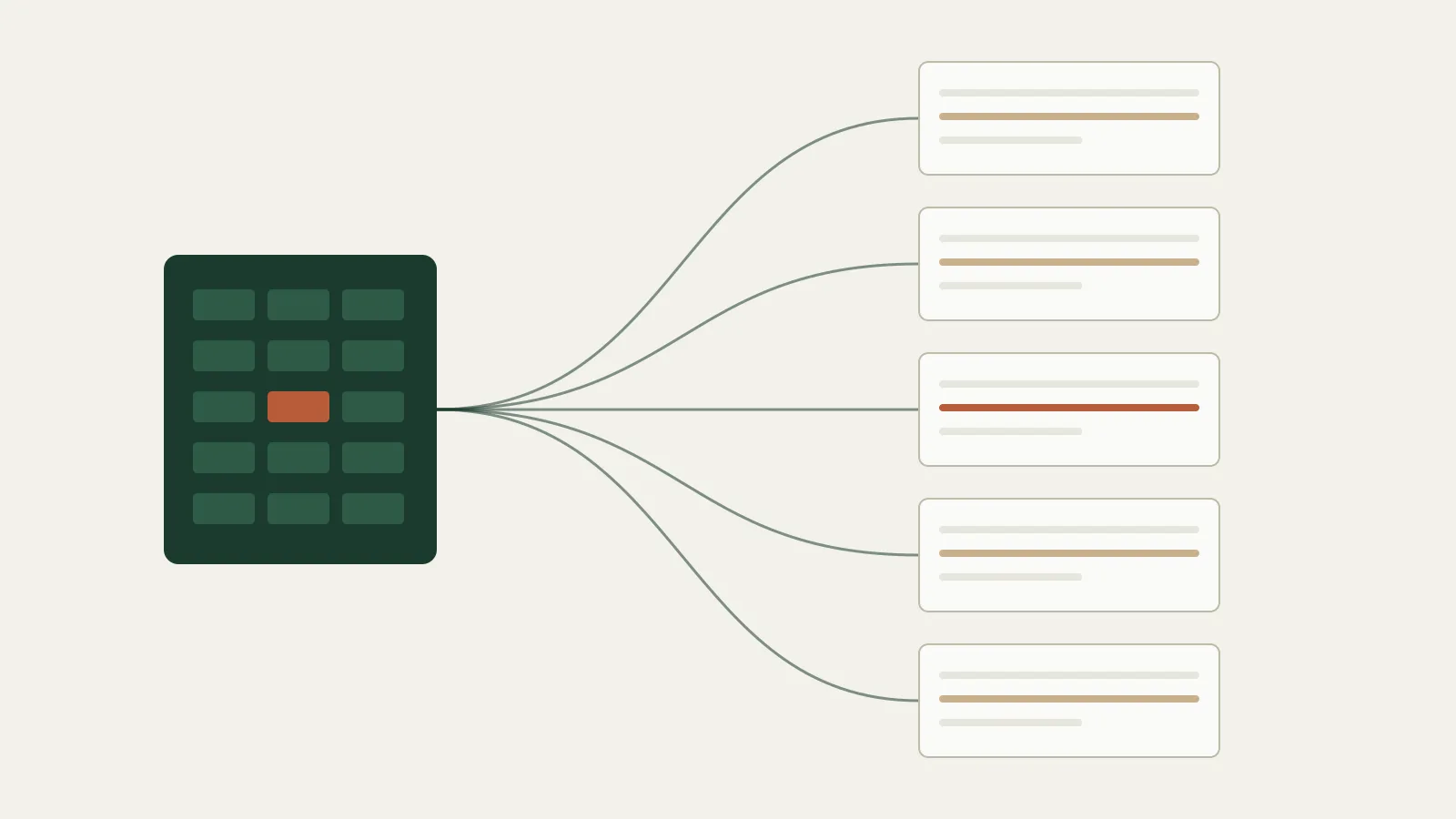
In brief: A health ingredient rests on a handful of studies, cited in five or six documents that each live a life of their own. The day a study is corrected or a claim wording is tightened, only one of those documents gets updated. A single evidence base (one table of studies, one table of claims, one table of deliverables) turns every document into a view of the same source, not a copy.
Take your flagship ingredient. Its pivotal clinical trial appears in the technical data sheet, the sales one-pager, the trade show deck, the product page on your website and the regulatory dossier. Five copies. In at least one of them, the tested dose has been rounded, the population broadened or the claim reworded “to make it punchier”. Nobody decided this. It is what copying does.
Regulation (EC) No 1924/2006 requires a claim to be based on generally accepted scientific evidence, and the food business operator must be able to justify it [1]. Justifying a claim means knowing, document by document, where every sentence comes from.
An example: the same study in three documents
A fictional example, to make this concrete. A randomised trial tests 10 g per day of a fibre for 12 weeks in overweight adults. The technical data sheet says “10 g per day, 12 weeks, overweight adults”. The one-pager says “from 10 g per day”. The trade show deck says “clinically proven in adults”.
None of these three sentences is false on its own. Together, they describe three different products. The first respects the conditions of the trial. The second implies a threshold the trial never looked for. The third has lost the study population.
In an evidence base, all three sentences are linked to the same row. Whoever writes “in adults” sees the real population next to their text. The gap does not vanish by itself, but it becomes visible before the deck goes to print, not after.
The principle: one source, many views
An evidence base does not replace any of your documents. It feeds them. Every study, every claim, every condition of use is entered once, checked once, dated once. Your deliverables become views: the technical data sheet shows the study with its exact dose, the one-pager shows the short version of the same study, the health claim dossier shows the full reference.
A tool like Airtable is enough for a marketing or R&D team: linked tables, filtered views, a change history. You do not need a six-month IT project to get started.
The minimum architecture: four tables
Studies. One row per publication: PubMed ID or DOI, design (randomised trial, observational, preclinical), population, dose, duration, primary endpoint, main result, limitations declared by the authors. A “checked by” field and a date.
Claims. The exact authorised wording, its reference in the Union Register [3] or in Regulation (EU) No 432/2012 [2], the conditions of use, and the studies that support it. The wording is never rewritten: it is copied from the regulatory source.
Usage wordings. The sentences your regulatory team has approved for each channel (trade show, website, email), linked to the claim they derive from. This is the table that protects your sales reps.
Deliverables. Each document, its version, and the list of studies and wordings it cites. When a study changes, the base tells you which documents need reworking.
| Situation | With copies | With an evidence base |
|---|---|---|
| A study is corrected by its publisher | The discrepancy surfaces at the next audit | The affected deliverables are listed |
| A sales rep asks “what can we say?” | They dig through the latest deck | They check the approved wordings |
| A new marketing hire | Reads five contradictory documents | Reads one table |
| Preparing an EFSA dossier | The bibliography is rebuilt from scratch | The bibliography exists, dated |
| Translating a document | Each language drifts | Approved wordings exist for each language |
Who does what: three roles are enough
A base without a clear division of work soon turns back into a shared spreadsheet. Three roles cover the essentials.
- R&D enters and checks the studies. They open each publication, fill in the dose, the population and the primary endpoint, and sign off the row.
- Regulatory approves the claims and the usage wordings. Nothing goes to a sales channel without its “approved” status.
- Marketing links each deliverable to the studies and wordings it cites, and reworks the documents flagged when a row changes.
One rule keeps things straight: nobody approves their own entry.
The fields everyone forgets
The first version of a base holds the studies and the claims. Four fields are almost always missing, and they are the ones you need on the day of an inspection.
- The status of the publication: published, corrected, retracted. A study corrected by its publisher keeps being cited for years in documents nobody rereads.
- The conditions of use of the claim: daily dose, target population, mandatory statements. They are part of the authorisation, just like the wording [2].
- The language of each wording. A loose translation of an authorised wording is a new claim.
- The date of the last check against the Union Register [3], which changes over time.
What the base changes for a health claim dossier
EFSA’s scientific and technical guidance for health claim applications calls for a structured presentation of the pertinent data, including favourable and unfavourable studies [4]. A base that only stores favourable studies is a sales pitch, not an evidence base. So include a “result” field that accepts “null” and “unfavourable”. It is uncomfortable. It is also what makes the base credible to your own regulatory team.
The limits (and how to manage them)
- The initial entry takes time. Do one complete pass on a single ingredient before expanding. One well-documented ingredient beats twenty half-filled records.
- The base is not a validated system. For a regulatory submission, your official document management system remains the reference. The base is for preparing, not for filing.
- Rights to PDFs. Store DOI and PubMed links, not full articles, unless a licence allows it.
- Without an owner, the base dies. A named person validates every row. The verification date is visible in every view.
Where to start on Monday
Pick the ingredient that generates the most sales questions. List the documents that cite it. For each one, note how the pivotal study is described. If all five descriptions match, you do not need a base. How many of your documents describe the same study with the same dose?
Sources
- Regulation (EC) No 1924/2006 of the European Parliament and of the Council of 20 December 2006 on nutrition and health claims made on foods. Official Journal of the European Union. OJ L 404, 30.12.2006.
- Commission Regulation (EU) No 432/2012 of 16 May 2012 establishing a list of permitted health claims made on foods. Official Journal of the European Union. OJ L 136, 25.5.2012.
- European Commission. EU Register of nutrition and health claims made on foods.
- EFSA Panel on Nutrition, Novel Foods and Food Allergens (NDA). Scientific and technical guidance for the preparation and presentation of a health claim application (Revision 3). EFSA Journal. 2021;19(3):6554.
FAQ
Do you need a developer to build this base?
Not for the minimum version. Four linked tables in Airtable can be set up without code. A developer becomes useful when you want to generate documents automatically from the base.
Can you store claims that are awaiting authorisation?
Yes, with an explicit status (“authorised”, “pending”, “rejected”) and one simple rule: only authorised claims feed the wordings used in sales channels.
How many studies do you need to enter before the base is useful?
The ones cited in at least one external document. That is where a mistake is expensive, and the scope is often narrower than you think.
Can the base power an AI assistant for sales reps?
That is its natural next step: an assistant that answers only from approved wordings and declines everything else. Without a clean base upstream, the assistant repeats the inconsistencies in your documents.
Upstream, the regulatory frame for claims is detailed in probiotics and EFSA. Downstream, a solid evidence base is what makes a brand citable by AI engines (GEO).