

In brief: Vibe coding means building software by describing it to an AI in plain language, instead of writing the code yourself. For a marketing, R&D or regulatory team at an ingredient supplier, it brings within reach tools that used to require an outside developer: an evidence base, filtered monitoring, a claims checker. The speed is real. Reliability does not come on its own: it depends on tests, human approval and rules about data.
The term is less than two years old. Andrej Karpathy, former head of AI at Tesla and a founding member of OpenAI, introduced it on X on 2 February 2025: a way of programming where you “fully give in to the vibes” and “forget that the code even exists” [1]. In November 2025, Collins Dictionary made it its word of the year, defining it as “the use of artificial intelligence prompted by natural language to assist with the writing of computer code” [2].
The word now covers two practices. The first, true to the original phrase, accepts whatever the AI produces without reading it. The second has the AI write the code, then puts it through tests and checks before relying on it. In a sector where every claim must be substantiated, only the second belongs.
What Nutrimedia has built this way
Nutrimedia is an editorial agency, not a software company. Yet its working tools are built in-house with Claude Code, Anthropic’s programming assistant. All of them are shown in the workshop.
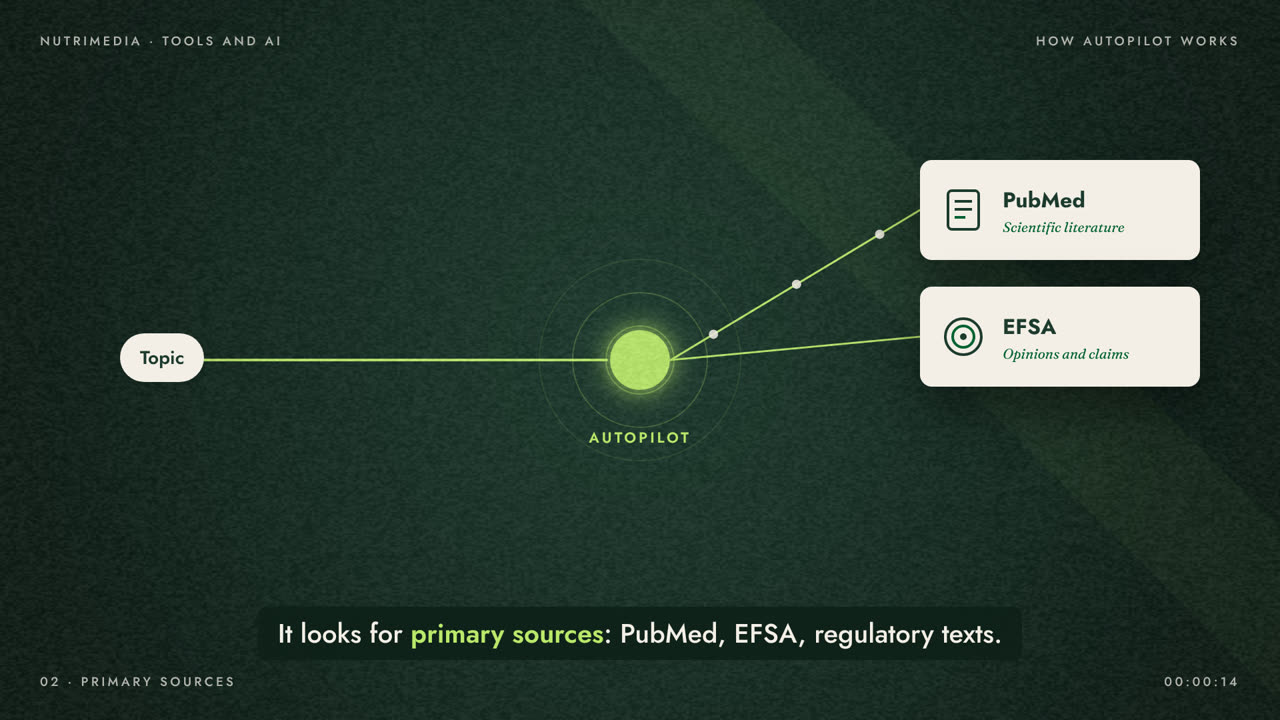
- Content Autopilot, the tool that runs monitoring, sourced writing and article tracking: built in five weeks and 52 successive versions. Its generation cost is $0.61 per article, fact-checking included [3]. It now has 272 automated tests, run on every change [5].
- The website migration from WordPress to its current engine: after the switch, all 483 addresses known to Google were tested one by one. 346 responded, 129 redirected to their new page, and only 2 were genuine errors [5].
- A CRM, an online diagnostic and a Search Console connector, each born from a specific need.
- Routine checks: after every site update, a tool checks the pages affected and every internal link, 34,761 links across 413 pages in the check of 14 October 2026 [5].
The Content Autopilot case study details the method and the measured results.
Ten possible uses for an ingredient team
None of these ideas requires a team of developers. Each one does require describing precisely what the tool must do, and what it must never do.
| Team need | Tool to build | What makes it reliable |
|---|---|---|
| One study cited differently in five documents | An evidence base: studies, claims and deliverables linked | One source, the documents are views of it |
| Monitoring that drowns you | A PubMed and EFSA filter that keeps only what could change a decision | The sorting rule written before the tool |
| A claim wording rephrased “to sound better” | A comparison between a document’s text and the EU register of claims | Exact match, then human approval |
| One-pagers that drift apart | A one-pager generator fed by the evidence base | No figure typed by hand |
| An effective dose hard to translate into a serving | A dose-per-serving calculator based on the doses tested | Every dose linked to its study |
| Sample requests that get lost | A tracker for samples and follow-ups | A scheduled follow-up, never forgotten |
| Trade show business cards never used | A contact capture and qualification form | Consent recorded at capture |
| Scattered competitor data sheets | A specification comparator | Source and date of every sheet |
| Sales reps improvising on the science | An assistant that answers from the dossier, with sources | It declines what the dossier does not support |
| Published content whose effect nobody tracks | A launch tracker: indexing, visibility, citations by AI engines | Dated alert thresholds |
The second row has its own article: automating scientific and regulatory monitoring.
What needs to be locked down
Building fast has a downside. In July 2025, Veracode gave 80 programming tasks to more than 100 AI models: the code worked, but introduced a security flaw in 45% of cases [4]. Code written by an AI should be checked like code from a contractor you do not know yet.
Four rules are enough to turn a quick prototype into a tool a team can rely on.
- Tests before trust. Every important rule in the tool (a calculation, a sort, a threshold) is checked by an automated test, run on every change. A tool without tests degrades without warning.
- Nothing goes out without human approval. A claim, a publication, an email: the tool prepares, a person decides. In Nutrimedia’s Autopilot, no article goes out without an approval click.
- Sensitive data stays with you. Unpublished trial results, customer data, formulations: they do not get pasted into a consumer tool. Choosing the AI tool and where it runs is part of the specification.
- A documented tool outlives its author. What the tool does, what it does not do, where its data lives: one page is enough, kept up to date.
Where to start
Pick a repetitive task whose cost is visible: the weekly monitoring digest, updating data sheets after a new study, tracking samples. Describe on one page what the tool must do and what it must never do. Build the smallest useful version, test it on your real data, and keep human approval at the output.
The first tool mostly teaches one thing: the hard part is no longer writing the code, it is knowing exactly what you want.
Which task in your team deserves its own tool?
Sources
- Karpathy, A. Post on X, 2 February 2025. https://x.com/karpathy/status/1886192184808149383
- Collins Dictionary. Word of the Year 2025: vibe coding, announced on 6 November 2025. https://www.collinsdictionary.com/woty
- Nutrimedia. Content Autopilot case study. https://www.nutrimedia.info/en/case-studies/content-autopilot/
- Veracode. 2025 GenAI Code Security Report, press release of 30 July 2025. https://www.veracode.com/press-release/ai-generated-code-poses-major-security-risks-in-nearly-half-of-all-development-tasks-veracode-research-reveals/
- Nutrimedia internal data: Autopilot test suite, HTTP check after migration and site link check, October 2026.
FAQ
Do you need to know how to code to do vibe coding?
Not to write the code: the AI does that. You do need to describe the need precisely, read a test result and reject what has not been checked. It is a specification skill more than a programming one.
How is it different from no-code tools like Airtable or Make?
No-code tools assemble existing building blocks and suit needs that fit their boxes. Vibe coding produces a custom tool. The two combine well: an Airtable base can feed a tool built with AI.
How long does it take to build a tool?
It depends on the ambition. Content Autopilot took five weeks. Nutrimedia’s publishing calendar, which shows what is scheduled day by day, was built, tested and put online on 14 October 2026.
Can these tools be used on regulatory data?
Yes, provided you choose an AI tool whose terms exclude reuse of your data, test every rule and keep human approval before any document leaves the company.